
Loading, please wait...
LOT 1037
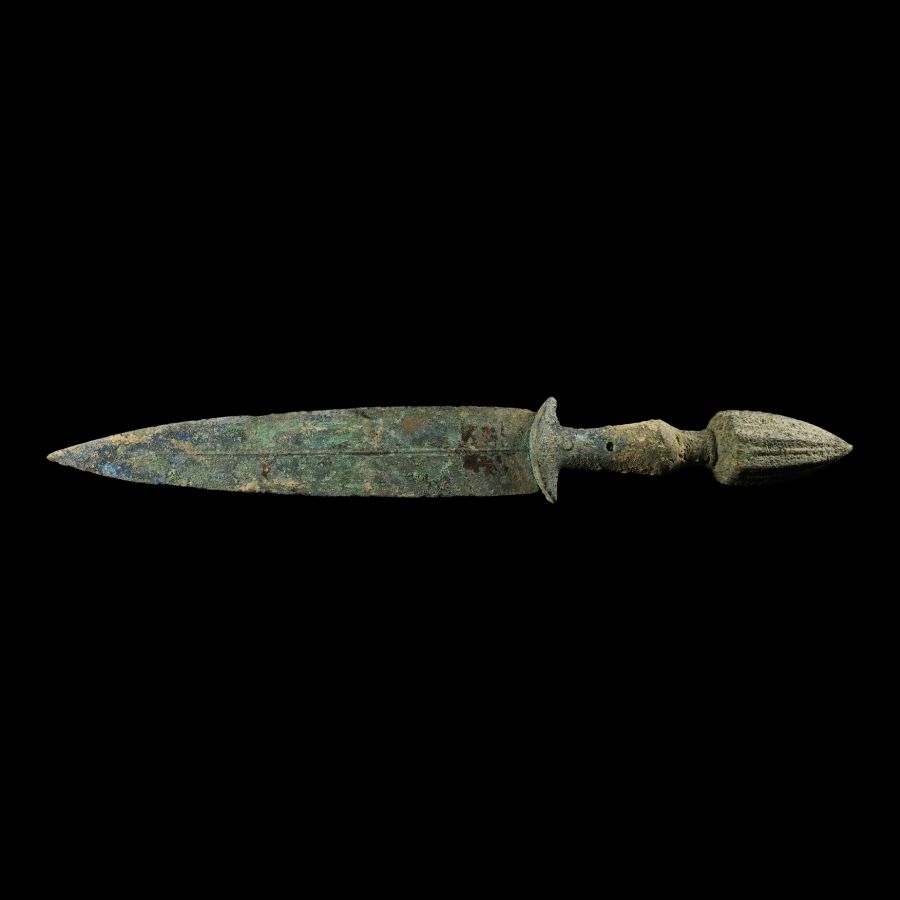
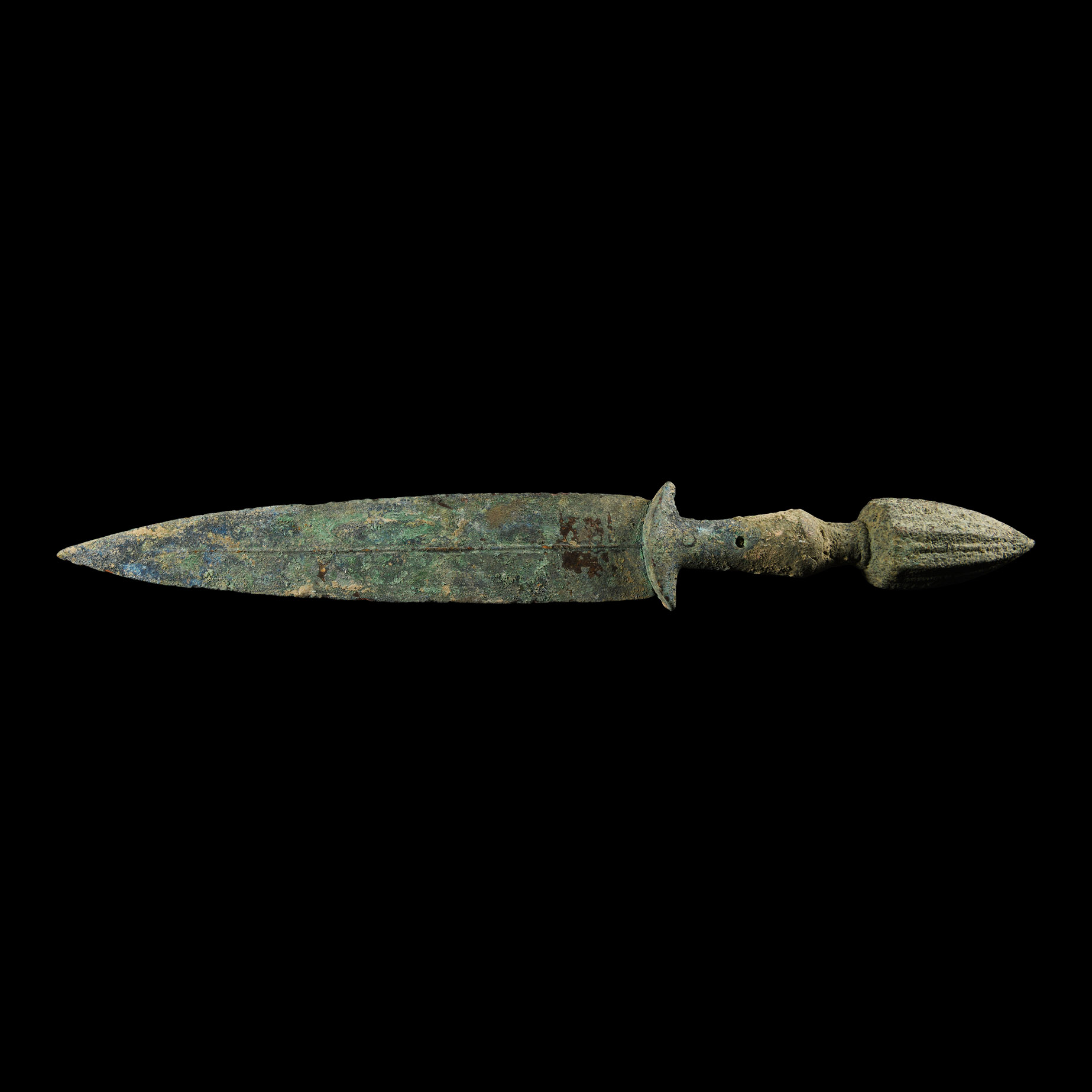
Luristan Bronze Dagger
3RD MILLENNIUM B.C.
10 3/8 in. (147 grams, 26.5 cm).
Composed of a leaf-shaped blade, central slightly raised midrib, separately casted hilt with crescentic guard, rivet hole and lozenge-shaped grip.
ProvenanceEx German collection, Cologne, 1980-1990s.
LiteratureSee Khorasani, M.M., Arms and Armour from Iran. The Bronze Age to the End of the Qajar Period, Tübingen, 2006, s. cat 1-2, for types.
FootnotesEarly bronze daggers from Luristan and Elam had separate casted hilt. Some scholars suggest that arsenic bronze was used in their production, and the handle was separately cast and rivetted to the hilt. Most scholars (Moorey, Mahboubian, Slotta, Vatandust, Khorasani) agree on a 3rd millennium B.C. dating based on the decoration of the hilt.
CONDITIONTimeLine Auctions follows a vetting process to ensure the authenticity and legality of all items, reinforcing our commitment to integrity and responsible trading. Each antiquity, antique, and coin lot undergoes thorough examination by a vetting committee of at least ten external specialists, professional trade association members, scientists, and archaeologists: Our Vetting Process
AUCTIONS:
TimeLine is a leading auction house specialising in antiquities, ancient art, collectables, natural history, coins, medals, and books. Our auctions offer museums, collectors, historians, and enthusiasts the opportunity to acquire unique and historically significant pieces.
LOT 1037
Luristan Bronze Dagger
Estimate £300 - 400€350 - 460 (for guidance only)$410 - 540 (for guidance only)
-
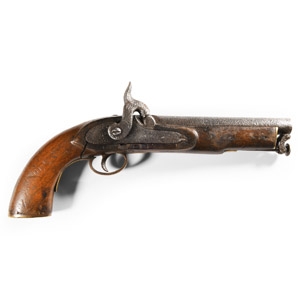
Newland Pattern Percussion Tower Pistol
19th century A.D.Sold for (Inc. bp): £234
About 5/8" bore pistol with 19cm (7½") barrel, the percussion lockplate marked 'TOWER' fitted with captive ramrod, full wood stock and butt (cracked) with brass butt cap, fore-end, ferrule and trigger guard and steel belt hook; action working. 1.17 kg, 35.5 cm
Acquired from Mostly Boxes, Northern Ireland. The Kusmirek Collection, UK. Accompanied by a Mostly Boxes invoice.
Sold as an exempt item under Section 58 (2) of the Firearms Act, 1968, to be held as a curiosity or ornament. No license required but buyer must be over 18 years of age. Overseas bidders should note that, due to UK regulations governing export of all firearms, overseas buyers will need to make arrangements for shipping this lot out of the UK directly, by air freight, with a specialist company or agent. -
.jpg)
Pseudo-Illyrian Chalcidian Variant Bronze Helmet
4th-1st century B.C.Estimate: £5,000 - 7,000 (+bp*)
Opening Bid: £1,667
Large rounded two-part bowl rivetted beneath the repoussé crest extending across the brow and around the circumference; repoussé arches above the eyes extending to the nasal; lateral D-shaped cheek-pieces with scallop to the forward edge, pierced for a chin-strap; some restoration of the bowl and one cheek-piece; mounted on a custom-made display stand. 4.7 kg total, 48 cm high including stand
Acquired 1971-1972. From the collection of the vendor's father. Property of a London, UK, collector. Accompanied by an academic report by Dr Raffaele D’Amato. This lot has been checked against the Interpol Database of stolen works of art and is accompanied by search certificate number no.11751-202770.
According both to Symonenko and Dedjulkin (2014, p.189, fig.9, nn.4-5-6), this category of helmet derives from Chalcidian types (with pseudo-Illyrian elements). As with Chalcidian helmets, our specimen shows vertical decorative lines on the bowl and triangular brow ornament. Distinct from Attic types, it does not have a protruding neck guard introduced on variant III of such helmets (Symonenko, 2014, fig. 15,2-3). According to Dedjulkin, these helmets derive from Greek prototypes, but are simplifications of the original models and made by local artisans. They were widely worn by mercenaries in the Hellenised armies of Pontus and other Hellenistic kingdoms across the Eastern Mediterranean. -
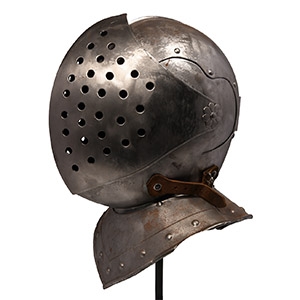
Italian Foot-Combat Helm
21st century A.D.Sold for (Inc. bp): £169
Comprising a pivoting visor, one piece skull raising to a small medial comb and fitted at the nape with a plume holder, flower-shaped pivots, front and rear gorget formed of a single plate. 3.9 kg, 37 cm high
The Kusmirek Collection, UK.
The helmet is a reproduction of a foot-combat helm, or great bascinet, used between the end of 15th and the first half of 16th century in the battles and tournaments. A similar helmet is that of Sir Giles Capel (1485-1556), a prominent figure at Henry VIII's court. These helmets were characterised by a unique rounded pierced visor with (here 60) slots for sight and ventilation. Helmets of this massive size and distinctive type were intended for foot-combat, a sporting contest fought by two fully armoured warriors armed with poleaxes, spears or swords. However, in this reproduction the visor has been mounted upon a separated collar.
