
Loading, please wait...
LOT 1430
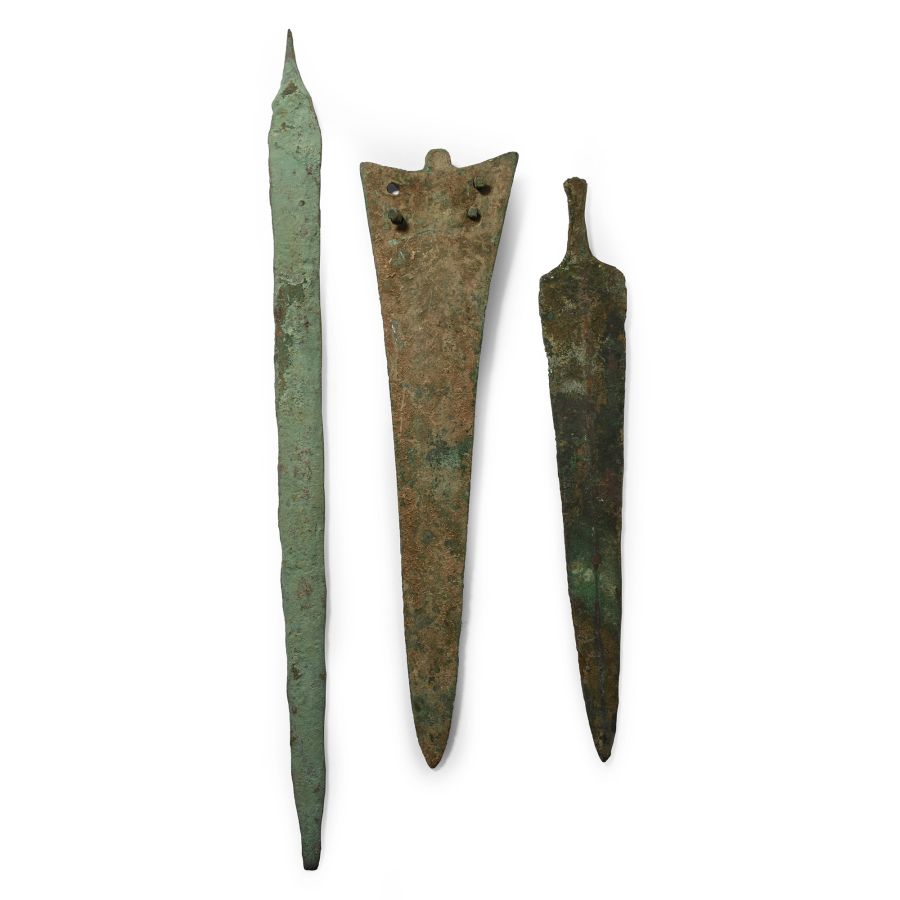
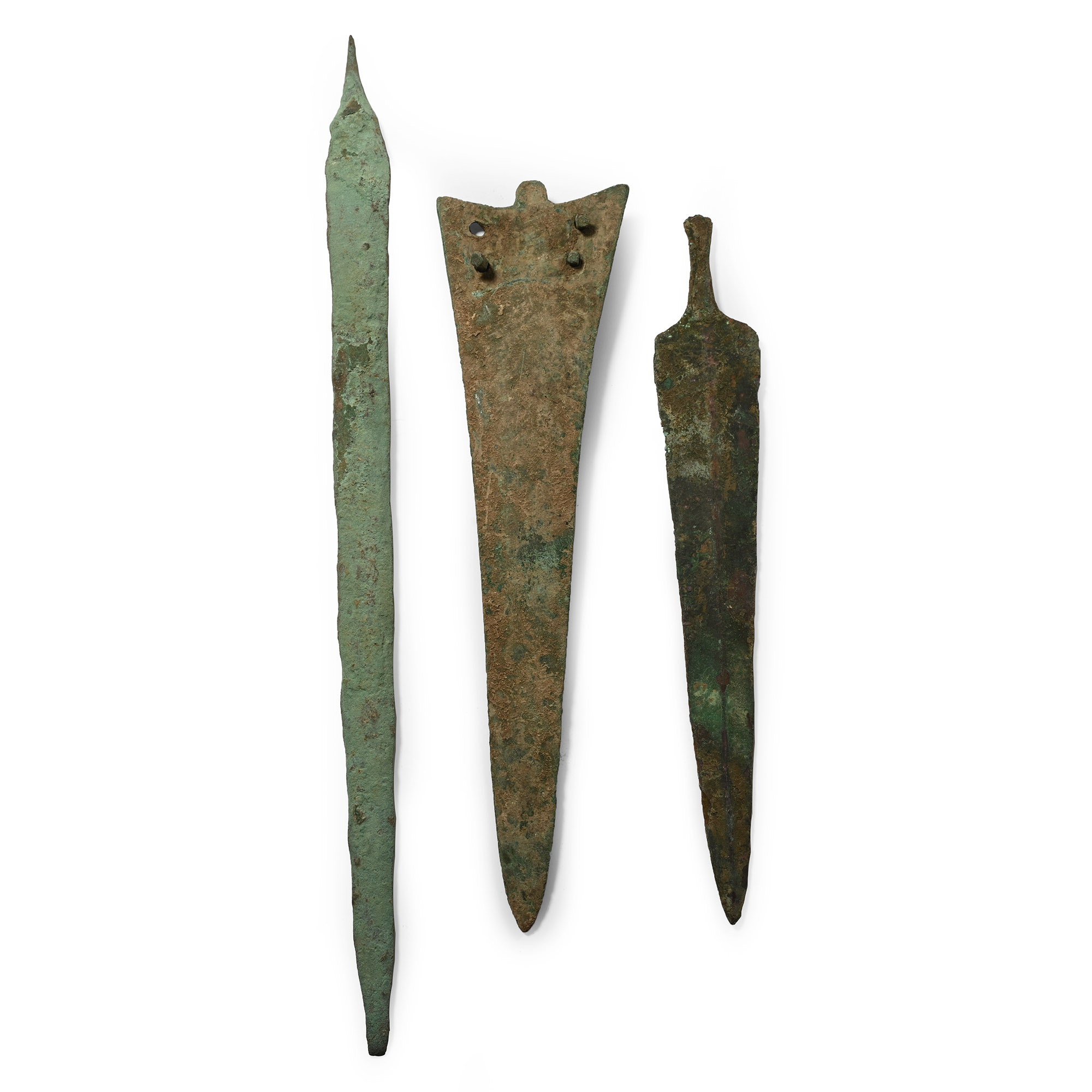
Luristan Bronze Dagger Group
EARLY 1ST MILLENNIUM B.C.
7 7/8 - 11 3/8 in. (264 grams total, 20-29 cm).
Comprising three dagger blades, one triangular with three fastening rivets on the ricasso, one with long tapered blade, rounded shoulders and long narrow tang, the third with a slender blade. [3]
ProvenanceAcquired 1980-2015.
Ex Abelita family collection.
This lot is accompanied by an illustrated lot declaration signed by the Head of the Antiquities Department, Dr Raffaele D’Amato.
This lot is accompanied by an illustrated lot declaration signed by the Head of the Antiquities Department, Dr Raffaele D'Amato.
Cf. for similar blades Christie's, The Axel Guttmann Collection of Ancient Arms and Armour, part 1, London, 2002, item 31, p.34.
FootnotesMoorey, Gordon and Khorasani created a classification of bladed weapons, according to which daggers are edged weapons not greater than 36cm in length, dirks (short swords) are between 36cm and 50cm in length, and swords are edged weapons greater than 50cm in length.
CONDITIONTimeLine Auctions follows a vetting process to ensure the authenticity and legality of all items, reinforcing our commitment to integrity and responsible trading. Each antiquity, antique, and coin lot undergoes thorough examination by a vetting committee of at least ten external specialists, professional trade association members, scientists, and archaeologists: Our Vetting Process
AUCTIONS:
TimeLine is a leading auction house specialising in antiquities, ancient art, collectables, natural history, coins, medals, and books. Our auctions offer museums, collectors, historians, and enthusiasts the opportunity to acquire unique and historically significant pieces.
-
.jpg)
Marlik Bronze Spearhead
14th-10th century B.C.Sold for (Inc. bp): £195
With rounded shoulders and square-section mid-rib running to the tip; short tang. 280 grams, 38.5 cm
Acquired 1980-2015. Ex Abelita family collection. This lot is accompanied by an illustrated lot declaration signed by the Head of the Antiquities Department, Dr Raffaele D’Amato. This lot is accompanied by an illustrated lot declaration signed by the Head of the Antiquities Department, Dr Raffaele D'Amato.
The blade belongs to the type VI of Marlik spearheads according to the Khorasani classification, with a long blade and a short tang, slightly rounded shoulders and pronounced midrib. Such spearheads have been excavated from the Marlik Royal Cemetery by Dr Negahban in Tomb 15, Trench XIII G. -
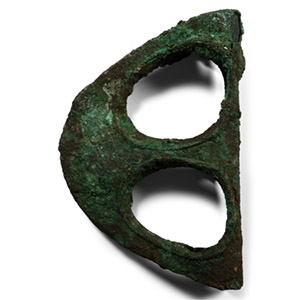
Canaanite 'Window' Bronze Axehead
2100-1800 B.C.Sold for (Inc. bp): £737
Curving blade with two large 'eye-shaped' openings, cylindrical socket. 142 grams, 11 cm
Acquired in the mid 1980s. Private collection, Switzerland, thence by descent. Private collection, since the late 1990s This lot is accompanied by an illustrated lot declaration signed by the Head of the Antiquities Department, Dr Raffaele D'Amato.
The ‘window’ axes have several morphological characteristics. The blade, semi-circular or elongated in shape, always ended in a rounded edge. In this type the blade was flat in section. It included two openings at its base—windows—of varying width, circular or oval. The haft consisted of a collar as wide as the blade. The weapon was threaded into an elongated wooden handle, often curved at its base, of oval section, with a differential width promoting the strength of the haft. It was thus wedged, and a rivet passed through the handle, just above the axe, serving as a stop. -
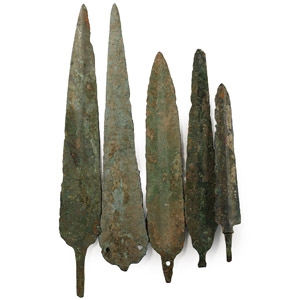
Western Asiatic Bronze Dagger Blade Collection
2200-600 century B.C.Sold for (Inc. bp): £182
Comprising four triangular and leaf-shaped blades, one with pierced tang with rivet hole and one pierced through the shoulders with two rivet holes; an arrowhead with strong mid-rib, short tang and narrow foliate blade. 321 grams total, 15-24.5 cm
Ex London art market, 1980-1990s. This lot is accompanied by an illustrated lot declaration signed by the Head of the Antiquities Department, Dr Raffaele D'Amato.
Some of the daggers represent one of the earliest form of the tangless round-heeled dagger, and the smaller examples were used as knives. Small tanged blades without a rivet, which have sometimes been identified as spearheads, are knives, while the riveted form could be used as a dagger or for domestic purposes.
