
Loading, please wait...
_900x900.jpg "Luristan Bronze Butted Axe")
_200x200.jpg "Luristan Bronze Butted Axe")
.jpg "Luristan Bronze Butted Axe")
LOT 1177
Luristan Bronze Butted Axe
3RD-2ND MILLENNIUM B.C.
6 7/8 in. (375 grams, 17.5 cm).
The cylindrical shaft decorated with three bosses, blade with diverging edges, the upper sides of the hole and part of the blade decorated with a dotted pattern.
ProvenanceAcquired 1980-2015.
Ex Abelita family collection.
See Gorelik, M., Weapons of Ancient East, IV millennium BC-IV century BC, Saint Petersburg (2003) in Russian, pl.XIX, no.38, from Assur.
FootnotesThe earliest Luristan bronze weapons, particularly daggers, axes, and adzes, share many similarities in form with Mesopotamian artefacts of the 3rd millennium BC. The unadorned weapons, especially the axes, adzes and picks, were made using simple clay or stone bivalve moulds with
a core inserted into them to form the socket for the shaft.
TimeLine Auctions follows a vetting process to ensure the authenticity and legality of all items, reinforcing our commitment to integrity and responsible trading. Each antiquity, antique, and coin lot undergoes thorough examination by a vetting committee of at least ten external specialists, professional trade association members, scientists, and archaeologists: Our Vetting Process
AUCTIONS:
TimeLine is a leading auction house specialising in antiquities, ancient art, collectables, natural history, coins, medals, and books. Our auctions offer museums, collectors, historians, and enthusiasts the opportunity to acquire unique and historically significant pieces.
-
.jpg)
Roman Bronze Military Mask Helmet Section
3rd century A.D.Sold for (Inc. bp): £975
From the upper part of the right side of the face mask, the upper edge with a band of embossed curved lines, probably representing stylised hairs, intertwined with laurel crown; embossed image of advancing Mars, the god of war, to the centre, depicted nude with military sagum, a pseudo-Corinthian helmet to the head and carrying a circular shield. 55 grams, 17 cm wide
Acquired 1960s-1990s. Late Alison Barker collection, a retired London barrister.
In the decorative patterns of Roman helmets, Mars was among the most revered deities in the Imperial army. After Jupiter, he was the most aristocratic god of the old Italic religion, master of armament, who governed military service (militiae potens) and oversaw the training ground, for which he was named Campester. The emperor Augustus named him Ultor (‘Avenger’) and dedicated to him a luxurious temple in the centre of the forum in gratitude for his victory over the murderers of Caesar and, in addition, granted to him the privileges of the Capitoline Jupiter. -
.jpg)
Smith and Wesson Old Model No 2 Revolver
1861-1874 A.D.Sold for (Inc. bp): £780
Also known as 'Model No 2 Army' with hinged frame, six shot .32 calibre rimfire cylinder with 'PATENTED APRIL 3 1855 JULY 5 1859 & DEC 18 1860' and 15cm (6") octagonal barrel marked 'SMITH & WESSON SPRINGFIELD MASS' to top with fixed extractor pin and spur trigger; serial number 47946 to butt strap with plain wood grip scales; action working. 690 grams, 27 cm
Acquired from Bolk Antique Arms, Netherlands, 2016. The Kusmirek Collection, UK. Accompanied by an original Bolk invoice.
Sold as an exempt item under Section 58 (2) of the Firearms Act, 1968, to be held as a curiosity or ornament. No license required but buyer must be over 18 years of age. Overseas bidders should note that, due to UK regulations governing export of all firearms, overseas buyers will need to make arrangements for shipping this lot out of the UK directly, by air freight, with a specialist company or agent. -
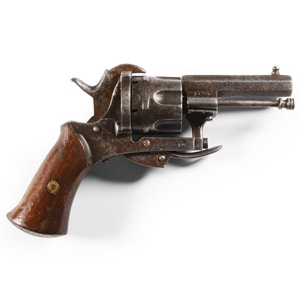
Belgian Pinfire Pocket Revolver
1877-1900 A.D.Sold for (Inc. bp): £143
Six-shot 7mm calibre double action Belgian proofed revolver with 55mm (2¼") barrel with hinged loading gate, extractor mounted at right side, folding trigger and fitted with plain wood butt scales; action stiff. 245 grams, 14 cm
Acquired from ROA Antique Arms Ltd. The Kusmirek Collection, UK. Accompanied by copy of the ROA listing.
Sold as an exempt item under Section 58 (2) of the Firearms Act, 1968, to be held as a curiosity or ornament. No license required but buyer must be over 18 years of age. Overseas bidders should note that, due to UK regulations governing export of all firearms, overseas buyers will need to make arrangements for shipping this lot out of the UK directly, by air freight, with a specialist company or agent.
