
Loading, please wait...
LOT 1133
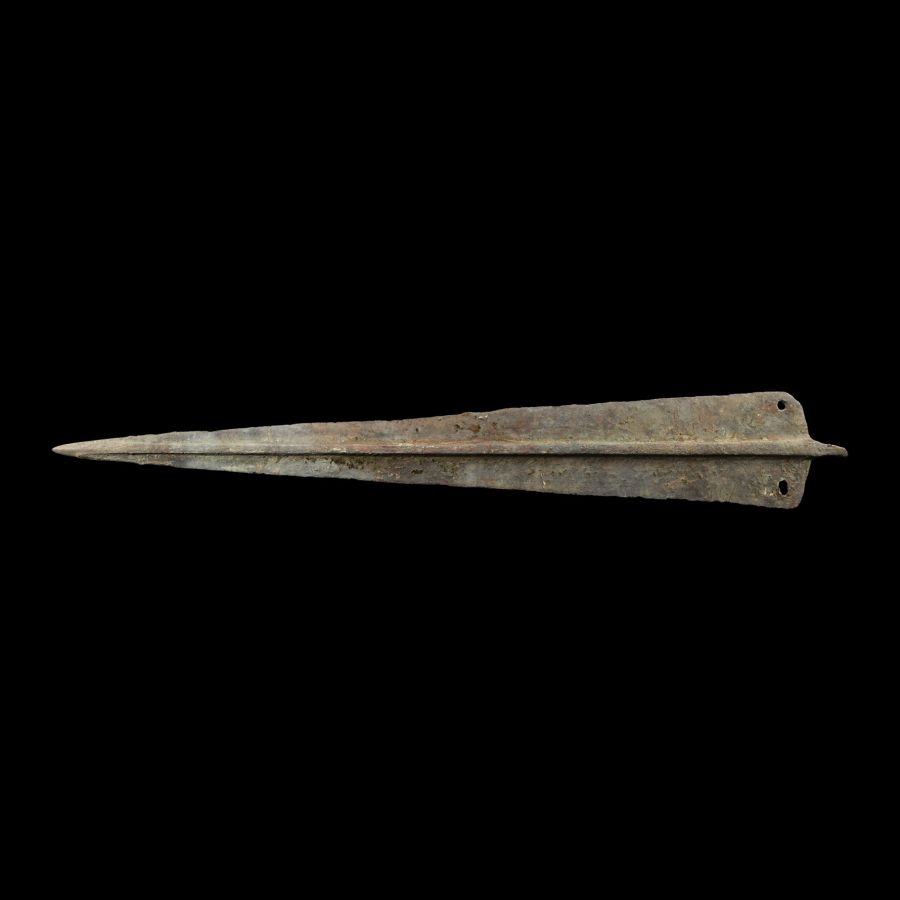
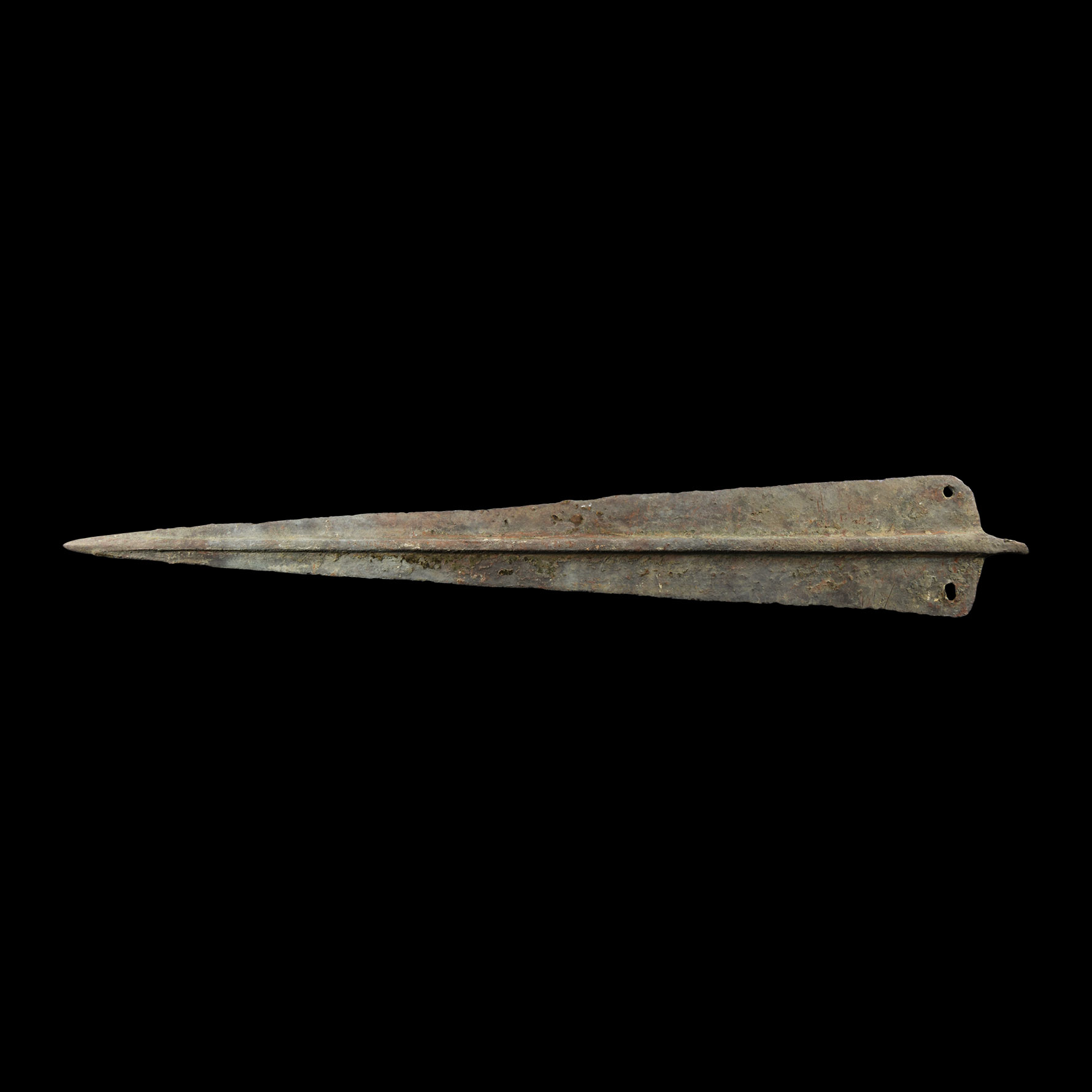
Luristan Bronze Blade
LATE 2ND- EARLY 1ST MILLENNIUM B.C.
14 in. (217 grams, 35.5 cm).
Sharply pointed with raised midrib to each face, square shoulders pierced to accept the fixings for the hilt, stub tang.
ProvenanceEx German collection, Cologne, 1980-1990s.
LiteratureSee similar in Christie's, The Axel Guttmann Collection of Ancient Arms and Armour, part 1, London, 2002, p.34, no.31, p.36, no.33; Malekzadeh, M., Hasanpur, A., Hashemi, Z., 'Fouilles (2005-2006) a Sangtarashan, Luristan, Iran' in Iranica Antiqua, vol.LII, 2017, pp.61-155, pl.32, no.205.
FootnotesThe two holes on the shoulders of the blade provided attachment for a separate hilt. This could have been a penannular grip, which can be seen on some swords from Sangtarashan; or in north-west Iranian blades with rectangular guard and flanged hilt, where the guard was rivetted to the blade, like in some swords in the Axel Guttmann collection.
CONDITIONTimeLine Auctions follows a vetting process to ensure the authenticity and legality of all items, reinforcing our commitment to integrity and responsible trading. Each antiquity, antique, and coin lot undergoes thorough examination by a vetting committee of at least ten external specialists, professional trade association members, scientists, and archaeologists: Our Vetting Process
AUCTIONS:
TimeLine is a leading auction house specialising in antiquities, ancient art, collectables, natural history, coins, medals, and books. Our auctions offer museums, collectors, historians, and enthusiasts the opportunity to acquire unique and historically significant pieces.
-
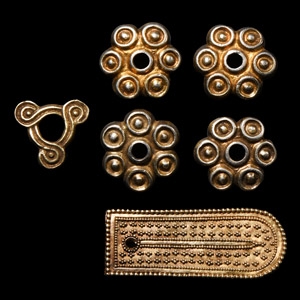
Avar-Byzantine Silver-Gilt Sword Belt Mount Group
7th century A.D.Estimate: £200 - 300 (+bp*)
Opening Bid: £80
Comprising six mounts: four 'floral' plates composed of six raised pellet-in-ring motifs arranged around a central hole, some mounting lugs remaining to the reverses; an openwork knotwork type with three mounting lugs to reverse; a hollow-formed rectangular plate with one rounded end, granulated borders framing granulated clusters arranged in orderly rows around a central arm and piercing; granulated border to reverse. 25.1 grams total, 18-48 mm
Fine condition.
Acquired in the 1980s-1990s. Ex an important central London gallery, London W1.
This type of belt element decorated with granulation, is present in the Avar graves of the second half of the 7th century, and was most likely produced in the workshops of the Eastern Roman Empire, from where they reached the Avar lands as imperial gifts (tomb of Kunbàboni) or spoils of war. They were part of multiple belts, to which sabers and knives were attached, commonly used among Avars, Bulgars and Romans during the 7th and 8th centuries AD. -
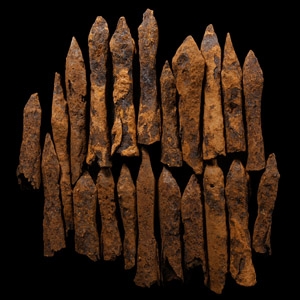
Medieval Iron Crossbow Bolt Group
Circa 12th-15th century A.D.Sold for (Inc. bp): £208
Composed of socketted bolts of various types, most with tapering or facetted square-section tips. 888 grams total, 5.4-10.3 cm
Acquired 1990s-early 2000s. East Anglian private collection. -
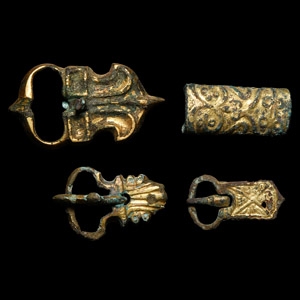
Khazar Gilt Sword Belt Buckle and Mount Group
9th-10th century A.D.Sold for (Inc. bp): £130
Comprising four gilt copper-alloy sword belt fittings: a large buckle plate with ogival head and trefoil plate; a buckle with roughly D-shaped loop and shell-style plate, triangular-section tongue; a buckle composed of an oval head and roughly rectangular plate decorated with an X-motif and enigmatic forms in each quarter, articulate tongue; a C-section mount displaying raised floral vines. 67 grams total, 37-59 mm
Fine condition.
Acquired in the 1980s-1990s. Ex an important central London gallery, London W1.
These wonderful fittings show similarities with examples from the Caucasus and Kuban regions. They show parallels with specimens from the Verchne-Szaltovo area, for example a bronze buckle from the catacomb grave no.11.
