
Loading, please wait...
_900x900.jpg "Luristan Bronze Blade Collection")
_200x200.jpg "Luristan Bronze Blade Collection")
.jpg "Luristan Bronze Blade Collection")
LOT 1048
Luristan Bronze Blade Collection
EARLY 1ST MILLENNIUM B.C.
7 7/8 - 9 1/2 in. (485 grams total, 20-24 cm).
Comprising six bronze short tapering blades, all with rounded shoulders and flattened mid-ribs, four with tapering tangs, one with tang pierced at tip; one of the narrowest blades is without a tang. [6]
ProvenanceAcquired 1980-2015.
Ex Abelita family collection.
See Christie's, The Axel Guttmann Collection of Ancient Arms and Armour, part 1, London, 2002, p.34, no.31.
FootnotesMoorey, Gordon and Khorasani created a classification of bladed weapons, according to which daggers are edged weapons not greater than 36cm in length, dirks (short swords) are between 36cm and 50cm in length, and swords are edged weapons greater than 50cm in length. These weapons belong to the dagger category.
CONDITIONTimeLine Auctions follows a vetting process to ensure the authenticity and legality of all items, reinforcing our commitment to integrity and responsible trading. Each antiquity, antique, and coin lot undergoes thorough examination by a vetting committee of at least ten external specialists, professional trade association members, scientists, and archaeologists: Our Vetting Process
AUCTIONS:
TimeLine is a leading auction house specialising in antiquities, ancient art, collectables, natural history, coins, medals, and books. Our auctions offer museums, collectors, historians, and enthusiasts the opportunity to acquire unique and historically significant pieces.
-
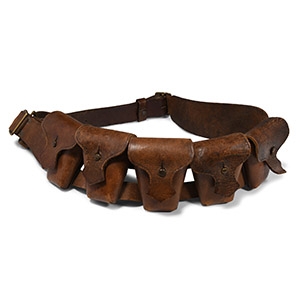
British Leather Ammunition Pouch Belt
1940s A.D.Sold for (Inc. bp): £26
A leather belt with brass buckles to which are rivetted five leather cartridge holders each with internal retaining strap and cover; the reverse of the belt stamped '2575665'. 591 grams, 90 cm long
The Kusmirek Collection, UK. -
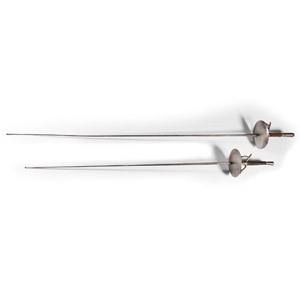
Post Medieval Fencing Foil Pair
Circa 1900 A.D.Sold for (Inc. bp): £33
Each with a long and narrow blade, the longer of square section, the shorter rectangular, each fitted with traditional slender, straight hilt, guard and finger-ring. 657 grams total, 85-106 cm
Acquired from Czerny's Auctions, Italy, 2016, lot 280. The Kusmirek Collection, UK. Accompanied by a copy of Czerny's invoice and listing. -
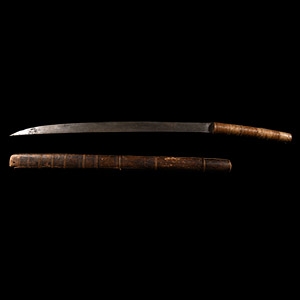
Burmese Iron Single-Edged Sword with Scabbard
19th century A.D. or earlierSold for (Inc. bp): £52
Comprising a smooth, slightly curved and unornamented blade, the hilt wrapped with organic plaited and plain string; tubular bamboo(?) scabbard wrapped with plaited string. 886 grams, 91 cm long
Ex Reeman Dansie, Colchester, Essex, UK.
The dha may have its origins with the Tai people who migrated to the area from present-day Yunnan Province in southern China. This sabre varied considerably according to locality but they shared some features that define them apart from other weapons and tools of the area, like the round cross-section grip, a long, gently curving blade with a single edge, and the absence of a guard.
