
Loading, please wait...
LOT 1434
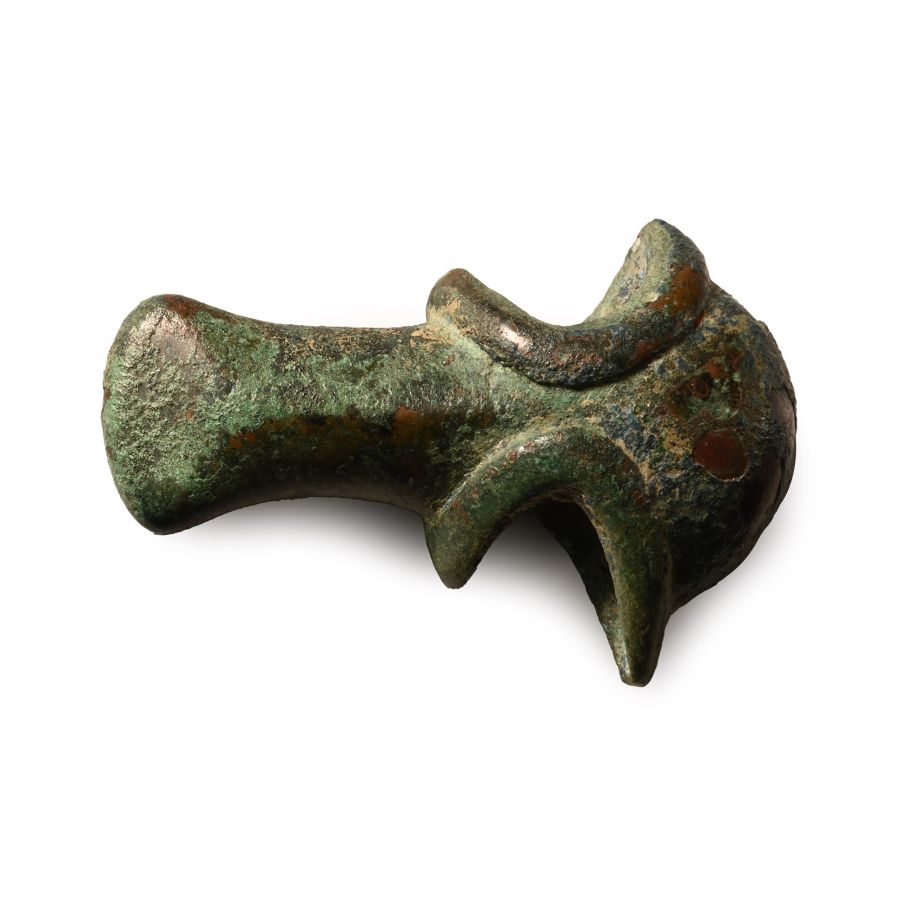
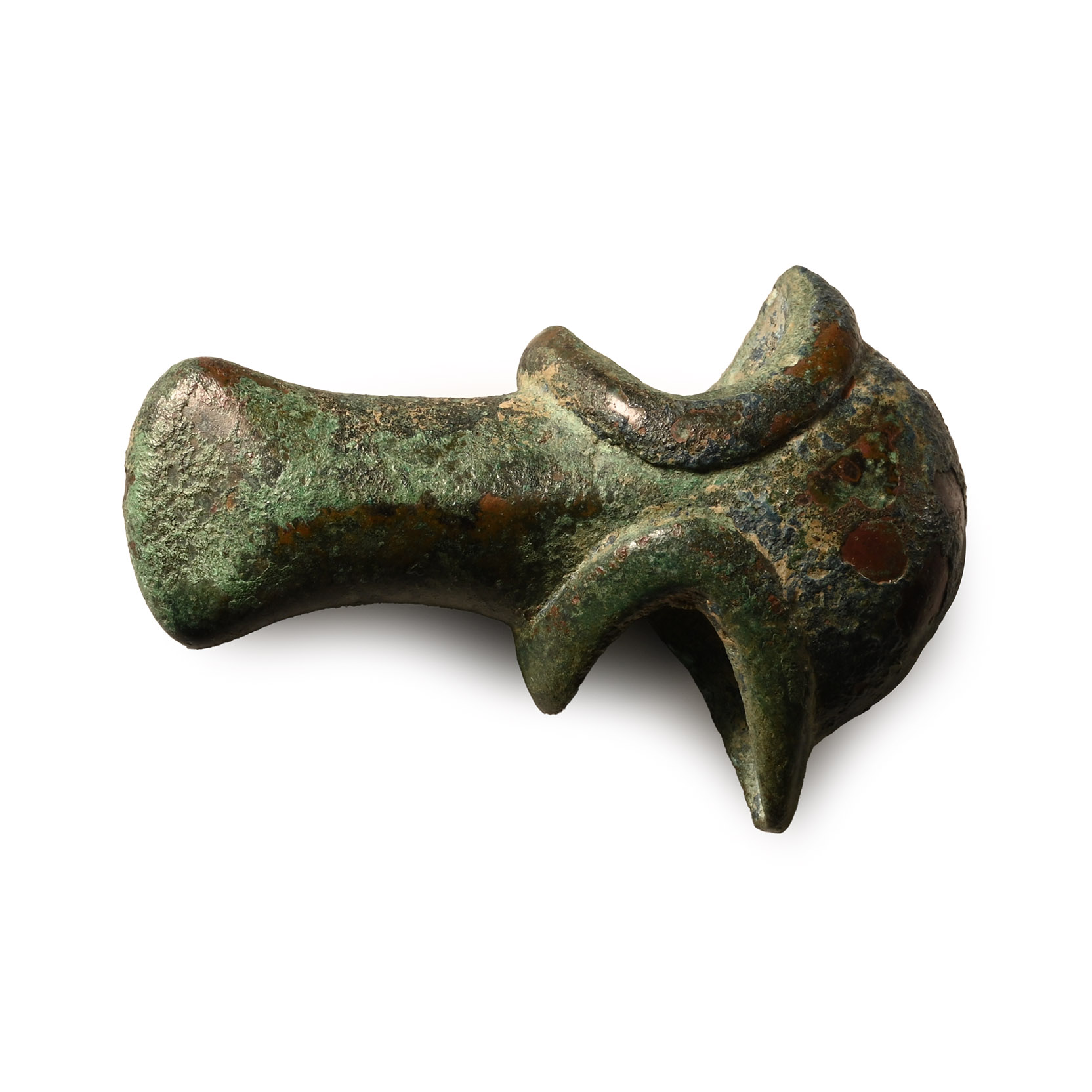
Luristan Bronze Axehead
3RD MILLENNIUM B.C.
3 in. (192 grams, 75 mm).
With a short blade flaring towards the cutting edge, rounded projection to the butt, rolled ridge around the shaft hole.
ProvenanceUK private collection before 2000.
Acquired on the UK art market.
Property of a London gentleman.
Cf. Mahboubian, H., Art of Ancient Iran, copper and bronze, London, 1997, p.166, fig.172a, for identical type; Gernez, G., L’armament en métal au Proche et Moyen-Orient: des origines a 1750 av. J.C., Paris, 2007, p.146, fig.2.12, subtype H2.F.a.
FootnotesThe type corresponds to the Gernez type H.2.Fa, of axes with symmetrical collar, rear hump and rectangular blade. The exact provenance of only three axes of this type outside Luristan are known, mainly in Elam: one was found at Tepe Giyan, a second comes from a pit tomb in Susa and the last, a miniature, belongs to level VI of Tepe Gawra, dated to the last third of the 3rd millennium B.C. All the others are known as originating from Luristan.
CONDITIONTimeLine Auctions follows a vetting process to ensure the authenticity and legality of all items, reinforcing our commitment to integrity and responsible trading. Each antiquity, antique, and coin lot undergoes thorough examination by a vetting committee of at least ten external specialists, professional trade association members, scientists, and archaeologists: Our Vetting Process
AUCTIONS:
TimeLine is a leading auction house specialising in antiquities, ancient art, collectables, natural history, coins, medals, and books. Our auctions offer museums, collectors, historians, and enthusiasts the opportunity to acquire unique and historically significant pieces.
-
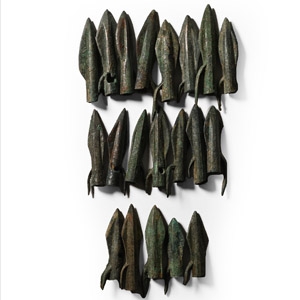
Scythian Bronze Arrowhead Collection
Circa 7th-3rd century B.C.Sold for (Inc. bp): £182
Each with a slender, lozenge-shaped blade and a socket extending near the tip, base of the socket with a side lug. 130 grams total, 37-57 mm
UK private collection before 2000. Acquired on the UK art market. Property of a London gentleman.
In Greek warfare archery was mainly employed by Scythians and Cretans for the longer-ranks. Both used composite bows made of wood, horn, bone and sinew. This explains the great range of Scythian arrowheads found on the Greek sites. -
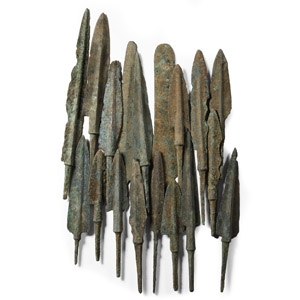
Luristan Bronze Arrowhead Collection
Circa 2nd millennium B.C.-9th century B.C.Sold for (Inc. bp): £234
Including triangular, leaf-shaped, barbed, square-section, and other types. 446 grams total, 10-17.5 cm
Ex London, UK, collection, 1990s.
It is significant to remember that the use of winged and barbed heads in Anatolia was common since the second millennium B.C., but apparently their employment began earlier in this area, where types like these occur alongside the non-barbed, predominantly ribbed and tanged types. -
.jpg)
Byzantine 'Greek Fire' Ceramic Fire Bomb or Hand Grenade
9th-11th century A.D.Sold for (Inc. bp): £98
With domed filler-hole, broad shoulder, alternating bands of crescent impressed detailing; intended to be filled with explosive liquid and wick, used as a hand grenade. 242 grams, 10.1 cm
From a collection acquired on the UK art market from various auction houses and collections mostly before 2000. From an important Cambridgeshire estate; thence by descent. Accompanied by an academic paper by military specialist Dr Raffaele D'Amato, dated 15 July 2019 and titled 'Eastern Roman Empire - Greek Fire Bomb or Hand Grenade (μεσαίον kακάβιον) 9th-11th century AD'.
Apart from the use of siphons or manual flame-throwers called cheirosiphona, special corps of Roman soldiers employed terracotta grenades, in the form of small jars, abundantly evidenced in archaeological excavations. Such were the γανωτα, vessels (sometimes also of bronze) used for Greek fire. They were called μεσαία kακαβιά or κυτροκακάβια where the former had a bulbous shape and the latter a more cylindrical form.
