
Loading, please wait...
LOT 1160
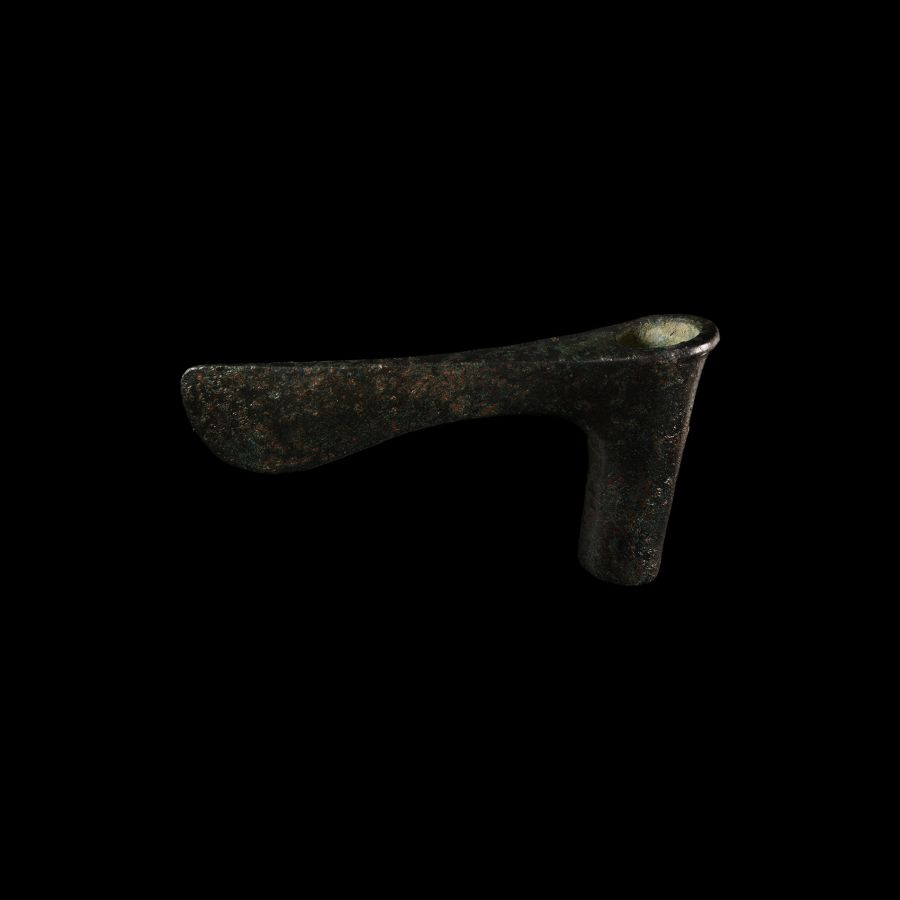
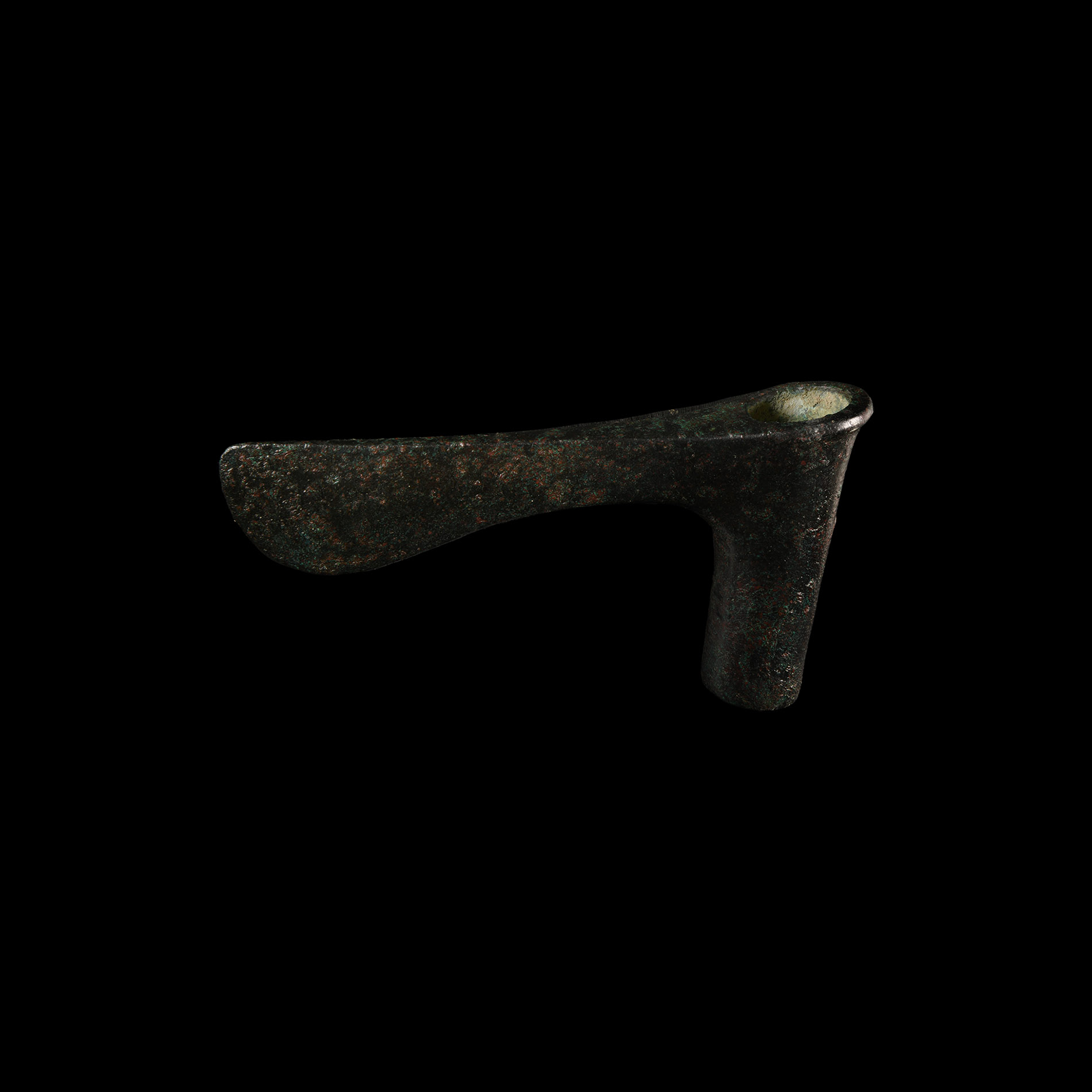
Luristan Bronze Axehead
2ND-1ST MILLENNIUM B.C.
6 in. (274 grams, 15 cm).
Composed of a roughly cylindrical socket, slightly scooper upper and lower cheek edges and convex cutting edge.
ProvenanceEx Alexander Cotton collection, Hampshire, UK, 1980s.
CONDITIONTimeLine Auctions follows a vetting process to ensure the authenticity and legality of all items, reinforcing our commitment to integrity and responsible trading. Each antiquity, antique, and coin lot undergoes thorough examination by a vetting committee of at least ten external specialists, professional trade association members, scientists, and archaeologists: Our Vetting Process
AUCTIONS:
TimeLine is a leading auction house specialising in antiquities, ancient art, collectables, natural history, coins, medals, and books. Our auctions offer museums, collectors, historians, and enthusiasts the opportunity to acquire unique and historically significant pieces.
LOT 1160
Luristan Bronze Axehead
Estimate £200 - 300€230 - 350 (for guidance only)$270 - 410 (for guidance only)
-
Medieval Iron Arrowhead Group
13th-15th century A.D.Sold for (Inc. bp): £182
Comprising tanged arrowheads of various types. 59 grams total, 5-11.6 cm
Acquired before 1972. The Kusmirek Collection, UK.
The projectiles belong to the type 1 of the A. Michalak classification. In Western Europe, especially from the 13th century onwards, arrows were made in various forms including: simple cone-shaped heads, rhomboid heads, hooked heads, heads with various curved barbs, willow-shaped heads, triangular and flat-bladed heads, crescent-shaped heads and sometimes as petal-shaped and battering heads. -
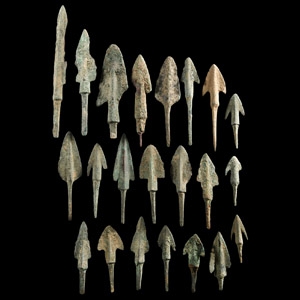
Luristan Bronze Arrowhead Group
2nd-1st millennium B.C.Sold for (Inc. bp): £208
Mainly composed of tanged arrowheads of barbed and leaf-shaped types, many with midribs. 178 grams total, 3.8-10.2 cm
Acquired 1990s. From the collection of a late Japanese weaponry collector. -
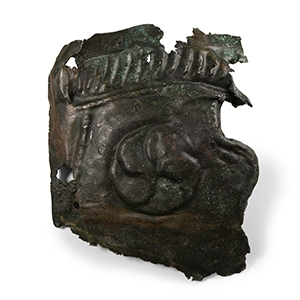
Roman Bronze Military Helmet Face Guard Section
3rd century A.D.Sold for (Inc. bp): £715
From the right side of the face mask, the upper edge with a band of embossed diagonal lines, probably intending to represent stylised hair, embossed spiral to the centre, a symbol clearly connected with the worship of the sun; a hole for the fastening thongs at ear-level which originally linked the face-guard to the bowl. 75 grams, 13 cm high
Acquired 1960s-1990s. Late Alison Barker collection, a retired London barrister.
The spiral decoration of the face-guard is connected with the solar cult. The spiral represents the rotary movement of the sun, and the spiral is probably the oldest known spiritual symbol connected with the sun, together with the swastika or tetragammadion. The connection can also be seen in Celtic art, where the representation of the spiral also follows the path of the sun, describing the movements of the heavenly body over the course of a solar year. The third century was characterised by diffusion of the solar cult, the Sol Invictus, among the Roman soldiers, with its symbols often represented on arms and weapons as an apotropaic element of protection.
