
Loading, please wait...
LOT 1165
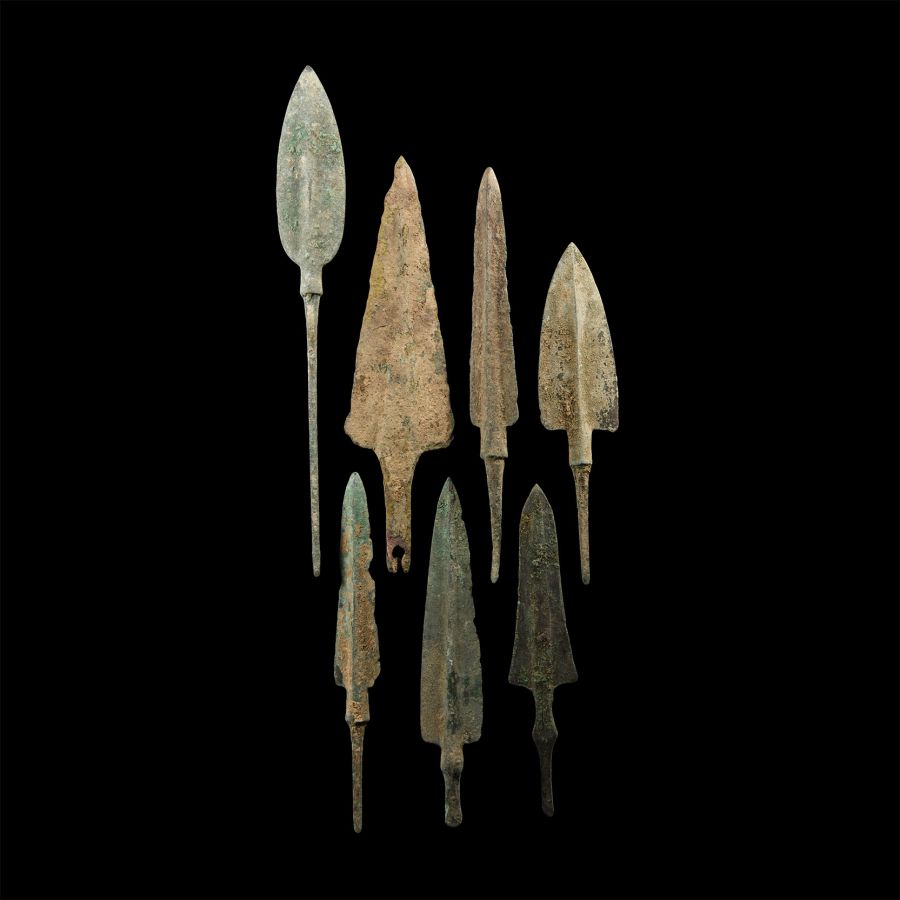
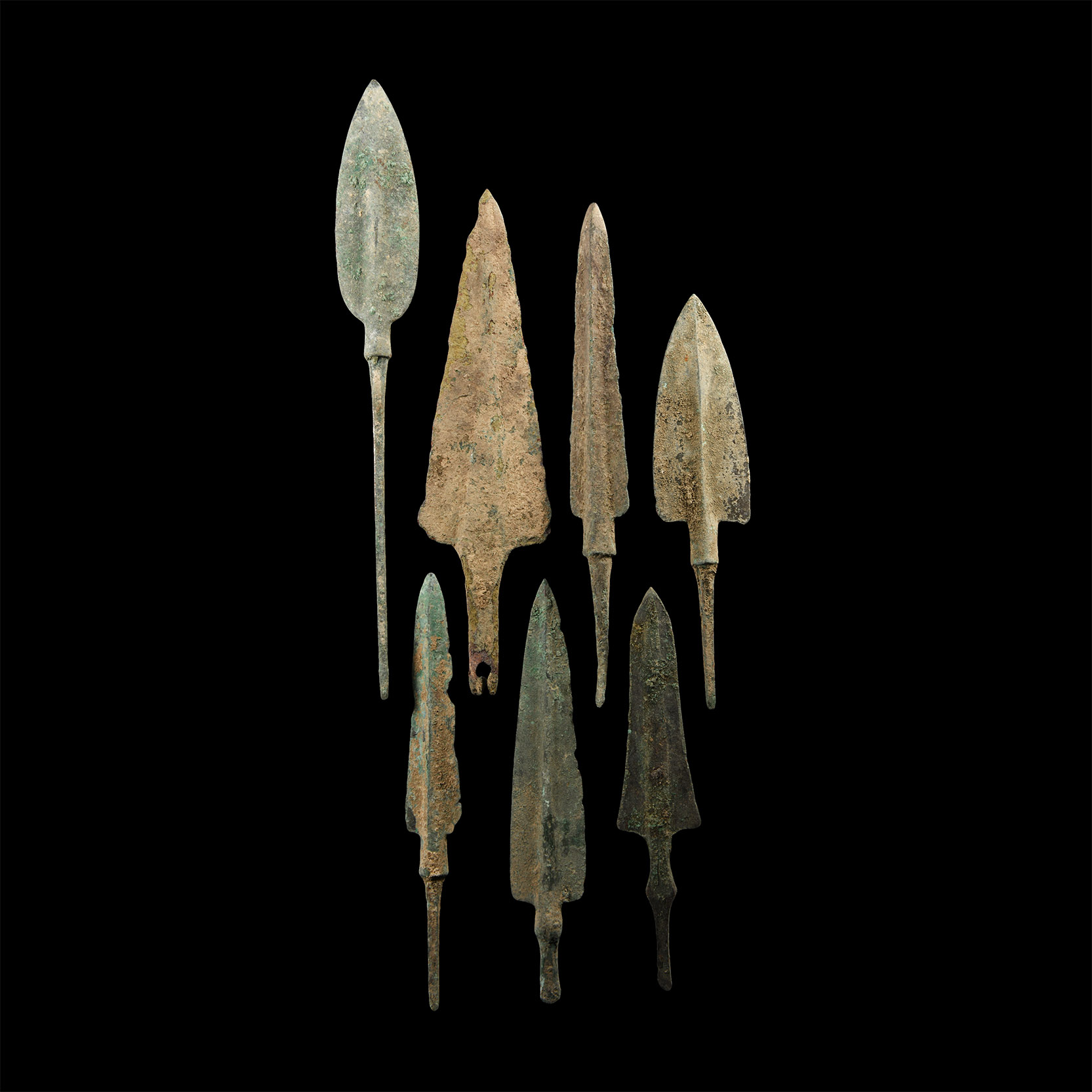
Luristan Bronze Arrowhead
2ND-1ST MILLENNIUM B.C.
4 3/4 - 7 1/4 in. (225 grams total, 12-18.5 cm).
Comprising mainly tanged arrowheads including various types of leaf-shaped heads with midribs. [7]
ProvenanceAcquired 1990s.
From the collection of a late Japanese weaponry collector.
TimeLine Auctions follows a vetting process to ensure the authenticity and legality of all items, reinforcing our commitment to integrity and responsible trading. Each antiquity, antique, and coin lot undergoes thorough examination by a vetting committee of at least ten external specialists, professional trade association members, scientists, and archaeologists: Our Vetting Process
AUCTIONS:
TimeLine is a leading auction house specialising in antiquities, ancient art, collectables, natural history, coins, medals, and books. Our auctions offer museums, collectors, historians, and enthusiasts the opportunity to acquire unique and historically significant pieces.
LOT 1165
Luristan Bronze Arrowhead
Estimate £150 - 200€170 - 230 (for guidance only)$200 - 270 (for guidance only)
-
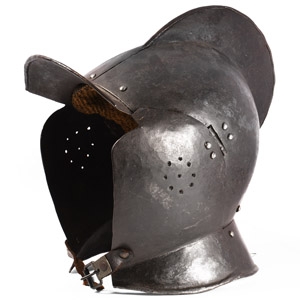
South German Burgonet Helm
Circa 1580-1610 A.D.Sold for (Inc. bp): £2,340
The rounded two-piece skull joined along the crest with a high medial comb, internally fitted with a quilted canvas lining sewn to a leather lining-band, the brow with a fixed rounded peak, outward-flanged rear edge with a matching one-piece neck guard, hinged cheek-pieces flanged outwards at the lower edge to serve as a continuation of the neck-guard. 1.7 kg, 29 cm
with Thomas Del Mar Ltd, 7th December 2017, lot 542. The Kusmirek Collection, UK. Accompanied by a copy of the Thomas Del Mar invoice. Accompanied by an academic report by Dr Raffaele D'Amato. This lot has been checked against the Interpol Database of stolen works of art and is accompanied by search certificate number no.11762-203983.
The burgonet (Italian borgognotta) had developed at the beginning of the 16th century from the sallet and soon became a very popular helmet worn in many parts of Europe (especially in Germany and Northern Italy) by infantry and later cavalry units. A clear advantage of this helmet was the unifying a good protective function against cut and thrust weapons with a unhindered field of sight, good ventilation and user comfort due to the small weight and the fact it could be worn independently without an armour. -
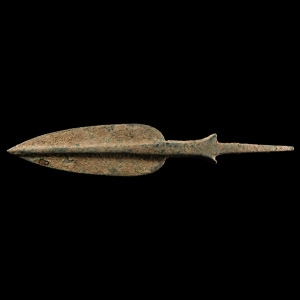
Amlash Bronze Spear Blade
12th-11th century B.C.Sold for (Inc. bp): £208
Leaf-shaped blade with pronounced midrib, square-section neck with flared ends and thick square-section tang. 299 grams, 26.7 cm
Ex German collection, Cologne, 1980-1990s.
The spearhead belongs to the type I of tripartite spears with broad mid-rib, reinforced shaft opening to reveal the tang and rounded shoulders. The blade with curved shoulders, a sharp point and a rectangular mid-rib. Stutzinger dated these pieces to 1200-1100 B.C. -
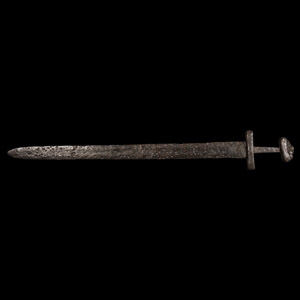
Viking Age Iron Sword with Five-Lobed Pommel
10th-11th century A.D.Sold for (Inc. bp): £4,550
Of Petersen Type S variant with a double-edged blade, shallow fullers and a rounded point; boat-shaped upper and lower guard with some remains of silver inlay, the pommel also showing traces of silver decoration. 1.3 kg, 87.5 cm
The structure of the blade is still homogenous but presents delamination on various part, corrosion damage along the edge and deep corrosion and pitting due to permanence in the water.
Acquired 1971-1972. From the collection of the vendor's father. Property of a London, UK, collector. Accompanied by an academic report by Dr Raffaele D’Amato. This lot has been checked against the Interpol Database of stolen works of art and is accompanied by search certificate number no.11756 - 202774.
Viking swords of Type S are commonly found in Nordic countries and in Eastern Europe, with only a small number found in Western Europe. The type was often characterised by splendid decoration achieved with silver and copper inlays, of which here some traces are still visible.
