
Loading, please wait...
LOT 1452
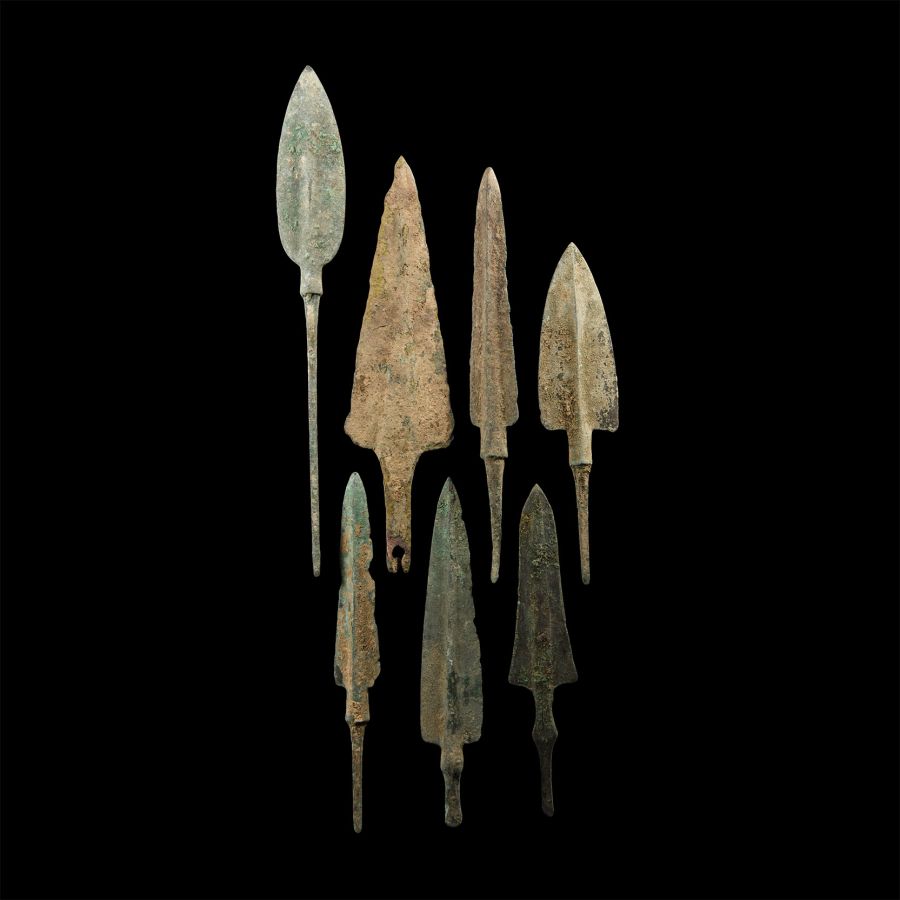
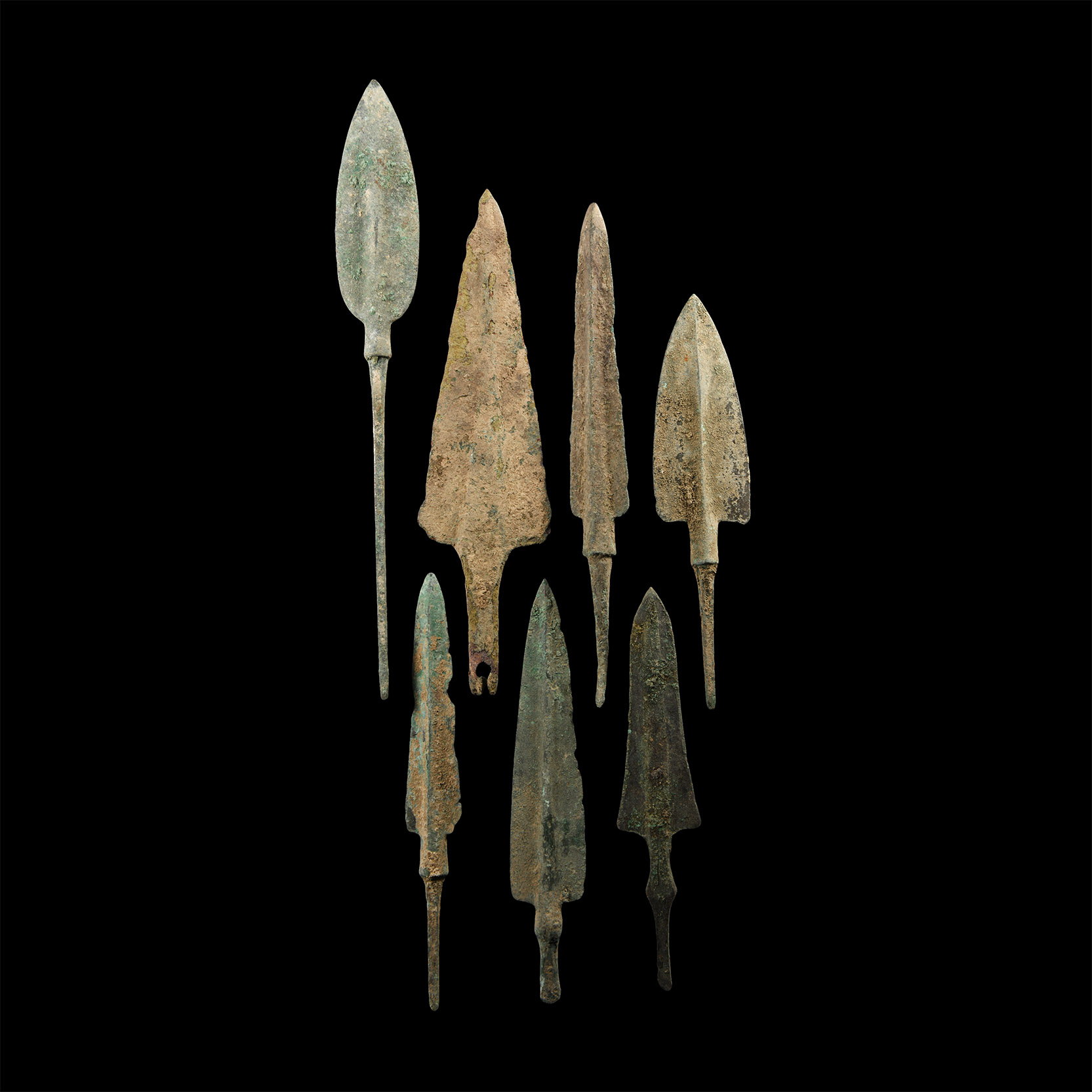
Luristan Bronze Arrowhead Group
13TH-7TH CENTURY B.C.
4 3/4 - 6 in. (200 grams total, 12-15.3 cm).
Comprising mainly tanged arrowheads including various types of leaf-shaped heads with midribs. [6]
ProvenanceAcquired 1990s.
From the collection of a late Japanese weaponry collector.
See for similar arrowheads Muscarella, O.W., Bronze and Iron Ancient Near Eastern Artifacts in the Metropolitan Museum of Art, New York, 1988, pp.289ff. nos.398, 403; Khorasani, M.M., Arms and Armour from Iran. The Bronze Age to the End of the Qajar Period, Tübingen, 2006, items 449,467, for some of the types represented here.
FootnotesThe barbed arrowhead seems to belong to the type V, subcategory type C, according to the classification of Khorasani and Negahban. In the four categories of triangular bronze arrowheads from Luristan, Marlik and Northern Iran individuated by Negahban, subtypes C and D of type V are larger arrow or javelin heads, C large triangular arrowheads with barbed shoulders and D with lanceolate shape and rounded midrib. The straight shoulders recalls a Marlik typology (see Khorasani, 2006, p.307, fig.379).
CONDITIONTimeLine Auctions follows a vetting process to ensure the authenticity and legality of all items, reinforcing our commitment to integrity and responsible trading. Each antiquity, antique, and coin lot undergoes thorough examination by a vetting committee of at least ten external specialists, professional trade association members, scientists, and archaeologists: Our Vetting Process
AUCTIONS:
TimeLine is a leading auction house specialising in antiquities, ancient art, collectables, natural history, coins, medals, and books. Our auctions offer museums, collectors, historians, and enthusiasts the opportunity to acquire unique and historically significant pieces.
-
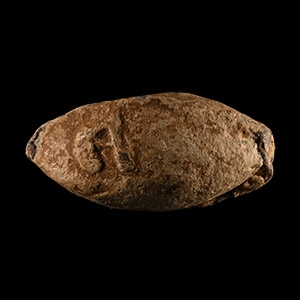
Roman 'Julius Caesar' Slingshot from the Battle of Munda
45 B.C.Sold for (Inc. bp): £715
A biconical facetted lentoid-section lead sling shot (glans), inscription monogram a combination of letters 'C', 'A' and 'E', for 'C A E S' referring to Julius Caesar. 68.9 grams, 37 mm
From the collection of an London antiquarian, 1980s. Accompanied by an academic paper by military specialist Dr Raffaele D'Amato, dated 4th May 2022 and titled 'Roman Res Publica - Lead Slingshots (glandes) of Caesarian Age - 45 B.C circa'. Accompanied by a printed copy of the Spanish cultural export licence 2022/07273.
The shot (type IIb of the Völling classification) is marked with the abbreviated name of Julius Caesar; it was used in quantity at the Battle of Monda (or Munda) against the last fellows of Pompey, the leaders of the Optimates, on the 17th March 45 BC. Similar shots were used in the Caesar's wars. The slingers of Caesar's age were part of the light infantry. Caesar speaks of his Balearic slingers during the conquest of Gaul. They wore a short tunic, with leather or rope sandals to the feet, and a warm overcoat which could also have been used to store projectiles. They also used a satchel to carry very deadly lead-like stones or bullets. -
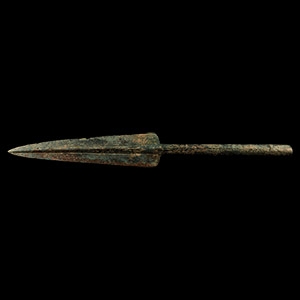
Large Marlik Type Bronze Socketted Spearhead with Blood Channels
14th-10th century B.C.Sold for (Inc. bp): £211
Comprising a triangular blade with prominent midrib, long split socket with two piercings for attachment and lower part decorated by horizontal circular grooves. 336 grams, 48 cm
Acquired 1980-2015. Ex Abelita family collection.
According to Khorasani, this spearhead belongs to the type VIII of his classification, characterised by a well-projecting midrib and long folded socket. The triangular blade is related to the subtype 2. Similar spearhead was excavated by Dr Negahban in the Royal Cemetery of Marlik (tomb 2, trench III D). -
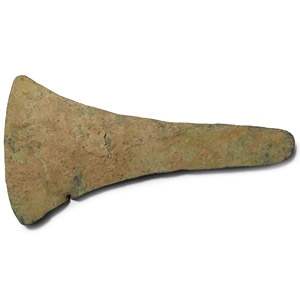
Western Asiatic Bronze Flat Axe
4th millennium B.C.Estimate: £100 - 140 (+bp*)
Opening Bid: £50
Formed with a rounded butt and slightly flared cutting edge; flat in cross-section. 138 grams, 18.5 cm
Acquired 1980-2015. Ex Abelita family collection.
This type of flat axes appeared in the last phase of the Late Chalcolithic Age. Flat axes without lugs were used as cutting tools or in war. In the later examples the sides of the blades was gradually widening towards the convex cutting edge.
