
Loading, please wait...
LOT 1429
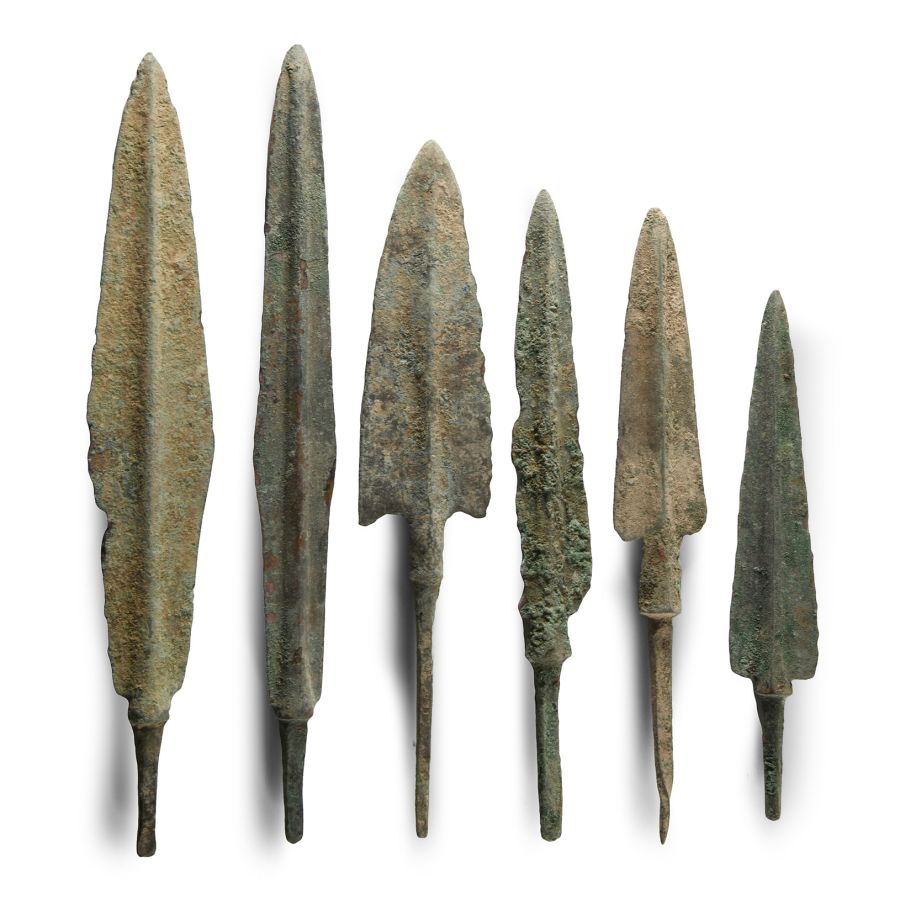
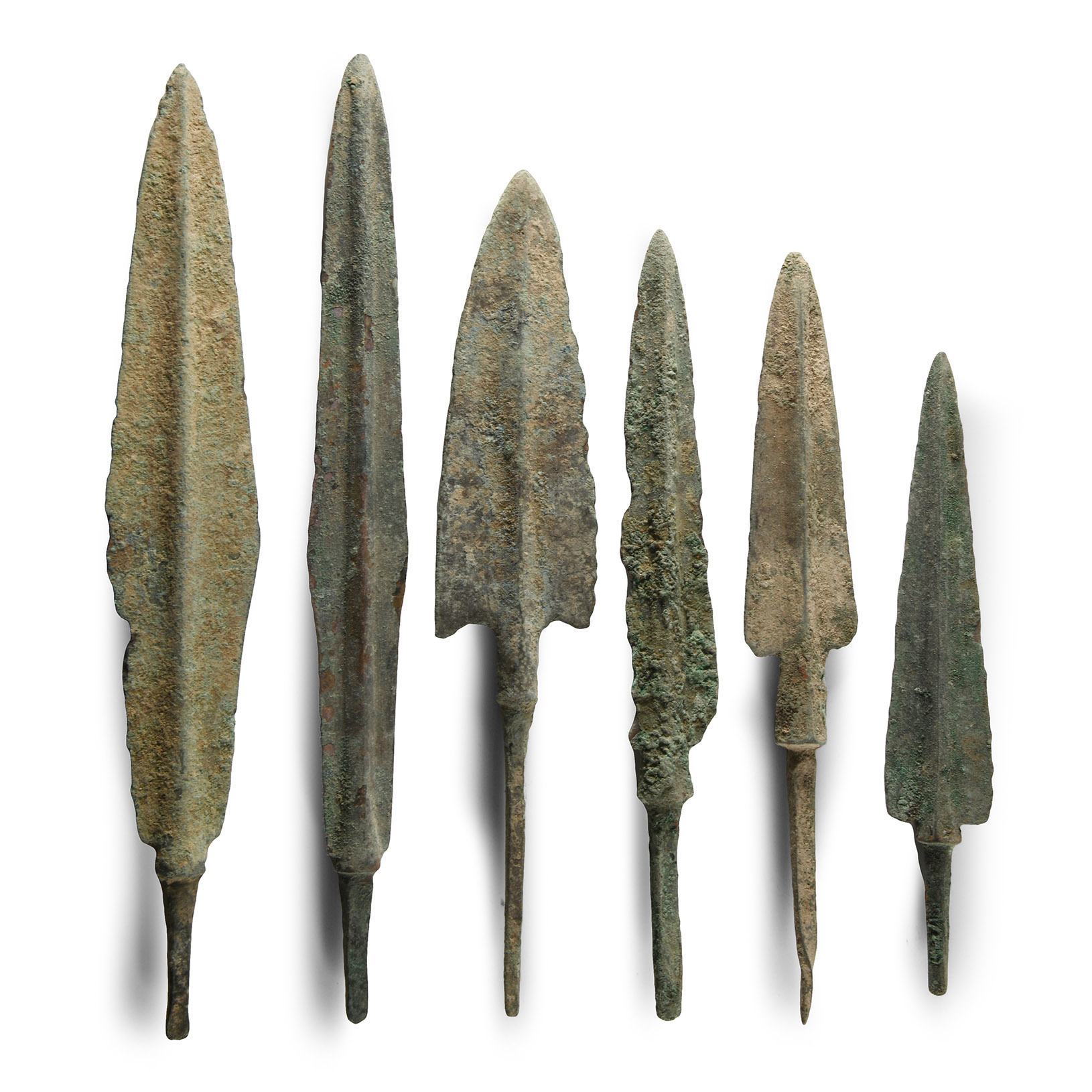
Luristan Bronze Arrowhead Group
12TH-9TH CENTURY B.C.
4 3/4 - 7 in. (216 grams total, 12.2 - 18 cm).
Comprising arrowheads of various types, mainly leaf-shaped and barbed types, with midribs. [6]
ProvenanceAcquired 1990s.
From the collection of a late Japanese weaponry collector.
See Khorasani, M.M., Arms and Armour from Iran. The Bronze Age to the End of the Qajar Period, Tübingen, 2006, figures 376, 379, and catalogue 467, for some of the represented types.
FootnotesThe barbed arrowhead seems to belong to the type V, subcategory type C, according to the classification of Khorasani and Negahban. In the four categories of triangular bronze arrowheads from Luristan, Marlik and Northern Iran individuated by Negahban, subtypes C and D of type V are larger arrow or javelin heads, C large triangular arrowheads with barbed shoulders and D with lanceolate shape and rounded midrib. The straight shoulders recalls a Marlik typology (see Khorasani, 2006, p.307, fig.379).
CONDITIONTimeLine Auctions follows a vetting process to ensure the authenticity and legality of all items, reinforcing our commitment to integrity and responsible trading. Each antiquity, antique, and coin lot undergoes thorough examination by a vetting committee of at least ten external specialists, professional trade association members, scientists, and archaeologists: Our Vetting Process
AUCTIONS:
TimeLine is a leading auction house specialising in antiquities, ancient art, collectables, natural history, coins, medals, and books. Our auctions offer museums, collectors, historians, and enthusiasts the opportunity to acquire unique and historically significant pieces.
-
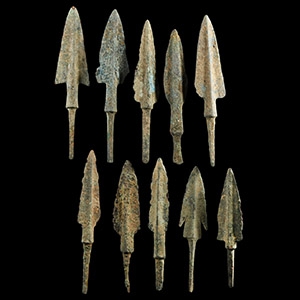
Luristan Bronze Arrowhead Group
14th-10th century B.C.Sold for (Inc. bp): £195
Comprising tanged arrowheads, including barbed and leaf-shaped examples. 158 grams total, 8-10.5 cm
Acquired 1990s. From the collection of a late Japanese weaponry collector.
The arrowheads seems to belong to the subtypes A and B of the Khorasani classification. They are mainly small triangular arrowheads with rounded and barbed shoulders. Some have angular or rounded midribs. The characteristic is also the cylindrical stem and the rectangular-sectioned tang. Many similar arrowheads were found in the Marlik excavations. -
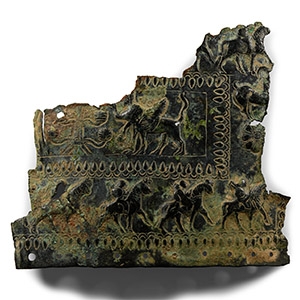
Urartu Bronze Repoussé Fragment with Advancing Warriors on Horseback
Circa 9th-7th century B.C.Sold for (Inc. bp): £1,560
The rectangular fragment with repoussé leaf borders, the outer scene composed of advancing warriors on horseback, each rider holding a round shield and a quiver of arrows on his back, a horned animal and a rosette to the right; the central scene with a winged human-headed bull flanking a tree, possibly a pomegranate tree or a tree of life; the lower edge pierced for attachment. 41 grams, 12 cm wide
From the property of the late Mr SM, London, UK, 1969-1999. Accompanied by a previous catalogue information slip. -
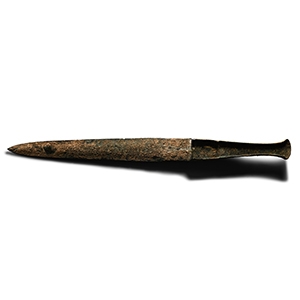
Canaanite Bronze Dirk
13th-12th century B.C.Estimate: £400 - 600 (‡+bp*)
Opening Bid: £200
With lentoid-section blade, tongue-shaped in plan, integral tapering hilt with flared finial, lateral flanges to accept a panel of bone or wood to each face forming the grip. 174 grams, 34 cm
Ex Joseph J. Gancie (1923-2010), Washington, Silver Spring, Maryland. with Alex Cooper Auctioneers Inc., sale 1035, 27 January 2013, lot 162a.
The dirk belongs to the type III in the Medvedskaya classification, used in Near East from the 13th to the 6th century B.C. The type is the 32a of the Maxwell-Hyslop study. The Asiatic daggers of this type are confined to Syria and Persia, but Transcaucasia also provides an interesting analogy from Kalekent on the Baku peninsula, where a pointed straight-sided dagger blade has a flanged hilt with the whole of the side flanges bent over the centre.
