
Loading, please wait...
LOT 1081
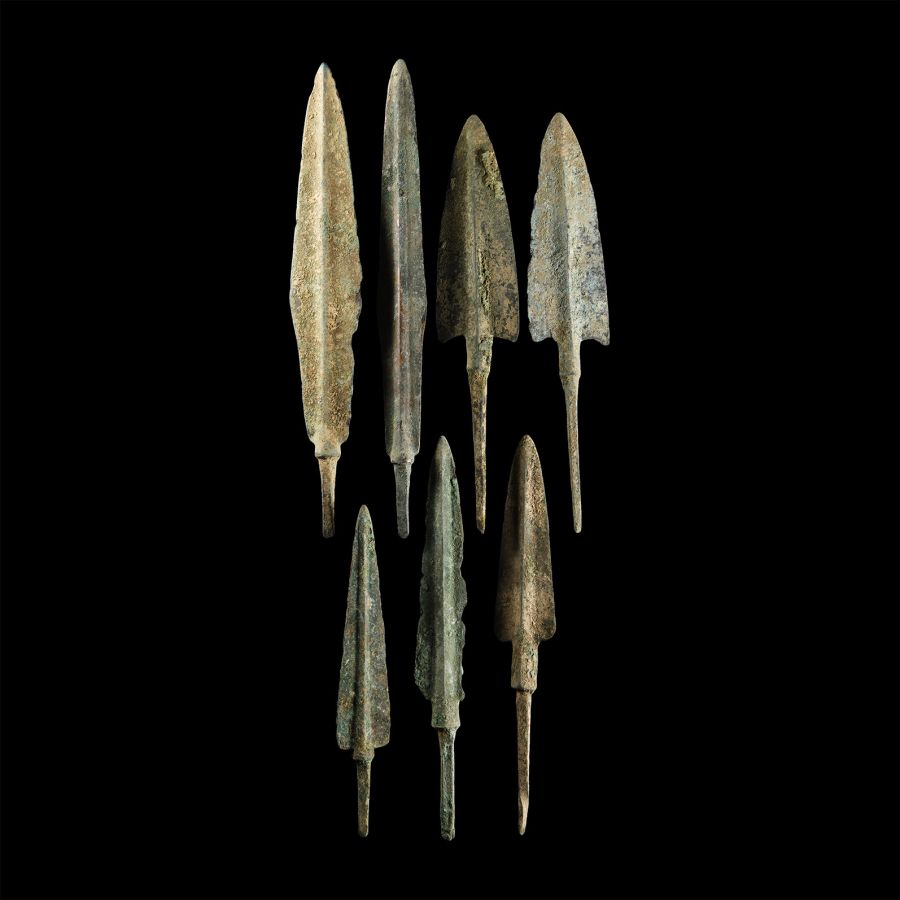
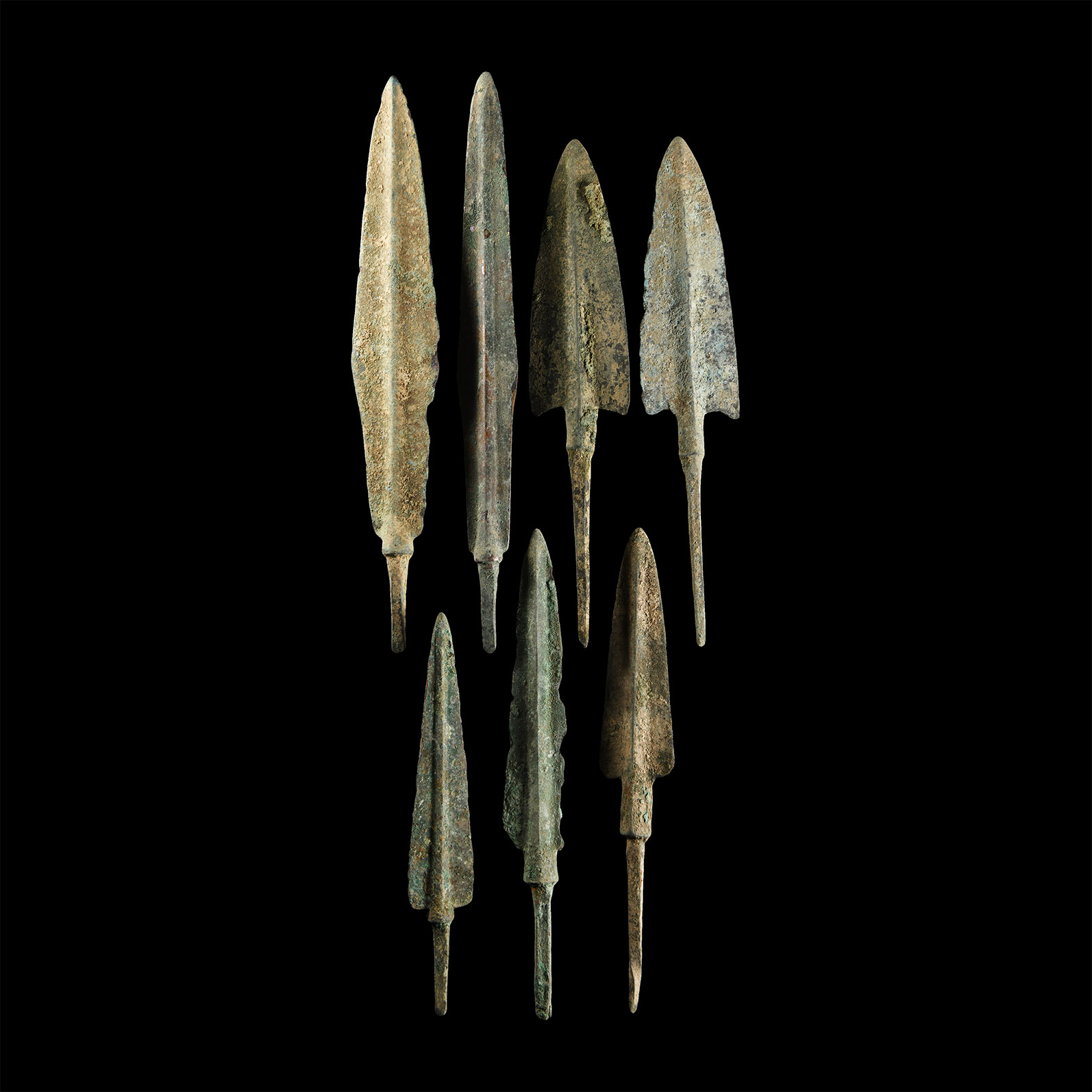
Luristan Bronze Arrowhead Group
2ND-1ST MILLENNIUM B.C.
4 3/4 - 7 in. (257 grams total, 12-18 cm).
Comprising arrowheads of various types, mainly including leaf-shaped and barbed types, with midribs. [7]
ProvenanceAcquired 1990s.
From the collection of a late Japanese weaponry collector.
TimeLine Auctions follows a vetting process to ensure the authenticity and legality of all items, reinforcing our commitment to integrity and responsible trading. Each antiquity, antique, and coin lot undergoes thorough examination by a vetting committee of at least ten external specialists, professional trade association members, scientists, and archaeologists: Our Vetting Process
AUCTIONS:
TimeLine is a leading auction house specialising in antiquities, ancient art, collectables, natural history, coins, medals, and books. Our auctions offer museums, collectors, historians, and enthusiasts the opportunity to acquire unique and historically significant pieces.
LOT 1081
Luristan Bronze Arrowhead Group
Estimate £150 - 200€170 - 230 (for guidance only)$200 - 270 (for guidance only)
-
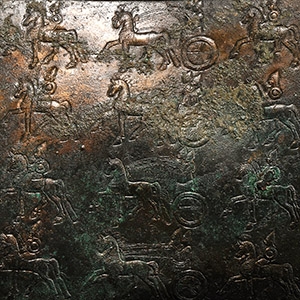
Neo-Assyrian 'Axel Guttmann' Bronze Belt Section Group
9th-7th century B.C.Sold for (Inc. bp): £2,340
Comprising two belt sections, each perforated around the edges for attachment: one with a repoussé display of alternating lions leaping towards warriors on horseback, leaping horned bulls and archers standing in horse-drawn war chariot; one fragment with articulate loop; the other folding over on itself, with repoussé display of helmetted warriors on horseback, alternating with warriors driving horse-drawn chariots; Urartian or Assyrian. 845 grams total, 30.5-35 cm
Ex Axel Guttmann collection, with reference no.AG R 244. Accompanied by an academic report by Dr Raffaele D’Amato. This lot has been checked against the Interpol Database of stolen works of art and is accompanied by search certificate number no.11760-203204. -
.jpg)
WWII 'RAF' Bomber (Mosquito) Helmet, Map and Whistle Group
1941 A.D. or laterSold for (Inc. bp): £1,170
Comprising: a type C leather open face helmet wired for type B communication, oxygen mask with hose and alloy-framed flying goggles with padded leather and rubber band, the frames stamped 'Stadium Made in England Patent Reg Design'; the helmet with webbing chin strap, buckles and stud fasteners, chamois leather lining bearing ink stamp and handwritten 'Adams Progressive' 'No.75-78', plug holder with paper label, tubular oxygen mask inlet marked 'MLD 18' 'MC253D', microphone plug and hose with brass connector stamped 'D/156'; together with an RAF flight map and an RAF 'ditching' whistle of classic snail type with Air Ministry's crown markings and reference numbers '23/230' and '293/14/L1795'; the helmet mounted on a wooden 'mannequin' head. 6.1 kg, 31 cm
Acquired from J C Militaria and Historic Flying Clothing Company. The Kusmirek Collection, UK. Accompanied by copies of listings for each item.
This type of helmet and system was introduced in 1941 A.D. -
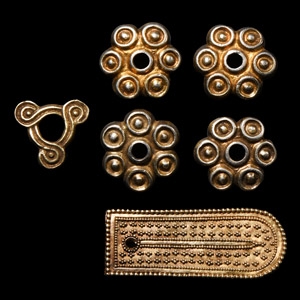
Avar-Byzantine Silver-Gilt Sword Belt Mount Group
7th century A.D.Estimate: £200 - 300 (+bp*)
Opening Bid: £80
Comprising six mounts: four 'floral' plates composed of six raised pellet-in-ring motifs arranged around a central hole, some mounting lugs remaining to the reverses; an openwork knotwork type with three mounting lugs to reverse; a hollow-formed rectangular plate with one rounded end, granulated borders framing granulated clusters arranged in orderly rows around a central arm and piercing; granulated border to reverse. 25.1 grams total, 18-48 mm
Fine condition.
Acquired in the 1980s-1990s. Ex an important central London gallery, London W1.
This type of belt element decorated with granulation, is present in the Avar graves of the second half of the 7th century, and was most likely produced in the workshops of the Eastern Roman Empire, from where they reached the Avar lands as imperial gifts (tomb of Kunbàboni) or spoils of war. They were part of multiple belts, to which sabers and knives were attached, commonly used among Avars, Bulgars and Romans during the 7th and 8th centuries AD.
