
Loading, please wait...
LOT 1119
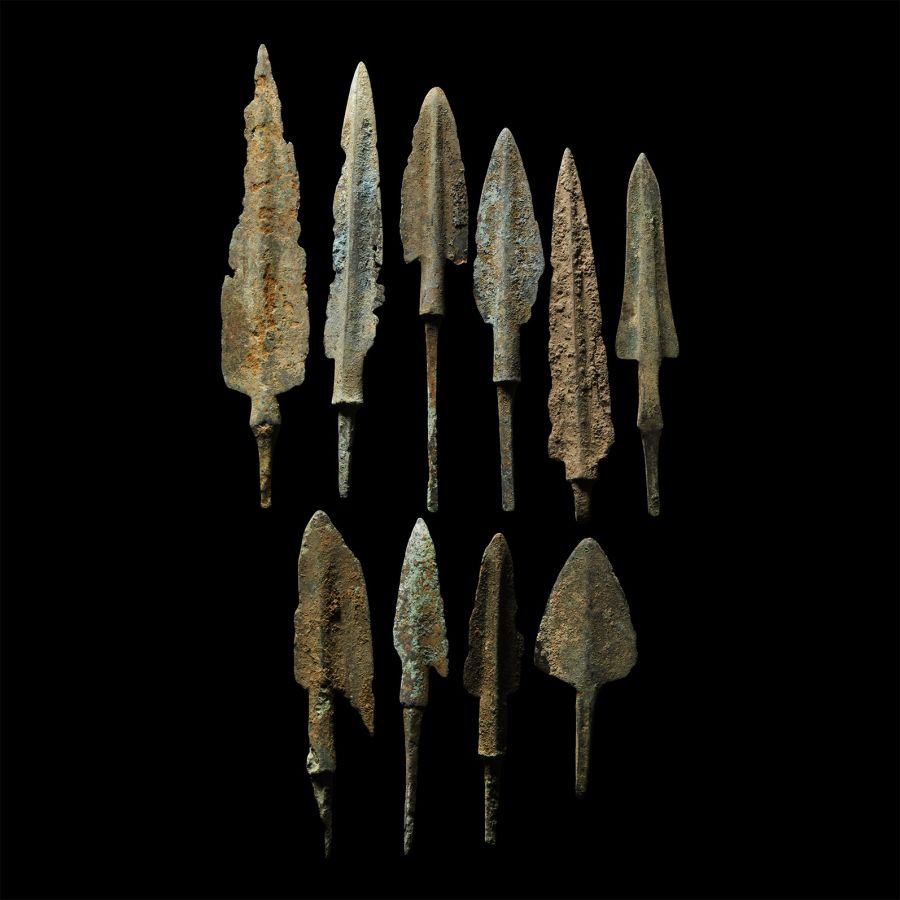
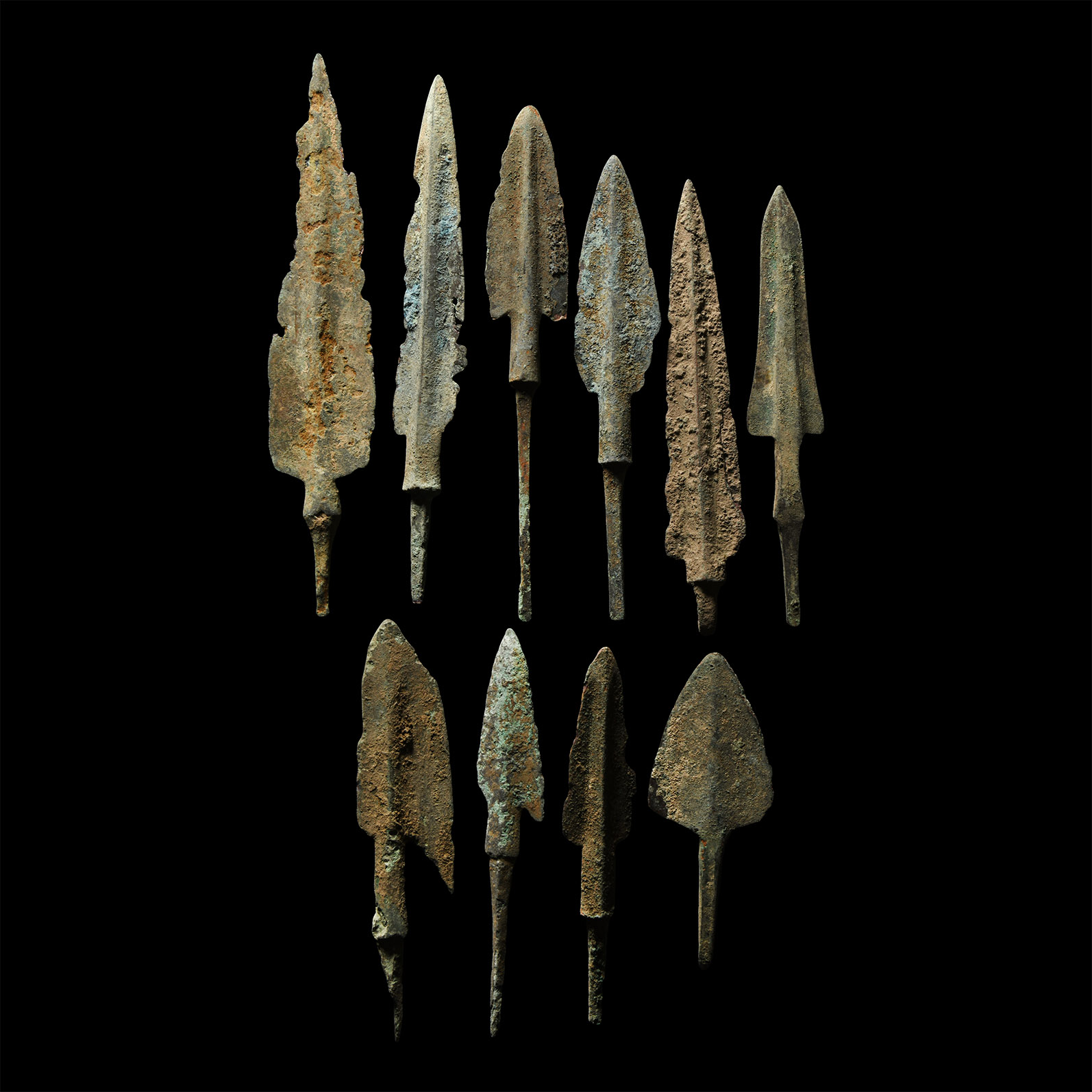
Luristan Bronze Arrowhead Group
2ND-1ST MILLENNIUM B.C.
3 - 5 in. (220 grams total, 7.5-12.5 cm).
Mainly composed of tanged examples of barbed and leaf-shaped types. [10]
ProvenanceAcquired 1990s.
From the collection of a late Japanese weaponry collector.
TimeLine Auctions follows a vetting process to ensure the authenticity and legality of all items, reinforcing our commitment to integrity and responsible trading. Each antiquity, antique, and coin lot undergoes thorough examination by a vetting committee of at least ten external specialists, professional trade association members, scientists, and archaeologists: Our Vetting Process
AUCTIONS:
TimeLine is a leading auction house specialising in antiquities, ancient art, collectables, natural history, coins, medals, and books. Our auctions offer museums, collectors, historians, and enthusiasts the opportunity to acquire unique and historically significant pieces.
LOT 1119
Luristan Bronze Arrowhead Group
Estimate £150 - 200€170 - 230 (for guidance only)$200 - 270 (for guidance only)
-
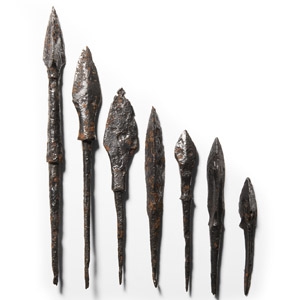
Medieval Iron Arrowhead Group
13th-15th century A.D.Sold for (Inc. bp): £182
Comprising tanged arrowheads of various types. 59 grams total, 5-11.6 cm
Acquired before 1972. The Kusmirek Collection, UK.
The projectiles belong to the type 1 of the A. Michalak classification. In Western Europe, especially from the 13th century onwards, arrows were made in various forms including: simple cone-shaped heads, rhomboid heads, hooked heads, heads with various curved barbs, willow-shaped heads, triangular and flat-bladed heads, crescent-shaped heads and sometimes as petal-shaped and battering heads. -
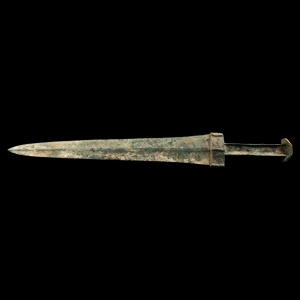
Luristan Bronze Dagger
2nd-1st millennium B.C.Estimate: £300 - 400 (+bp*)
Opening Bid: £160
Comprising a narrow double-edged blade, triangular in profile with raised midrib, rectangular guard with flanges, rectangular grip with lateral flanges to accept an organic grip, curved integral finial. 312 grams, 43 cm
Ex German collection, Cologne, 1980-1990s.
This weapon is typical of the cemeteries dating to the local Late Bronze Age (1300-1000 B.C.). The blade is still triangular but the crescentic pommel is reduced and flanged to be filled with organic material such as bone or wood. -
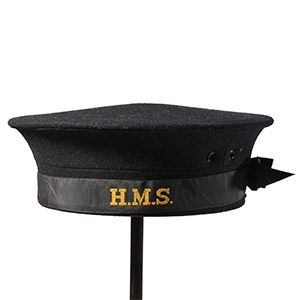
Royal Navy Rating's Cap
Dated 1942 A.D.Sold for (Inc. bp): £20
Standard British naval issue dark blue rating's cap with Toronto maker's ink stamp and date inside, fitted with black fabric 'H.M.S.' ribbon and chin-strap. 196 grams, 25 cm
Acquired from The Historic Flying Clothing Company, 2014. The Kusmirek Collection, UK. Accompanied by a copy of a previous invoice.
