Loading, please wait...
Details
LOT 1153
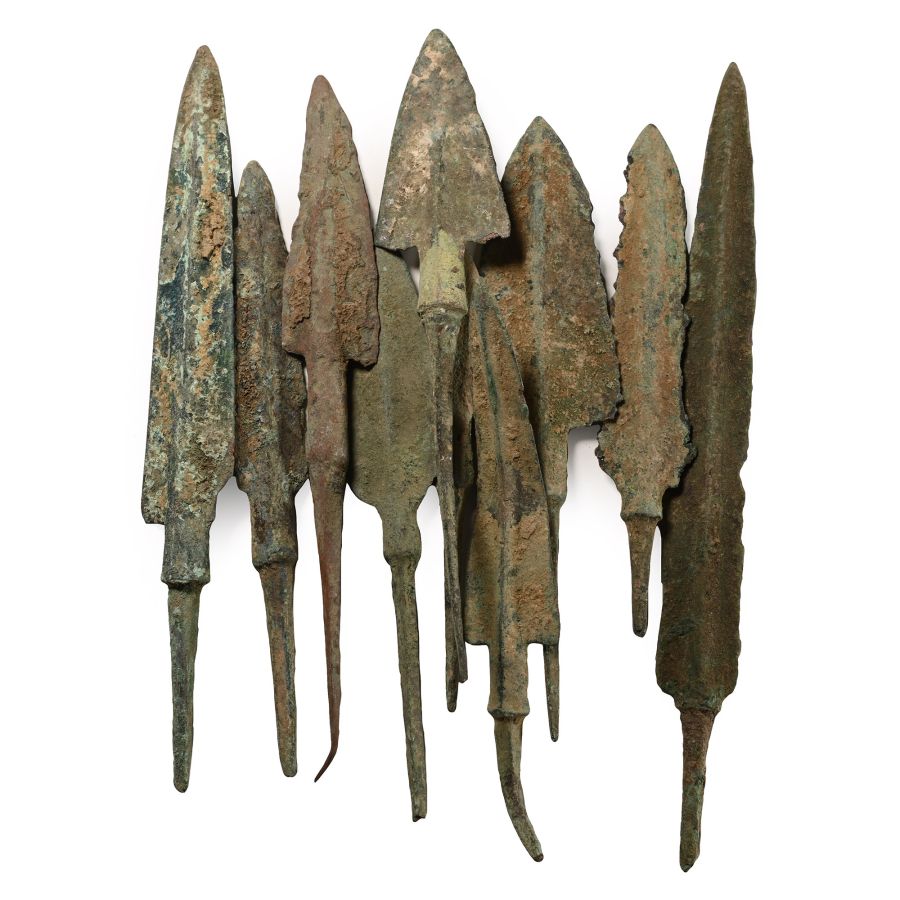
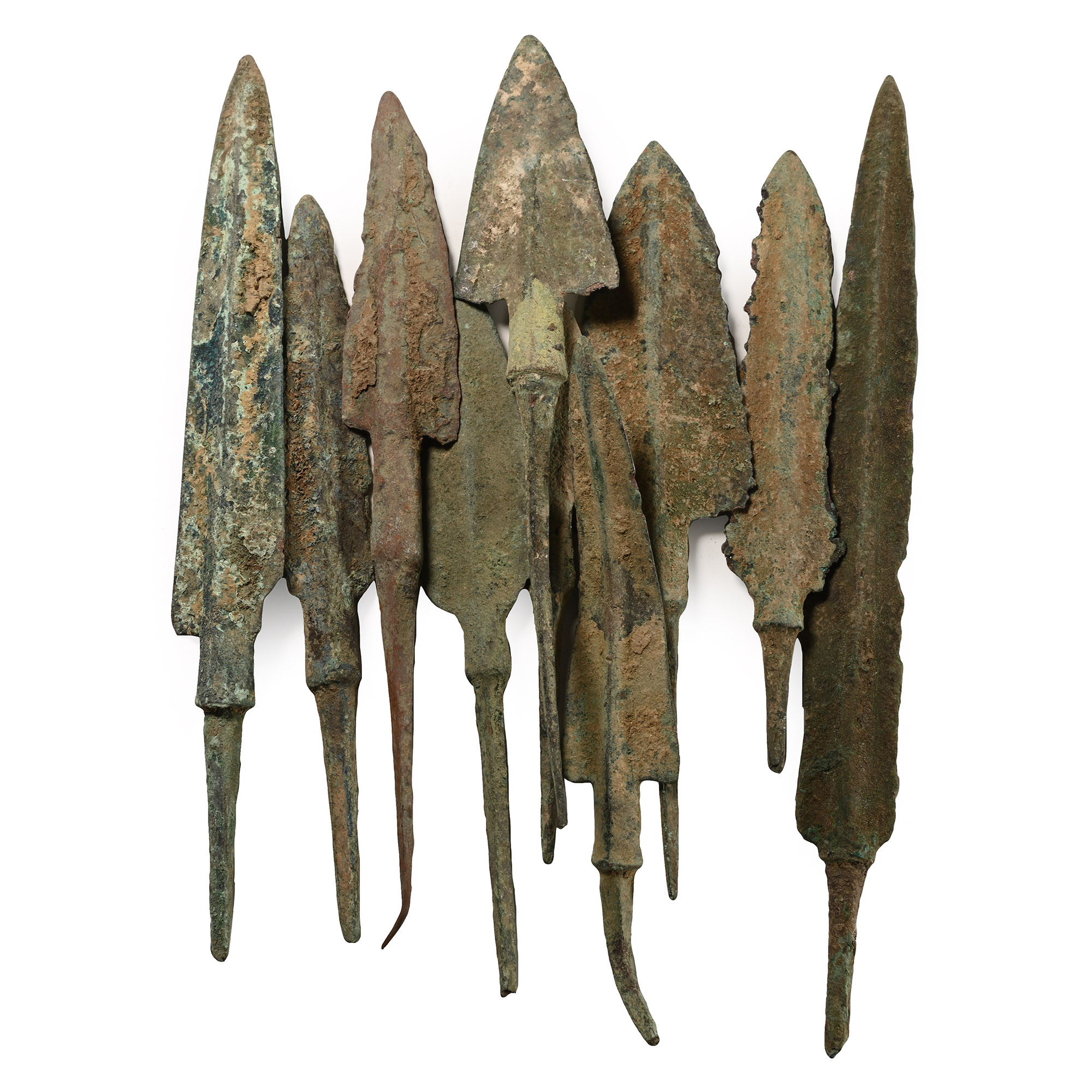
Luristan Bronze Arrowhead Collection
13TH-9TH CENTURY B.C.
3 3/4 - 6 1/4 in. (225 grams total, 94 - 158 mm).
Comprising large triangular and leaf-shaped types with one barbed example. [10]
Provenance
Ex London art market, 1980-1990s.
This lot has been cleared against the Art Loss Register database, and is accompanied by an illustrated lot declaration signed by the Head of the Antiquities Department, Dr Raffaele D'Amato.
Literature
See Khorasani, M.M., Arms and Armour from Iran. The Bronze Age to the End of the Qajar Period, Tübingen, 2006, figures 463 and 467, for the barbed and triangular types.
Footnotes
One series of arrowheads seem to belong to the category of lanceolate head and rounded shoulders from the category Type V, i.e. triangular arrowheads with rounded or angular midrib. Some other arrowheads seem to be a subcategory of subtype A of Khorasani but longer.
CONDITIONVETTING:
TimeLine Auctions follows a vetting process to ensure the authenticity and legality of all items, reinforcing our commitment to integrity and responsible trading. Each antiquity, antique, and coin lot undergoes thorough examination by a vetting committee of at least ten external specialists, professional trade association members, scientists, and archaeologists: Our Vetting Process
AUCTIONS:
TimeLine is a leading auction house specialising in antiquities, ancient art, collectables, natural history, coins, medals, and books. Our auctions offer museums, collectors, historians, and enthusiasts the opportunity to acquire unique and historically significant pieces.
RELATED LOTS
-
Western Asiatic Stone Bowl with Birds
3rd millennium B.C.Estimate: £3,000 - 4,000 (‡+bp*)
Opening Bid: £1,600
Hemispherical in profile with narrow rim, frieze of perching birds in relief, each with a pellet eye, stub beak, large comma-shaped hatched wing and leg held horizontally beneath the body; rim chipped. 273 grams, 11.2 cm
with Holy Lands House, Israel, 1960s. Private collection, 2005. This lot has been checked against the Interpol Database of stolen works of art and is accompanied by a search certificate no.12595-232195.
The chlorite stone vessels of early Bactria were kidney-shaped vessels with simple geometric decoration or, like our specimen, semi-circular. Small cylindrical vases were used as cosmetic containers, together with chlorite cosmetic flasks. -
Neo-Babylonian Chalcedony Stamp Seal with King
Circa 7th-6th century B.C. or laterSold for (Inc. bp): £650
Tongue-shaped in profile with incuse image of a worshipping king before an altar, crescent above. 11.61 grams, 26 mm
From a collection of a Devonshire, UK, gentleman established from the mid 1990s. -
North-Syrian Green Stone Cylinder Seal with Standing Human-Like Figures
Circa 2800-2400 B.C.Sold for (Inc. bp): £598
With two standing figures; accompanied by a museum quality impression and a copy of an old scholarly note, typed and signed by W.G. Lambert, late Professor of Assyriology, University of Birmingham, 1970-1993, which states:Cylinder Seal of Dark Green Stone 55 x 22 mm. The engraved are divides into two main parts. In the major part two standing human-like figures are shown with one hand joining that of the other figure and the other held at the waist as if ready for action. Between them is a small similar figure with arms outstretched. Above are two concentric circles, and sundry shapes and linear motifs fill spaces. The minor part shows two pairs of horned animals tête bêche to eath(sic) other pair. The bottom two, with rising horns, face each other; the top two (one a stag, the other with different horns) are in a line. A snake and various shapes fill the spaces. Upper and lower rules enclose the design. This is a North-Syrian or Anatolian seal, c. 2800-2400 B.C. It is exceptionally large, in very good condition, and outstanding in every way.' 47 grams, 55 mm
with Sotheby's Antiquities, London, 10-11 December 1992, no.74. Accompanied by a copy of a scholarly note, typed and signed by Professor Wilfrid George Lambert in 1992.
Seals were the working signatures of the ancient Near East. Pressed or rolled into wet clay, they secured jars, bags, doors and tablets, and left a distinct impression that identified the owner, authorised a transaction, and showed whether a container had been opened. Stamp seals (pressed once to leave a single emblem) appear from the 7th–4th millennia BC and continue throughout later periods; cylinder seals (rolled to create a repeating frieze) developed in Mesopotamia in the late 4th millennium BC and are used into the 1st millennium BC. Beyond administration, seals were miniature artworks and amulets. Their images—gods and worshippers, royal hunts, banquets, heroes and mythic beasts—broadcast rank, piety and profession, and were believed to protect the owner. Materials range from soft stones to hard chalcedonies, haematite and lapis, worked with drills and abrasives to achieve crisp intaglio cutting. Many were worn on cords or rings and followed their owners through life, sometimes into the grave. Seals matter because they underpin the earliest systems of record-keeping and trade. Impressions on tablets and bullae are primary documents for ancient law, economy and religion; the seals themselves preserve that imagery in the round. For collectors, well-cut examples with sharp impressions, good polish and honest ancient wear are especially desirable, and pieces with early collection histories are keenly sought.