
Loading, please wait...
LOT 1517
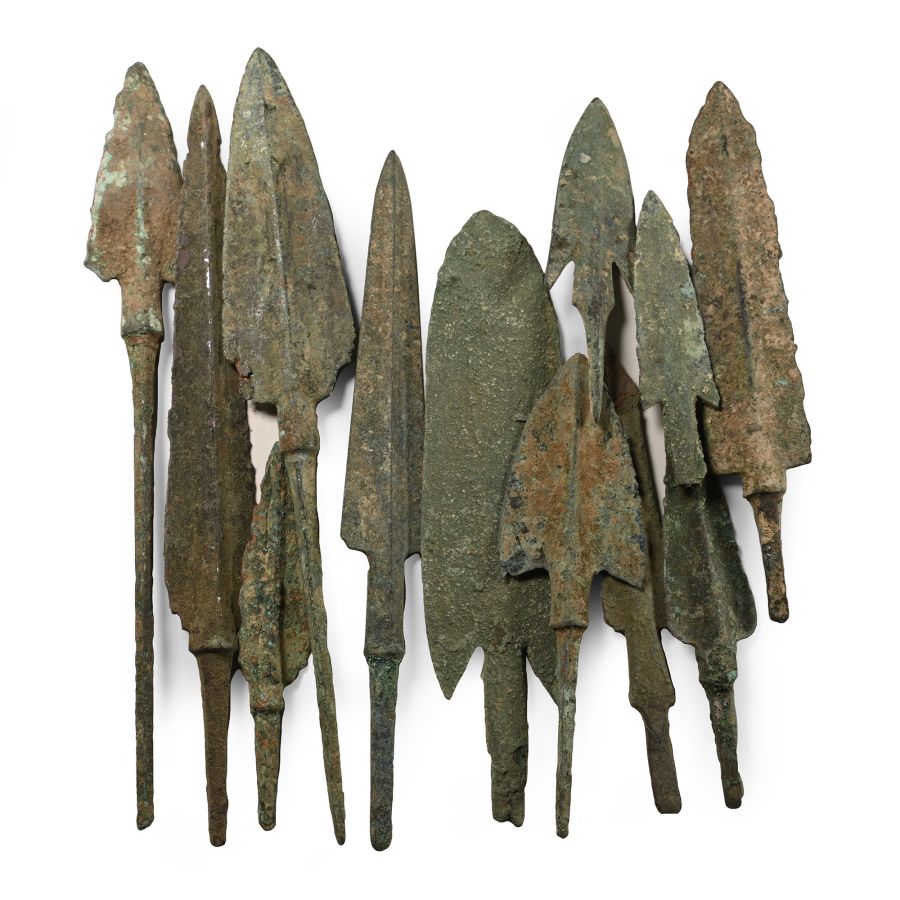
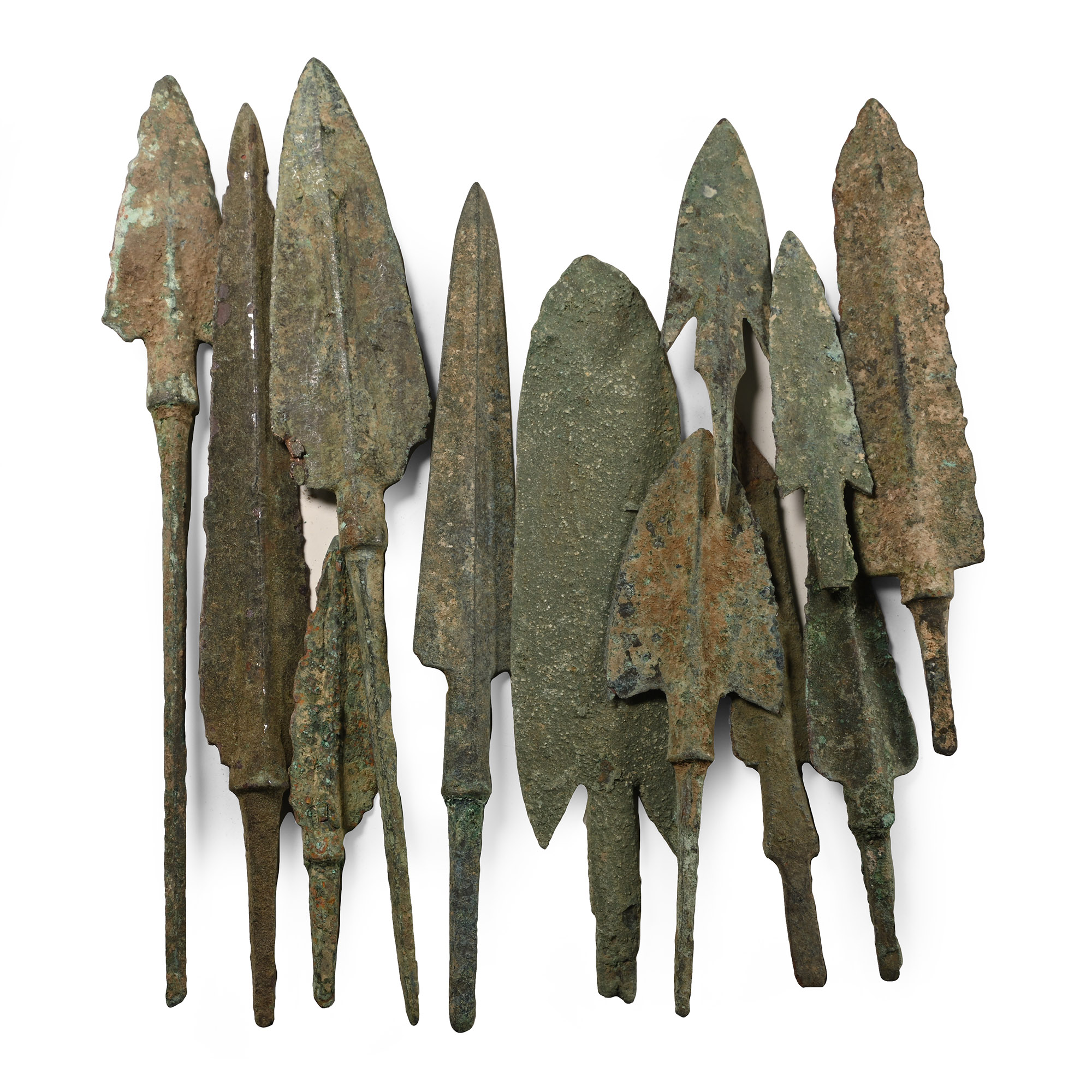
Luristan Bronze Arrowhead Collection
14TH-10TH CENTURY B.C.
2 1/2 - 6 5/8 in. (288 grams total, 6.4-16.9 cm).
A group of large tanged arrowheads, mainly of triangular type with some barbed examples. [12]
ProvenanceEx London art market, 1980-1990s.
This lot is accompanied by an illustrated lot declaration signed by the Head of the Antiquities Department, Dr Raffaele D'Amato.
See Muscarella, O.W., Bronze and Iron Ancient Near Eastern Artifacts in the Metropolitan Museum of Art, New York, 1988, pp.289ff, for similar arrowheads.
FootnotesAlthough some of them are different in shape, these arrowheads are apparently related types of a polythetic group. Two basic deltoid forms are represented: one has a sharp, flat blade, the ends of which extend to form wings or barbs, and a prominent midrib extending into a long tang that often has a stop; the blade shape varies from deltoid to more triangular. The other form has no barbs, but it has a prominent midrib extending to the tang, and a narrow leaf-shaped blade.
CONDITIONTimeLine Auctions follows a vetting process to ensure the authenticity and legality of all items, reinforcing our commitment to integrity and responsible trading. Each antiquity, antique, and coin lot undergoes thorough examination by a vetting committee of at least ten external specialists, professional trade association members, scientists, and archaeologists: Our Vetting Process
AUCTIONS:
TimeLine is a leading auction house specialising in antiquities, ancient art, collectables, natural history, coins, medals, and books. Our auctions offer museums, collectors, historians, and enthusiasts the opportunity to acquire unique and historically significant pieces.
-
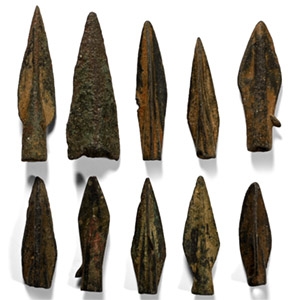
Greek Period High Quality Large Bronze Arrowhead Collection
5th-3rd century B.C.Sold for (Inc. bp): £65
Mostly long leaf-shaped types with short socket. 50 grams total, 30-45 mm
From an English collection formed before 2000. This lot is accompanied by an illustrated lot declaration signed by the Head of the Antiquities Department, Dr Raffaele D'Amato. -
.jpg)
Viking Iron Sword with Bronze Hilt of Petersen Type L
11th-13th century A.D.Sold for (Inc. bp): £6,240
A 'Curonian' sword comprising a straight blade with a narrow and long tang, showing signs of employment on the edges; boat-shaped bronze cross guard with Jellinge style decoration of circles and crosses; rivetted seven-lobed pommel with an upper guard showing similar ornament. 689 grams, 81.5 cm
Private collection formed in Europe in the 1980s. Westminster collection, central London, UK. This lot has been checked against the Interpol Database of stolen works of art and is accompanied by search certificate number no.12618-235588. This lot has been cleared against the Art Loss Register database, and is accompanied by an illustrated lot declaration signed by the Head of the Antiquities Department, Dr Raffaele D'Amato.
The sword, with its seven-lobed pommel and its guards finds good parallels with Baltic swords used by Prussian, Curonians, Estonian and Lithuanian pagan warriors; clear parallels can be seen in Kazakevičius 1996, figs.62-63 (fig.2) and Tomsons, 2012, fig.2 (Fig.3),3,7. The Curonian swords of this type, sometimes with animal head decoration on the lower guard, were widespread and used in the Eastern Baltic lands from 10th to 13th century. -
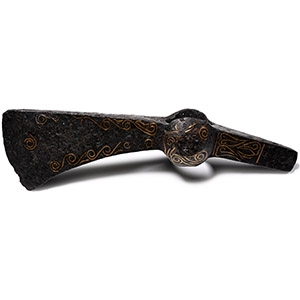
Eastern Viking Period Laten Inlaid Iron Axehead
9th century A.D.Sold for (Inc. bp): £5,200
With narrow straight blade, shank to the rear with square hammer-face, inlaid geometric and vegetal ornaments. 275 grams, 17.7 cm
Private collection formed in Europe in the 1980s. Westminster collection, central London, UK. This lot has been cleared against the Art Loss Register database, and is accompanied by an illustrated lot declaration signed by the Head of the Antiquities Department, Dr Raffaele D'Amato.
Battle-axes came into use in Scandinavia, especially in the Eastern parts of Sweden, Gotland and Denmark. Among the types, there were narrow-bladed types described to be very light in the sources. They could weigh as little as 200-250 grams, making them suitable for single-handed use. Some of them were decorated according to the Slavic taste.
