
Loading, please wait...

LOT 1437
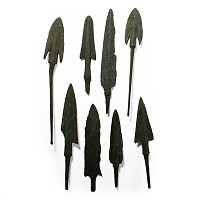
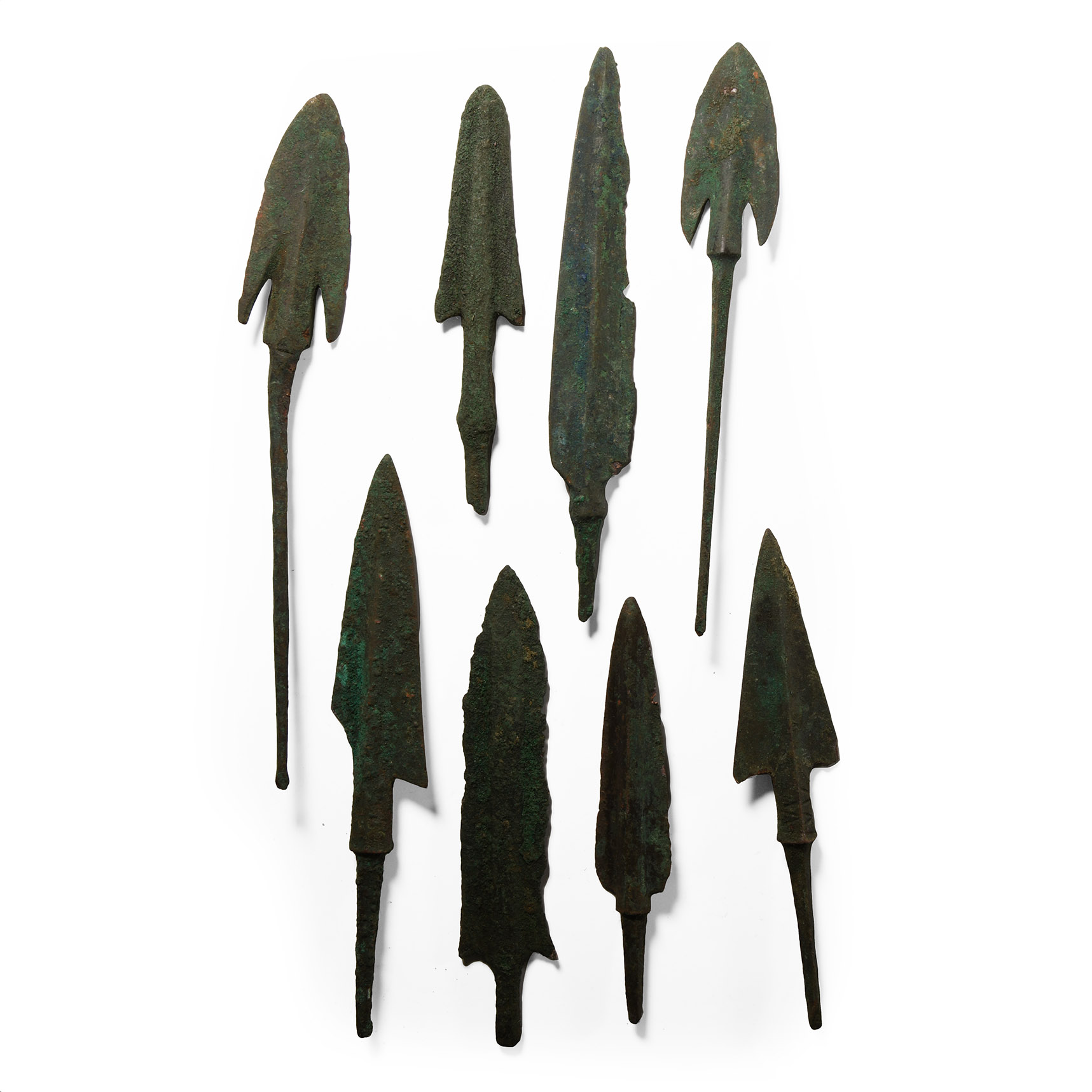
Luristan Bronze Arrowhead Collection
14TH-10TH CENTURY B.C.
4 - 6 3/8 in. (212 grams total, 10.1-16.2 cm).
Two with a sturdy square-section tang, narrow barbed head with midrib; the others with triangular or foliate blades; each with a raised midrib and a short tang. [8]
ProvenanceEx London collection, formed 1990-2000.
LiteratureSee Muscarella, O.W., Bronze and Iron Ancient Near Eastern Artifacts in the Metropolitan Museum of Art, New York, 1988, pp.289ff, for similar arrowheads.
FootnotesAlthough some of them are different in shape, these arrowheads are apparently related types of a polythetic group. Two basic deltoid forms are represented: one has a sharp, flat blade, the ends of which extend to form wings or barbs, and a prominent midrib extending into a long tang that often has a stop; the blade shape varies from deltoid to more manifestly triangular. The other form has no barbs, but it has a prominent midrib extending to the tang, and a narrow leaf-shaped blade.
CONDITIONTimeLine Auctions follows a vetting process to ensure the authenticity and legality of all items, reinforcing our commitment to integrity and responsible trading. Each antiquity, antique, and coin lot undergoes thorough examination by a vetting committee of at least ten external specialists, professional trade association members, scientists, and archaeologists: Our Vetting Process
AUCTIONS:
TimeLine is a leading auction house specialising in antiquities, ancient art, collectables, natural history, coins, medals, and books. Our auctions offer museums, collectors, historians, and enthusiasts the opportunity to acquire unique and historically significant pieces.
-
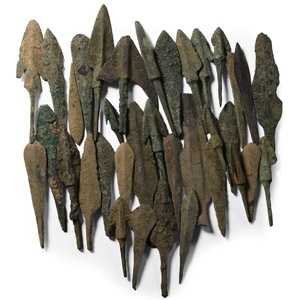
Luristan Bronze Arrowhead Collection
Circa 14th-10th century B.C.Sold for (Inc. bp): £234
Including triangular, leaf-shaped, barbed and other types. 324 grams total, 37-92 mm
Ex London, UK, collection, 1990s.
The arrowhead of type IV according to Khorasani classification (arrowheads with jet like wings) is very interesting and rare. Similar arrowheads, often found in the Marlik excavations, looked like a stylised flying bird, such as a swallow. They have rounded terminals of the stretched-out wings. The rib on the blade thickens towards the point. -
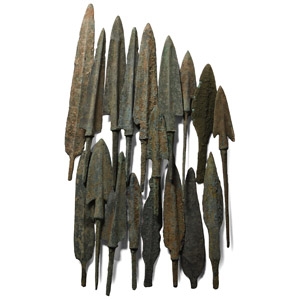
Luristan Bronze Arrowhead Collection
Circa 13th-9th century B.C.Sold for (Inc. bp): £312
Including triangular, leaf-shaped, barbed and other types. 446 grams total, 10-16.5 cm
Ex London, UK, collection, 1990s.
One series of arrowheads seem to belong to the category of lanceolate head and rounded shoulders from the category Type V, i.e. triangular arrowheads with rounded or angular midrib. Some other arrowheads seem to be a subcategory of subtype A of Khorasani but longer. -
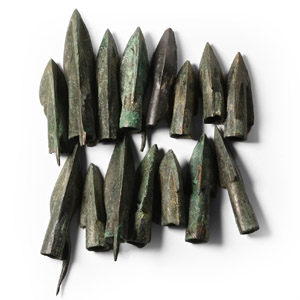
Greek Bronze Tri-Finned Arrowhead Collection
Circa 7th-3rd century B.C.Sold for (Inc. bp): £195
Comprising: seven arrowheads with a slender, lozenge-shaped blade and a socket extending near the tip, base of the socket with a side lug; eight socketted bronze arrowheads, mainly triangular or foliate in section, trilobate and with short socket. 77 grams total, 23-46 mm
UK private collection before 2000. Acquired on the UK art market. Property of a London gentleman.
The Scythians were famous for their archery abilities, and were often employed as mercenaries. The Athenian tyrant Pisistratus hired them and they participated in battles beside the Athenian phalanx as well as serving as a police corps keeping order within the city of Athens. This explains the great range of Scythian arrowheads found on the Greek sites.
