
Loading, please wait...
LOT 0130
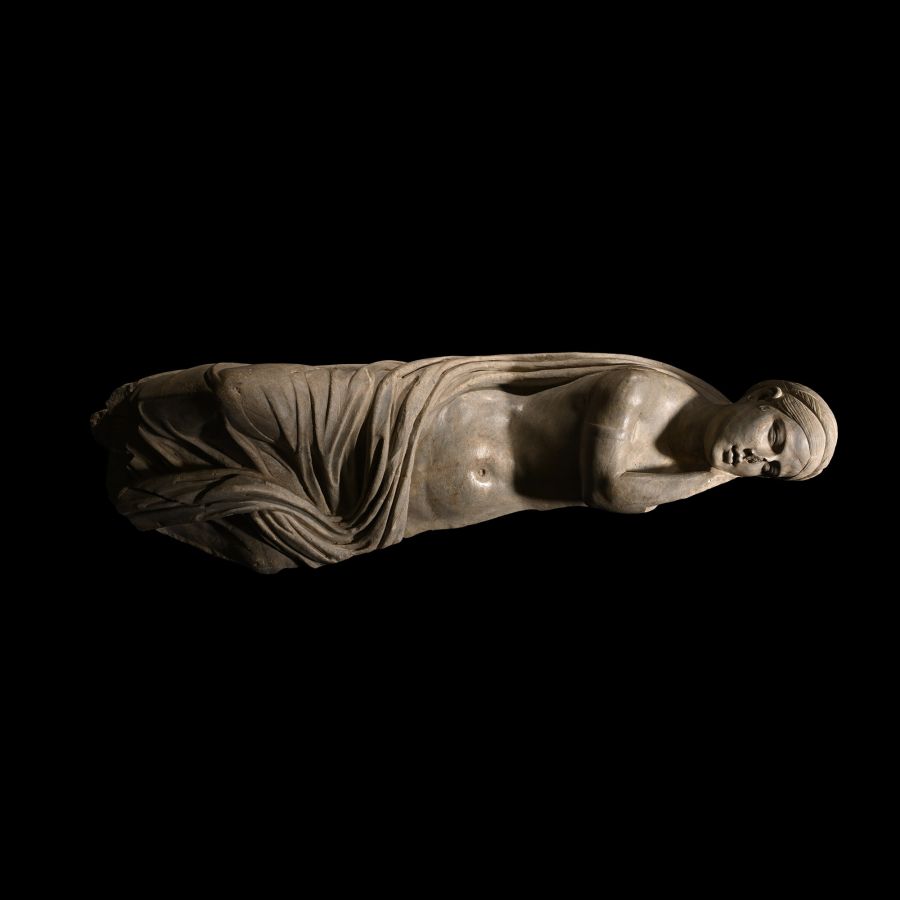
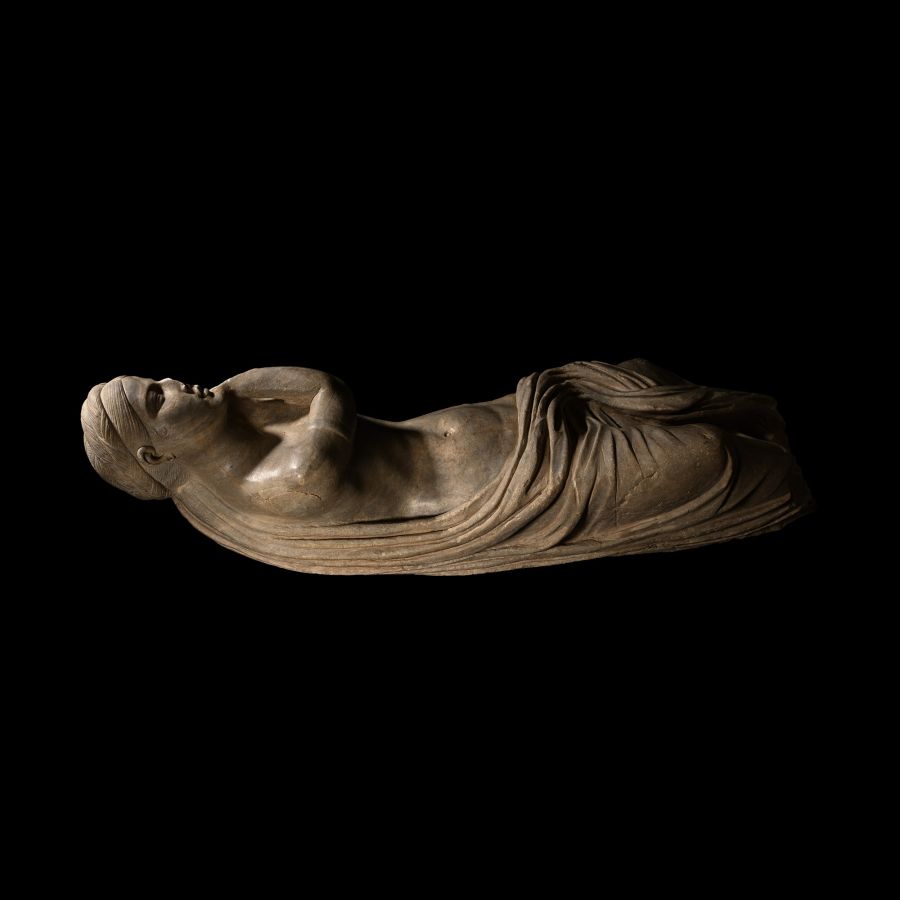
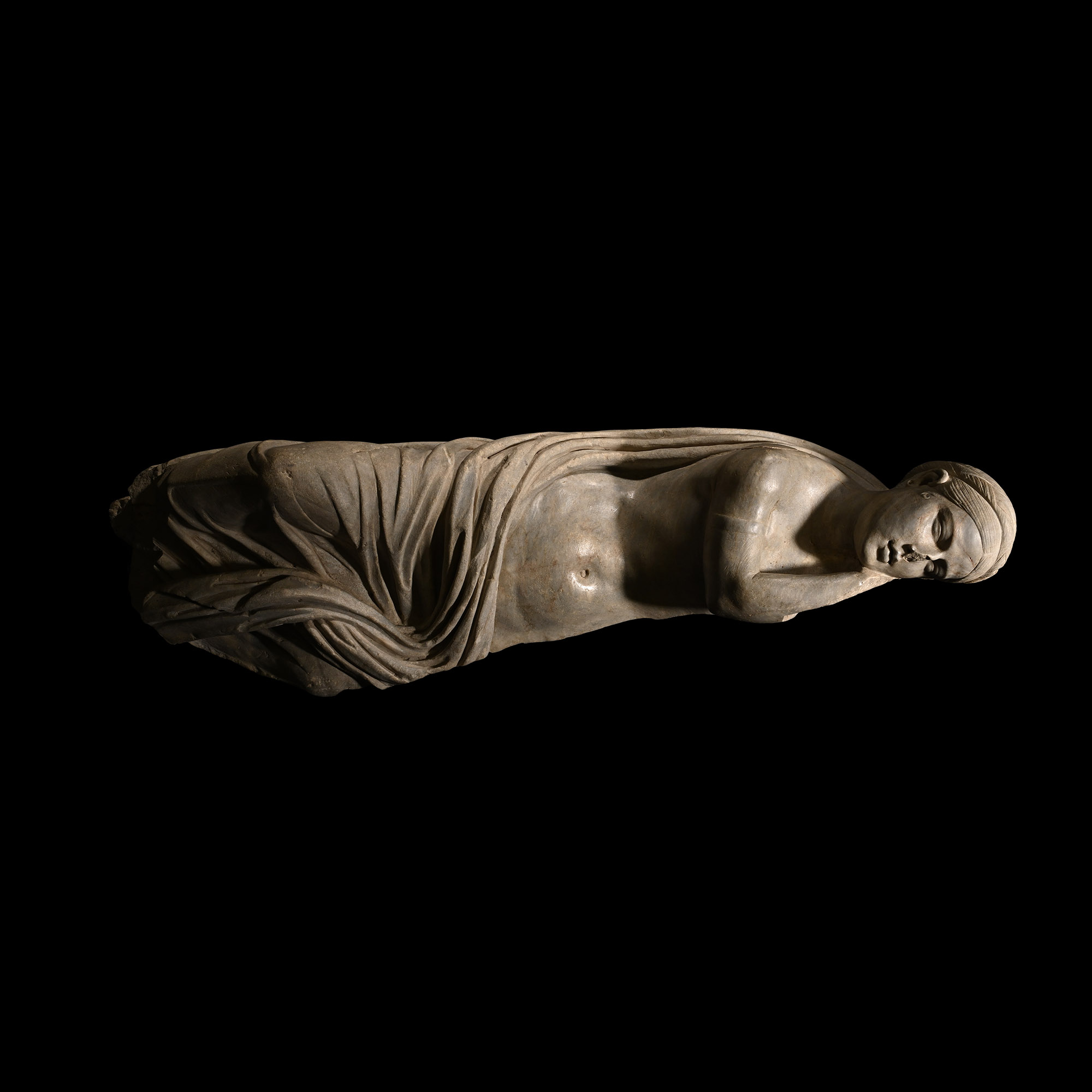
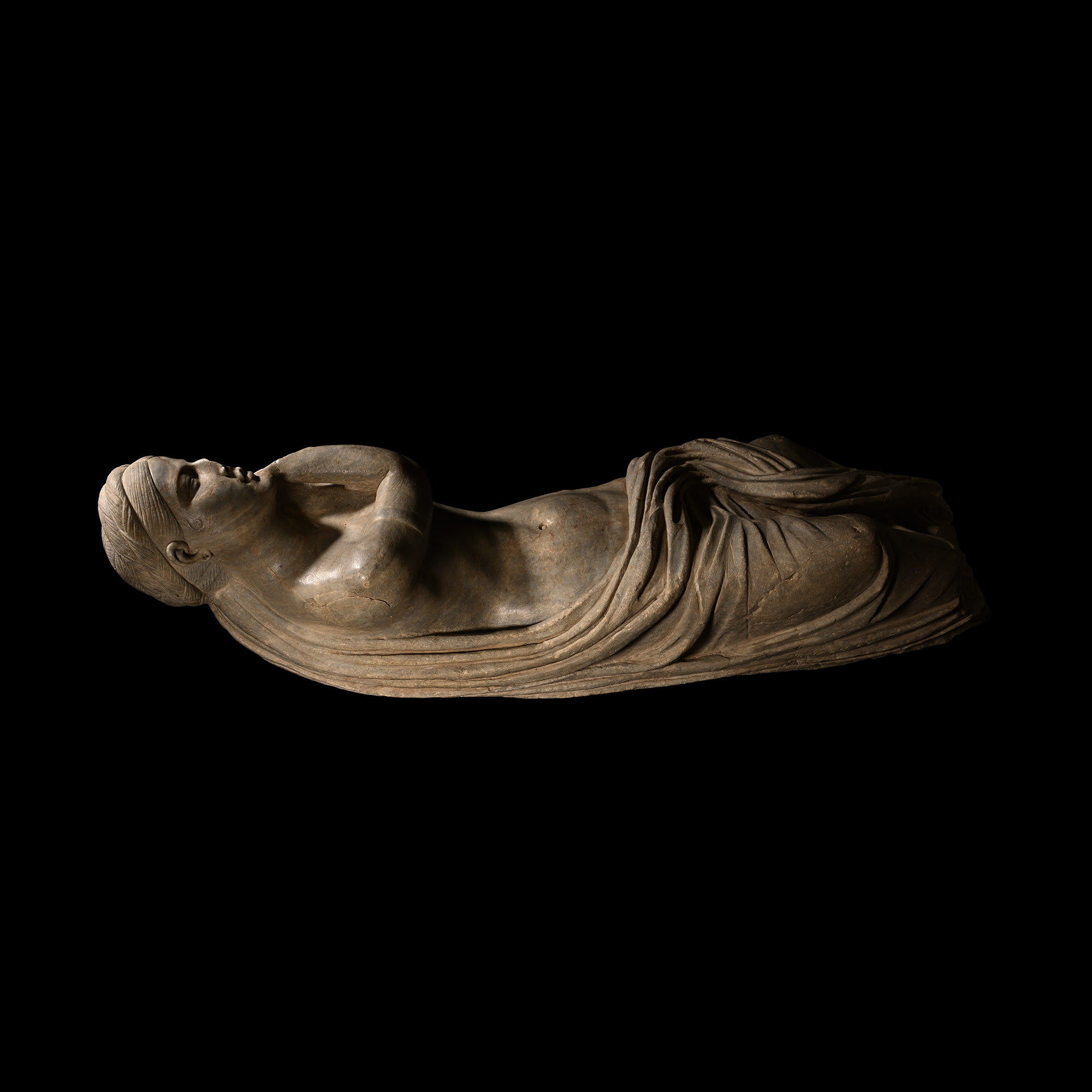
Life-Size Roman Marble Sleeping Girl from a Sarcophagus Lid
2ND CENTURY A.D.
43 1/4 in. (46 in.) (104 kg, 110 cm long (120 kg, 117 cm including stand)).
Modelled in the half-round, nude with eyelids half-closed in sleep; a drapery partly covering the head and wrapping around the lower body under the hips; the hairstyle similar to those of the Antonine Dynasty, the peaceful face supported by the hands and the ear pierced to accept an earring; iron reinforcing rod to the feet and the right arm's armilla a later replacement; upper head restored in Parian marble.
ProvenanceAcquired from G. Rihani, 1987.
English private collection.
Accompanied by a copy of the purchase invoice, 2 July 1987.
Accompanied by an academic report by Dr Raffaele D'Amato.
This lot has been checked against the Interpol Database of stolen works of art and is accompanied by search certificate number no.12231-218595
Cf. a similar statue of a sleeping girl in Galleria Borghese, Rome, inv.no.XIV, 140-160 A.D. in Moreno, P., Stefani, Ch., Galleria Borghese, Milano, 2000, p.38, n.6a.
FootnotesThe girl shows exotic features, evocative of Roman North Africa, where a mixed Romano-Berber population lived in one of the richest provinces of the Empire. However, the hairstyle refers to those of the Antonine Dynasty, such as the portraits of the Empress Faustina the Elder. It represents probably a sarcophagus lid of a young noble girl, commissioned by her loving parents. Some restorations, today still visible, were done in ancient times: an iron rod at the feet for reinforcement, the armilla on the right arm sculpted at a later stage, the hole in the ear for the insertion of a lost metal or glass earring, the upper part of the head restored in antique with a portion of Parian marble. The sculpture is a Roman work, but it was inspired by a Hellenistic model, probably from Pergamon.
CONDITIONTimeLine Auctions follows a vetting process to ensure the authenticity and legality of all items, reinforcing our commitment to integrity and responsible trading. Each antiquity, antique, and coin lot undergoes thorough examination by a vetting committee of at least ten external specialists, professional trade association members, scientists, and archaeologists: Our Vetting Process
AUCTIONS:
TimeLine is a leading auction house specialising in antiquities, ancient art, collectables, natural history, coins, medals, and books. Our auctions offer museums, collectors, historians, and enthusiasts the opportunity to acquire unique and historically significant pieces.
LOT 0130
Life-Size Roman Marble Sleeping Girl from a Sarcophagus Lid
Sold for (Inc. bp): £20,800
-
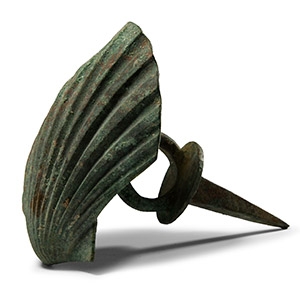
Roman Bronze Scallop Shell Chariot Mount
2nd century A.D.Estimate: £1,000 - 1,400 (+bp*)
Opening Bid: £500
Formed as a scallop shell with integral staple and spurs developing to a ring with disc above and square-section mounting spike. 351 grams, 12.7 cm
Acquired in the 1960s. Private collection, Rosenheim, Germany. Private collection, England. -
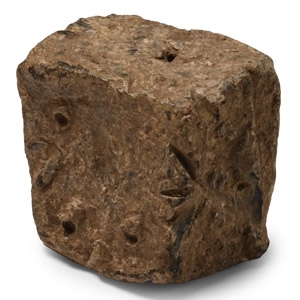
Roman 'Wiltshire' Lead Dice Gaming Piece
1st-4th century A.D.Sold for (Inc. bp): £46
Cuboid with impressed point markings disposed 1:5, 2:3, 4:6; with old collector's record card. 44.8 grams, 22 mm
Found Wiltshire, UK. From the important private collection of dice and gaming pieces of Colin Narbeth, London, UK, collection no.65. Accompanied by a Colin Narbeth catalogue identification card. -
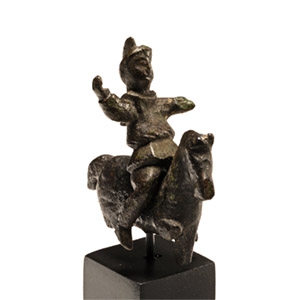
Roman Bronze Statuette of Mars on Horseback
2nd-3rd century A.D.Sold for (Inc. bp): £286
Wearing a crested helmet, cloak, bloused tunic and braccae, the god bestriding his mount with right arm raised and hand open to support a spear; mounted on a custom-made stand. 80.1 grams total, 68 mm including stand
From a collection acquired on the UK art market from various auction houses and collections mostly before 2000. From an important Cambridgeshire estate; thence by descent.
