
Loading, please wait...
_900x900.jpg "Lead Musket Ball Collection")
_200x200.jpg "Lead Musket Ball Collection")
.jpg "Lead Musket Ball Collection")
LOT 1374
Lead Musket Ball Collection
17TH-18TH CENTURY A.D.
1/2 - 3/4 in. (2.08 kg total, 12-18 mm).
Group of ninty-nine lead musket and pistol balls. [99, No Reserve]
ProvenanceUK gallery, early 2000s.
CONDITIONTimeLine Auctions follows a vetting process to ensure the authenticity and legality of all items, reinforcing our commitment to integrity and responsible trading. Each antiquity, antique, and coin lot undergoes thorough examination by a vetting committee of at least ten external specialists, professional trade association members, scientists, and archaeologists: Our Vetting Process
AUCTIONS:
TimeLine is a leading auction house specialising in antiquities, ancient art, collectables, natural history, coins, medals, and books. Our auctions offer museums, collectors, historians, and enthusiasts the opportunity to acquire unique and historically significant pieces.
-
.jpg)
Luristan Spear Tip Group
13th-6th century B.C.Sold for (Inc. bp): £234
Comprising four tips with triangular blades; each with a raised midrib and a long tang. 143 grams total, 13.5-18.2 cm
Acquired 1980-2015. Ex Abelita family collection.
Although some of them are different in shape, these arrowheads are apparently related types of a polythetic group. Two basic deltoid forms are represented: one has a sharp, flat blade, the ends of which extend to form wings or barbs, and a prominent midrib extending into a long tang that often has a stop; the blade shape varies from deltoid to more manifestly triangular. The other form has no barbs, but it has a prominent midrib extending to the tang, and a narrow leaf-shaped blade. -
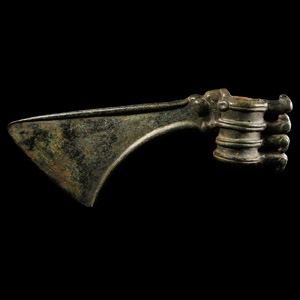
Luristan Bronze Spike-Butted Axehead
11th-8th century B.C.Estimate: £3,000 - 4,000 (‡+bp*)
Opening Bid: £1,500
Blade with folded upper and lower edge, cylindrical socket with projecting ribs formed as the necks and heads of birds, blace 'projecting' from the mouth of a roaring lion at the neck. 478 grams, 22.5 cm
Ex Parisian private collection. with Cuvreau Expertises Enchères S.A., sale 60, 21 June 2009, lot 105. This lot has been checked against the Interpol Database of stolen works of art and is accompanied by search certificate number no.11876-206787. -
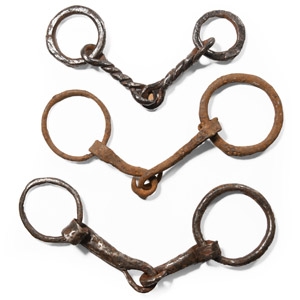
Medieval Iron Horse Bit Collection
14th-16th century A.D.Sold for (Inc. bp): £130
Snaffle bits with linked-ring joints, curb-bit ring to each end; many of these objects are published in the Detector Finds book series. 284 grams total, 17-20.5 cm
From the collection of the famous author, writer and speaker, Gordon Bailey, Essex, UK; formed since 1968.
