
Loading, please wait...
_900x900.jpg "Late Roman Rosso-Antico Thumb Pestle")
_200x200.jpg "Late Roman Rosso-Antico Thumb Pestle")
.jpg "Late Roman Rosso-Antico Thumb Pestle")
LOT 0106
Late Roman Rosso-Antico Thumb Pestle
3RD-6TH CENTURY A.D.
4 3/4 in. (312 grams, 12 cm).
Red marble pestle or grinding tool, the handle formed as a thumb with knuckle and nail detailing; old collector's label '2' to underside.
ProvenanceEx private collection, Mrs L.S., 1980s.
Acquired from the above, 1999.
Private European collection.
This lot has been checked against the Interpol Database of stolen works of art and is accompanied by a search certificate number no.12096-218201.
Mainly used by medical staff for grinding ingredients such as medicinal compounds, cosmetics and culinary spices.
CONDITIONTimeLine Auctions follows a vetting process to ensure the authenticity and legality of all items, reinforcing our commitment to integrity and responsible trading. Each antiquity, antique, and coin lot undergoes thorough examination by a vetting committee of at least ten external specialists, professional trade association members, scientists, and archaeologists: Our Vetting Process
AUCTIONS:
TimeLine is a leading auction house specialising in antiquities, ancient art, collectables, natural history, coins, medals, and books. Our auctions offer museums, collectors, historians, and enthusiasts the opportunity to acquire unique and historically significant pieces.
LOT 0106
Late Roman Rosso-Antico Thumb Pestle
Estimate £1,800 - 2,400€2,090 - 2,780 (for guidance only)$2,430 - 3,240 (for guidance only)
-
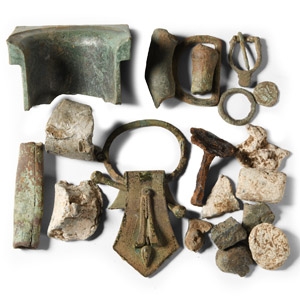
Roman and Other 'Wetwang' Artefact Collection
1st-4th century A.D. and laterSold for (Inc. bp): £5
Including lead casting blanks, buckles, the socketted base of a figurine and other items. 282 grams total, 11-48 mm
Found near Wetwang, East Yorkshire, UK. Acquired 2005. Ian Wilkinson collection, Nottinghamshire, UK. -
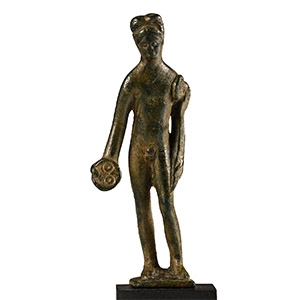
Roman Bronze Statuette of Mercury
2nd-3rd century A.D.Sold for (Inc. bp): £260
Shown standing nude with caduceus resting against the left forearm, a patera in the right hand, bunched lobes and centre-parted hairstyle; mounted on a custom-made display stand. 69 grams total, 98 mm including stand
From a collection acquired on the UK art market from various auction houses and collections mostly before 2000. From an important Cambridgeshire estate; thence by descent.
Mercury is one of the most widespread divinities among the votive statuettes of Roman Age. The god of the Roman pantheon was similar to the Greek Hermes and the Etruscan Turms. -
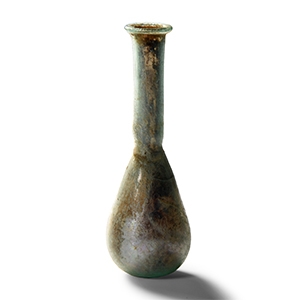
Roman Iridescent Glass Unguentarium
1st-2nd century A.D.Sold for (Inc. bp): £78
With piriform body and flat base, narrow neck and everted rim. 10.5 grams, 81 mm
Acquired 1980-2015. Ex Abelita family collection.
