
Loading, please wait...
LOT 0179
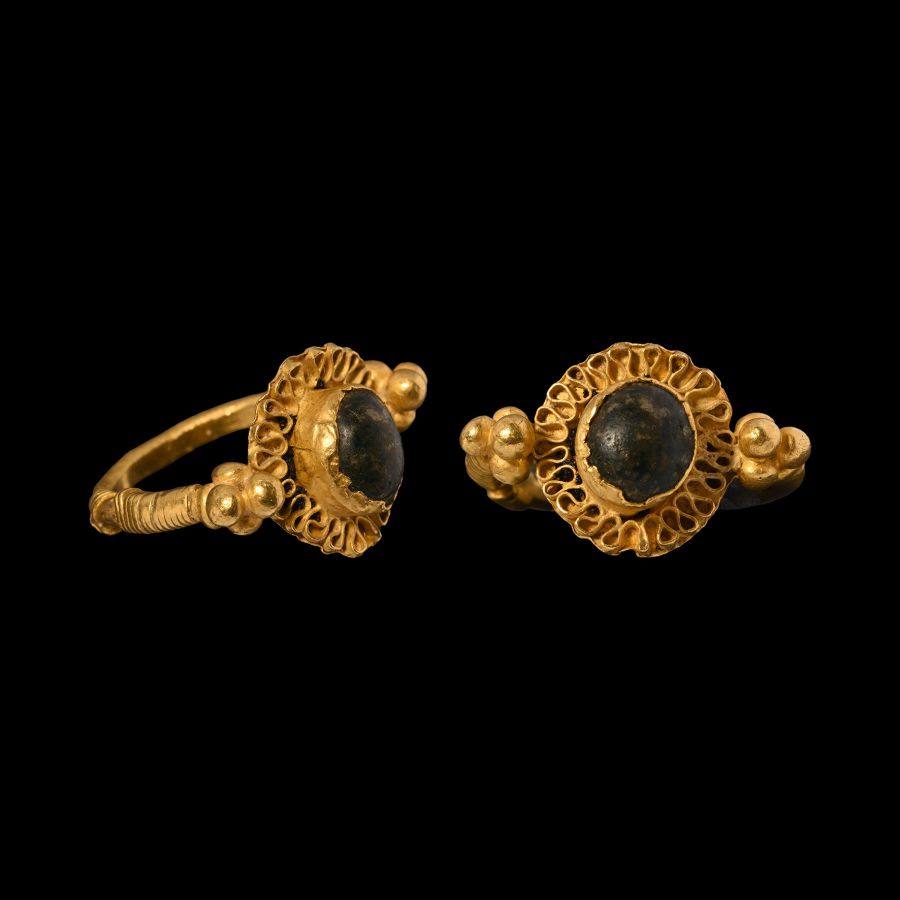
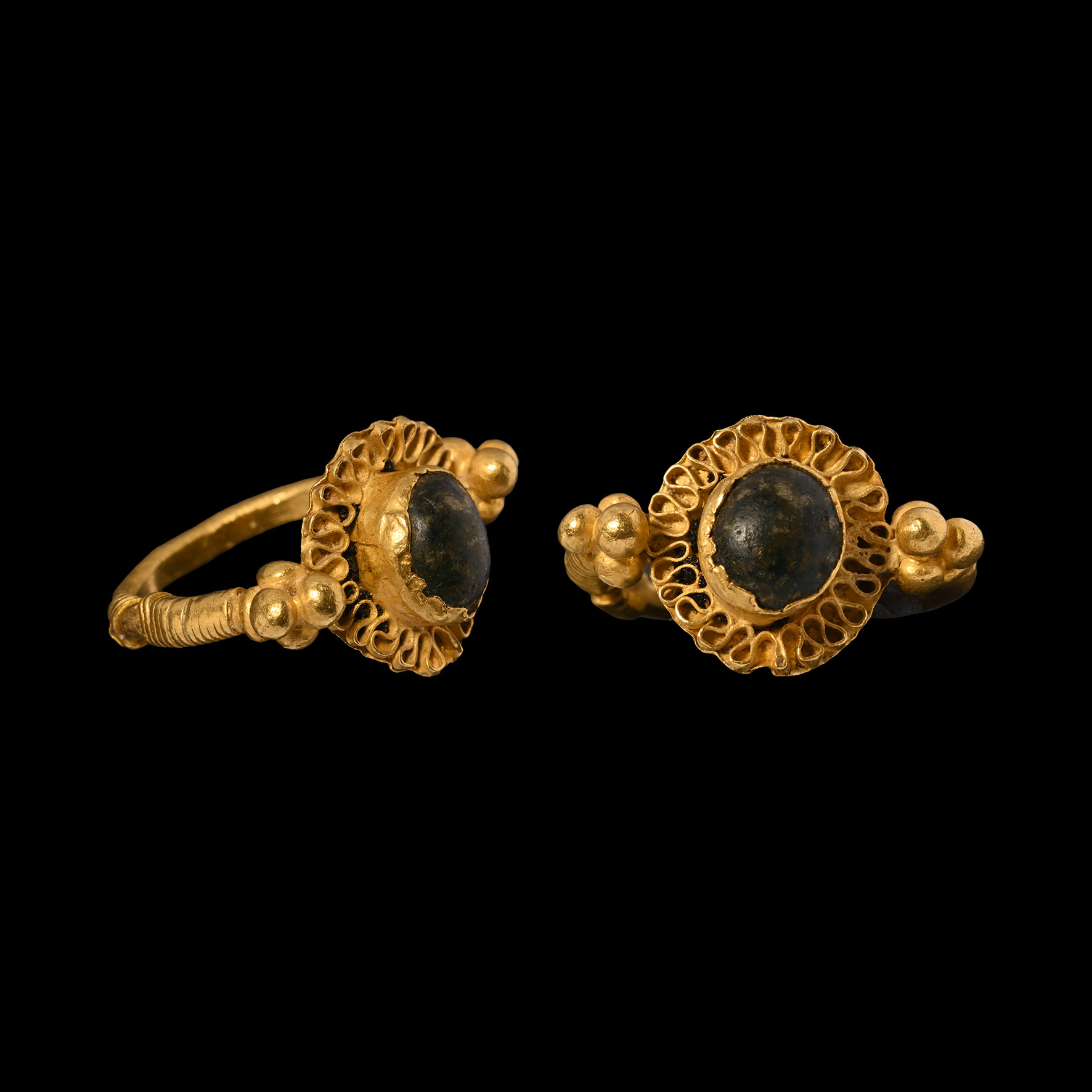
Late Roman or Merovingian Gold Ring with Rosette and Green Cabochon
5TH-7TH CENTURY A.D.
7/8 in. (5.14 grams, 22.93 mm overall, 17.05 mm internal diameter (approximate size British L 1/2, USA 6, Europe 11.87, Japan 11)).
Comprising a round-section hoop with granule pyramids to the shoulder, decorative wire wrapped around the hoop on one side; rosette-shaped applied bezel with filigree decoration, raised setting with dark green glass cabochon; possibly a marriage. [No Reserve]
ProvenancePrivate collection USA.
From the Alexander Gallery, New York, USA, in the early 2000s.
Cf. Hadjadj, R., Bagues Merovingiennes - Gaul du Nord, Paris, 2007, item 273, for similar.
CONDITIONTimeLine Auctions follows a vetting process to ensure the authenticity and legality of all items, reinforcing our commitment to integrity and responsible trading. Each antiquity, antique, and coin lot undergoes thorough examination by a vetting committee of at least ten external specialists, professional trade association members, scientists, and archaeologists: Our Vetting Process
AUCTIONS:
TimeLine is a leading auction house specialising in antiquities, ancient art, collectables, natural history, coins, medals, and books. Our auctions offer museums, collectors, historians, and enthusiasts the opportunity to acquire unique and historically significant pieces.
LOT 0179
Late Roman or Merovingian Gold Ring with Rosette and Green Cabochon
Sold for (Inc. bp): £845
-
.jpg)
Roman Horse Gemstone in Gold Ring
1st-2nd century A.D. and laterEstimate: £3,000 - 4,000 (+bp*)
Opening Bid: £1,500
An oval garnet cabochon engraved with a horse on a baseline in a dynamic pose with lowered head; set in a possibly Byzantine gold ring with a grooved hoop supporting a box bezel, a pellet to each lower corner. 5.65 grams, 24.27 mm overall, 20.92 mm internal diameter (approximate size British P, USA 7 1/2, Europe 16.23, Japan 15)
Acquired from London galleries during the 1990s. From the jewellery collection of a London, UK, gentleman. This lot has been checked against the Interpol Database of stolen works of art and is accompanied by search certificate no.12115-214296. -
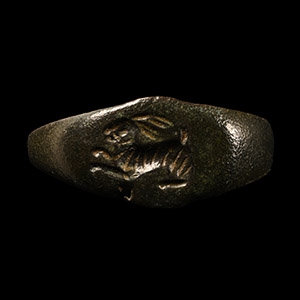
Roman Bronze Ring with Rabbit
3rd century A.D.Sold for (Inc. bp): £234
With integral ellipsoid bezel, intaglio crouching rabbit motif. 2.63 grams, 20.35 mm overall, 18.78 mm internal diameter (approximate size British P 1/2, USA 7 3/4, Europe 16.86, Japan 16)
Ex German art market, 2000s. Acquired from an EU collector living in London. From the collection of Surrey, UK, gentleman. -
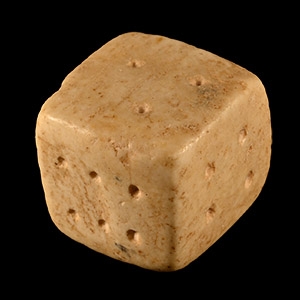
Large Roman Marble Gaming Dice
1st-4th century A.D.Sold for (Inc. bp): £104
Cuboid with rounded edges, spots disposed 1:6, 2:4, 3:5; the '1' a ring-and-dot, the others dimples. 18 grams, 20 mm
Ex Dr. Champion collection. Acquired 31 October 2003. From the important private collection of dice and gaming pieces of Colin Narbeth, London, UK, collection no.205. Accompanied by a Colin Narbeth catalogue identification slip.
