
Loading, please wait...
LOT 0719
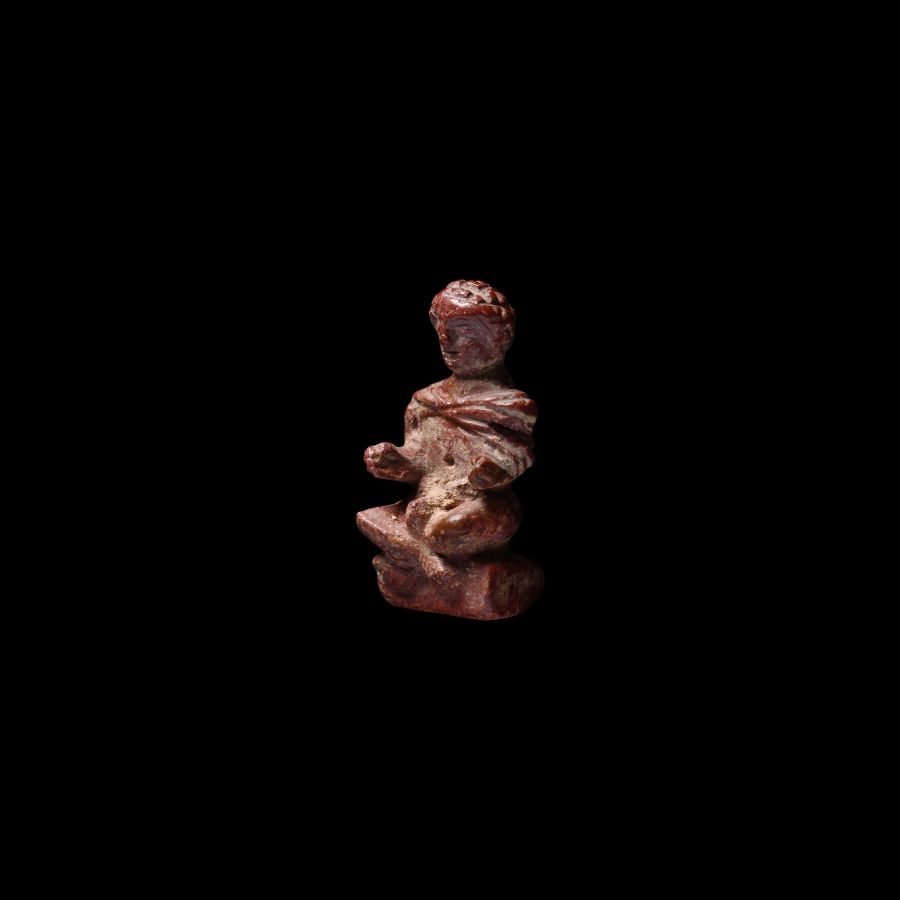
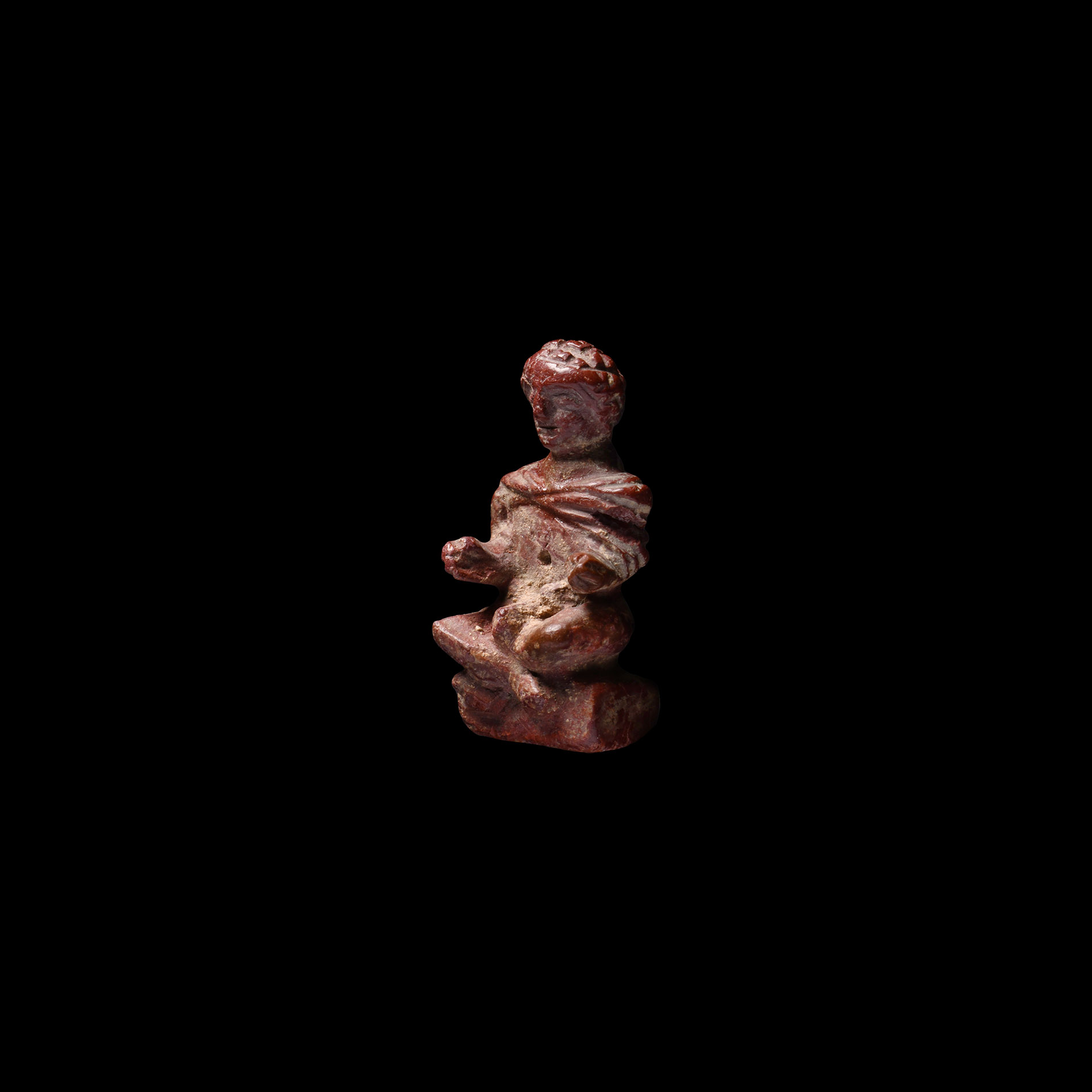
Late Roman Glass Pendant of a Seated Cloaked Male
3RD-4TH CENTURY A.D.
1 3/8 in. (9.13 grams, 36 mm high).
Modelled in the round, seated cross-legged on a rectangular base, featuring semi-naturalistic facial and anatomical features and an exaggerated phallus; suspension loop to reverse.
ProvenanceAcquired 1969-1999.
London collection of the late Mr S.M., thence by descent.
TimeLine Auctions follows a vetting process to ensure the authenticity and legality of all items, reinforcing our commitment to integrity and responsible trading. Each antiquity, antique, and coin lot undergoes thorough examination by a vetting committee of at least ten external specialists, professional trade association members, scientists, and archaeologists: Our Vetting Process
AUCTIONS:
TimeLine is a leading auction house specialising in antiquities, ancient art, collectables, natural history, coins, medals, and books. Our auctions offer museums, collectors, historians, and enthusiasts the opportunity to acquire unique and historically significant pieces.
-

Roman Marble Head of a Woman
1st-early 3rd century A.D.Sold for (Inc. bp): £3,510
Carved in the round with youthful features; large eyes with thickened eyelids, especially the lower lid, well-defined eyebrows forming two long arcs; small mouth with fleshy lips and deep corners; the hair parted at the centre and forming two symmetrical bands of wavy locks leaving the ears uncovered, secured with a ribbon and gathered at the nape of the neck to a small braid with a low hanging knot; mounted on a custom-made display stand. 2.95 kg total, 24.5 cm high including base
19th-20th century collection, based on the stand. Ex German collection, 1980s. with HVMC Auctions, Monaco, 12 May 2021, lot 99. Accompanied by an academic report by Dr Marina Mattei and Dr Laura Maria Vigna. This lot has been checked against the Interpol Database of stolen works of art and is accompanied by search certificate number no.11761-202174.
The arrangement of the hair is characteristic of female portraits of the late Antoninian to early Severan age. The head finds comparisons with a female portrait in the National Roman Museum, depicting an elderly woman of the Antoninian age, and with another female portrait in the National Roman Museum, dated to the third decade of the 3rd century A.D., reworked in the Tetrarchic Period, with the hairstyle falling within the so-called 'Nest Frisur' of the Severan age. -

Roman Bronze Horse
2nd-3rd century A.D.Estimate: £700 - 900 (+bp*)
Opening Bid: £389
Modelled standing on a rectangular base, standing facing, tail hanging between legs, simple stylised facial detailing. 80 grams, 47 mm high
‘The Ancient Menagerie Collection’ formerly the property of a Cambridgeshire lady, collected since the 1990s and acquired from auctions and dealers throughout Europe and the USA, now ex London collection. -
Large Roman Bronze Basilisk
4th century A.D.Estimate: £500 - 700 (+bp*)
Opening Bid: £278
The upper body, neck and head of a mythical basilisk (cockatrice), modelled in the round with the body of a serpent and head of a cockerel, the body with a tapering round-section profile, stylised detailing to the head. 260 grams, 88 mm
‘The Ancient Menagerie Collection’ formerly the property of a Cambridgeshire lady, collected since the 1990s and acquired from auctions and dealers throughout Europe and the USA, now ex London collection.
The basilisk, known from the Renaissance onwards as a cockatrice, was a Graeco-Roman mythical two-legged dragon or serpent-like creature with a cock's head. It had the reputed ability to kill people by either looking at them, touching them, or sometimes breathing on them. According to legend a cockatrice would die instantly upon hearing a rooster crow, and having a cockatrice looking at itself in a mirror was one of the few sure ways to kill it.
