
Loading, please wait...
LOT 0828
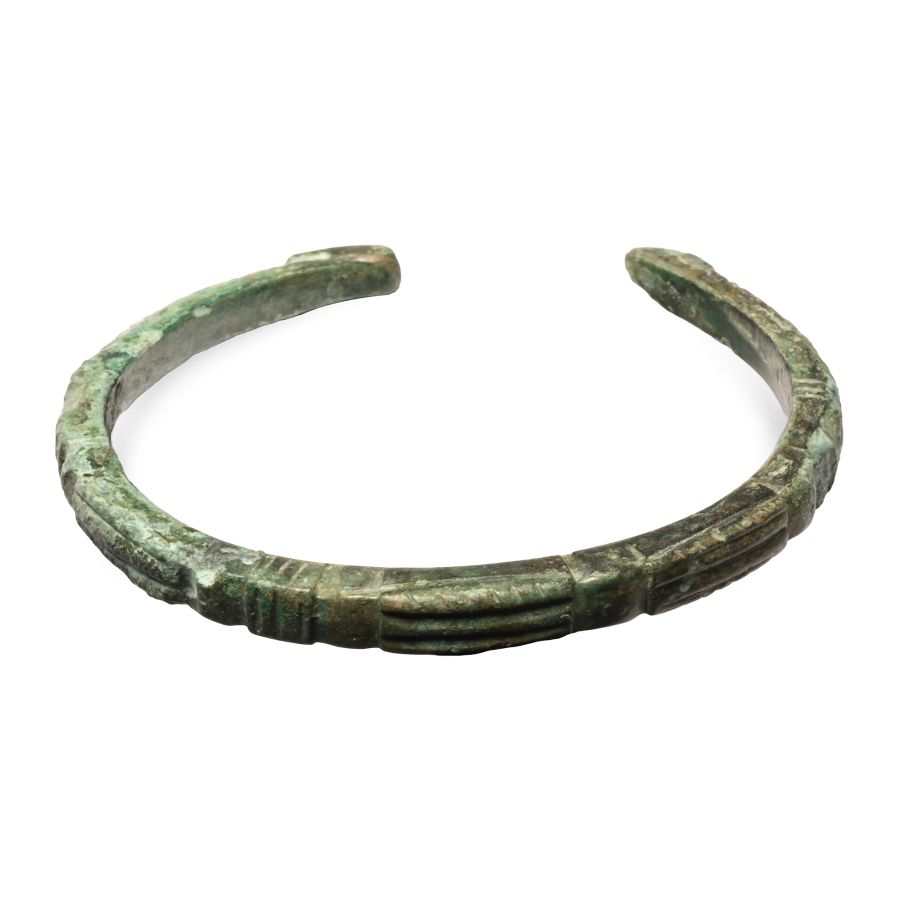
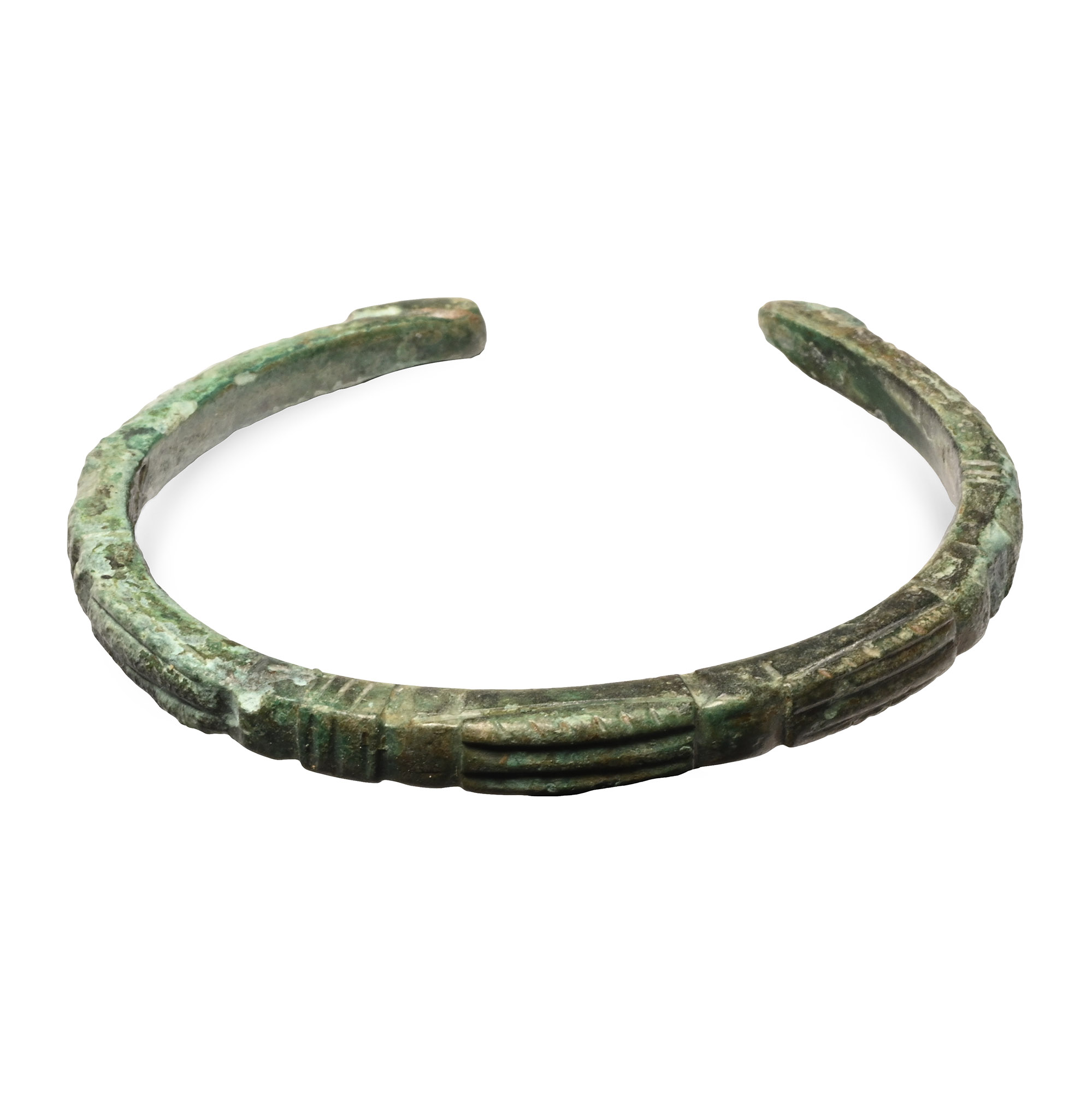
Late Roman Decorated Bronze Military Bracelet
4TH-5TH CENTURY A.D.
2 1/2 in. (24.1 grams, 65 mm).
Thick penannular body with tapering finials, the upper faces divided into decorative panels with linear motifs. [No Reserve]
ProvenanceEx German art market, 2000s.
Acquired from an EU collector living in London.
From the collection of a Surrey, UK, gentleman.
This lot is accompanied by an illustrated lot declaration signed by the Head of the Antiquities Department, Dr Raffaele D'Amato.
TimeLine Auctions follows a vetting process to ensure the authenticity and legality of all items, reinforcing our commitment to integrity and responsible trading. Each antiquity, antique, and coin lot undergoes thorough examination by a vetting committee of at least ten external specialists, professional trade association members, scientists, and archaeologists: Our Vetting Process
AUCTIONS:
TimeLine is a leading auction house specialising in antiquities, ancient art, collectables, natural history, coins, medals, and books. Our auctions offer museums, collectors, historians, and enthusiasts the opportunity to acquire unique and historically significant pieces.
-
.jpg)
Roman Silver Figure of a Man
2nd-3rd century A.D.Sold for (Inc. bp): £338
Standing erect wearing a draped toga, bearded and with thick bowl-cut hair. 9.05 grams, 39 mm
Acquired in the mid 1980s-1990s. From the family collection of Mr S.A., Switzerland, thence by descent. Private collection since the late 1990s. This lot is accompanied by an illustrated lot declaration signed by the Head of the Antiquities Department, Dr Raffaele D'Amato. -
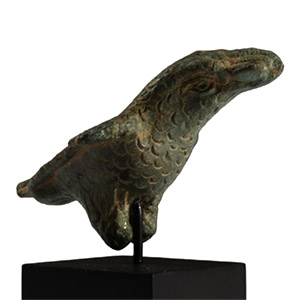
'The Kempsey' Roman Bronze Military Eagle Statuette
Circa 43-410 A.D.Sold for (Inc. bp): £390
Modelled in the round as a standing eagle with its wings spread, the overlapping wingtips covering the short tail; incised feather detailing to the body and wings, wide head with detailed eyes, remains of a military insignia (a victory wreath or fish?) held in its hooked beak; mounted on a custom-made display stand. 180 grams total, 76 mm high including stand
Found Kempsey, Malvern Hills, Worcestershire, UK. Accompanied by a copy of the British Museum's Portable Antiquities Scheme (PAS) report no.WAW-19C7C8. This lot is accompanied by an illustrated lot declaration signed by the Head of the Antiquities Department, Dr Raffaele D'Amato.
Both Ovid and Plutarch place the inception of manipular ensigns with Romulus, where bundles (manipuli) of hay were tied to high poles which served as rallying points for units of the army. Eventually, icons of animals replaced these ensigns: the eagle, wolf, Minotaur, horse, and boar. In 107 B.C., Gaius Marius made sweeping military reforms and the Aquila became the sole standard of the legion, which according to (Pliny NH. 10.5.16) ‘By making the Aquila the standard for all legions improved unity and gave soldiers a symbol that expressed their attachment to an all-encompassing body, to which the soldiers’ loyalty could be directed’. Due to its place at the head of each legion, it became the emblem of the Roman legions, which enforced Roman rule in the provinces, giving the eagle its connotation of dominion. -
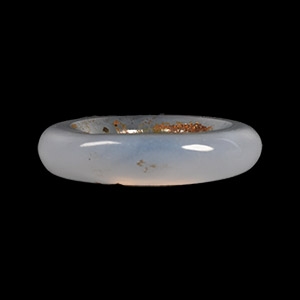
Roman Chalcedony Ring
1st century B.C.-1st century A.D. or laterSold for (Inc. bp): £104
Ellipsoid-shaped with carinated hoop on both inner and outer side. 3.56 grams, 25.90 mm overall, 14.47 mm internal diameter (approximate size British F 1/2, USA 3, Europe 4.3, Japan 4)
with H.A.C.A.G., Basel, prior 1999. This lot is accompanied by an illustrated lot declaration signed by the Head of the Antiquities Department, Dr Raffaele D’Amato. This lot is accompanied by an illustrated lot declaration signed by the Head of the Antiquities Department, Dr Raffaele D'Amato.
This ring, with a flat ellipsoid-shaped bezel, is related to type 2i of the Roman rings in Gallia, and they were usually considered as grave goods. Similar rings have often been found in Illyricum, Salonae, Zadar, Nin or Asseria.
