
Loading, please wait...
_900x900.jpg "Late Roman Carnelian Double Portrait Gemstone")
_200x200.jpg "Late Roman Carnelian Double Portrait Gemstone")
_900x900.jpg "Late Roman Carnelian Double Portrait Gemstone")
_200x200.jpg "Late Roman Carnelian Double Portrait Gemstone")
.jpg "Late Roman Carnelian Double Portrait Gemstone")
.jpg "Late Roman Carnelian Double Portrait Gemstone")
LOT 1013
Late Roman Carnelian Double Portrait Gemstone
4TH CENTURY A.D.
1 in. (3.38 grams, 24 mm).
A brown oval intaglio with two facing male busts, both diademed and togate, the left bust bearded, possibly depicting Serapis and Horus.
ProvenanceMr F.D. collection, acquired on the European art market, 1975 to present.
CONDITIONTimeLine Auctions follows a vetting process to ensure the authenticity and legality of all items, reinforcing our commitment to integrity and responsible trading. Each antiquity, antique, and coin lot undergoes thorough examination by a vetting committee of at least ten external specialists, professional trade association members, scientists, and archaeologists: Our Vetting Process
AUCTIONS:
TimeLine is a leading auction house specialising in antiquities, ancient art, collectables, natural history, coins, medals, and books. Our auctions offer museums, collectors, historians, and enthusiasts the opportunity to acquire unique and historically significant pieces.
-
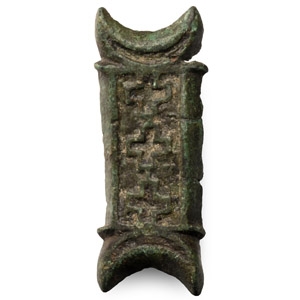
Romano-British Bronze Belt Mount with Crescent Moons and Crosses
2nd century A.D.Sold for (Inc. bp): £52
Rectangular plate with three Greek crosses, each end with a crescentic moon; two rivets on the rear. 4.84 grams, 40 mm
Found Cambridgeshire, UK. From a Kent collection formed in the 1990s. -
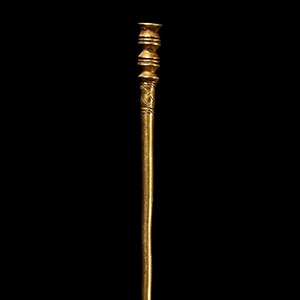
Roman Decorated Gold Dress Pin
1st-4th century A.D.Estimate: £700 - 900 (‡+bp*)
Opening Bid: £350
Slender body with balustered finial, a band of hatched herringbone decoration beneath the finial. 2.74 grams, 72 mm
Ex 'Neuburg' Collection, Germany, 1970. with Gorny & Mosch, Munich, Germany. with Galerie Rhéa, Zurich, Switzerland. -
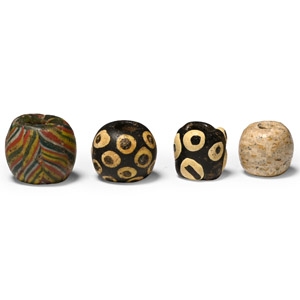
Roman Glass Bead Group
1st-3rd century A.D.Sold for (Inc. bp): £91
Comprising mosaic and other types, annular and spherical profiles. 22 grams total, 14-16.5 mm
with Archaeologia, Switzerland, before 1983. Ex private North American collection. London private collection, 2016.
