
Loading, please wait...
LOT 0931
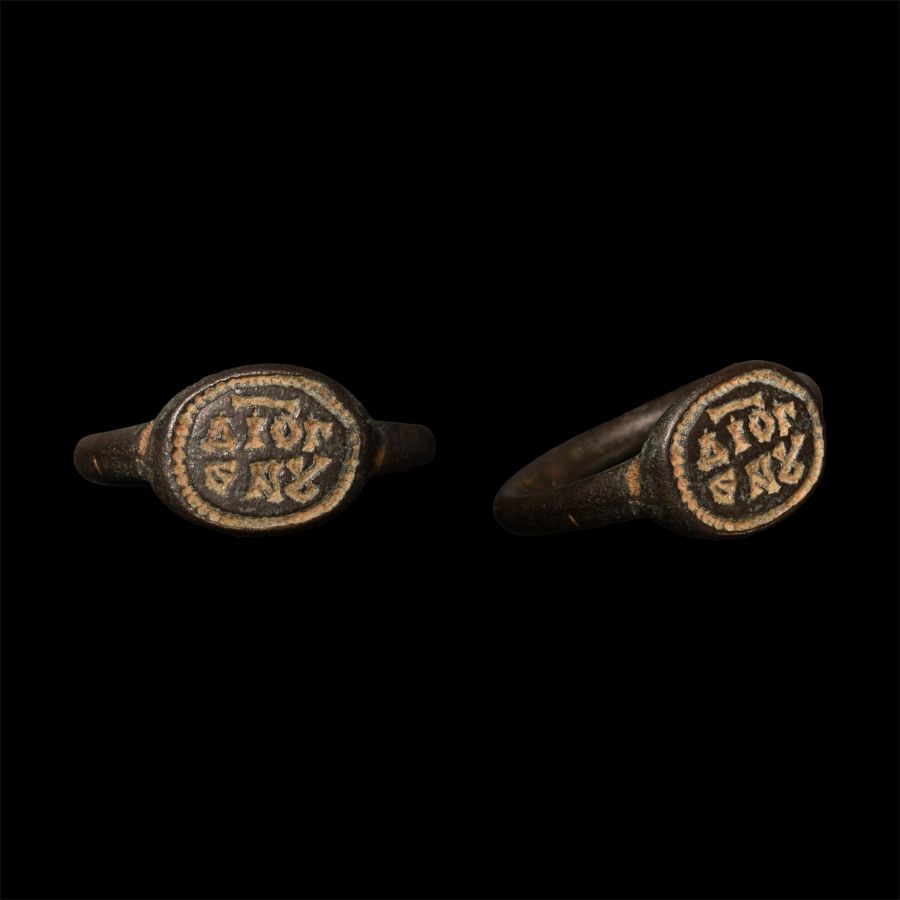
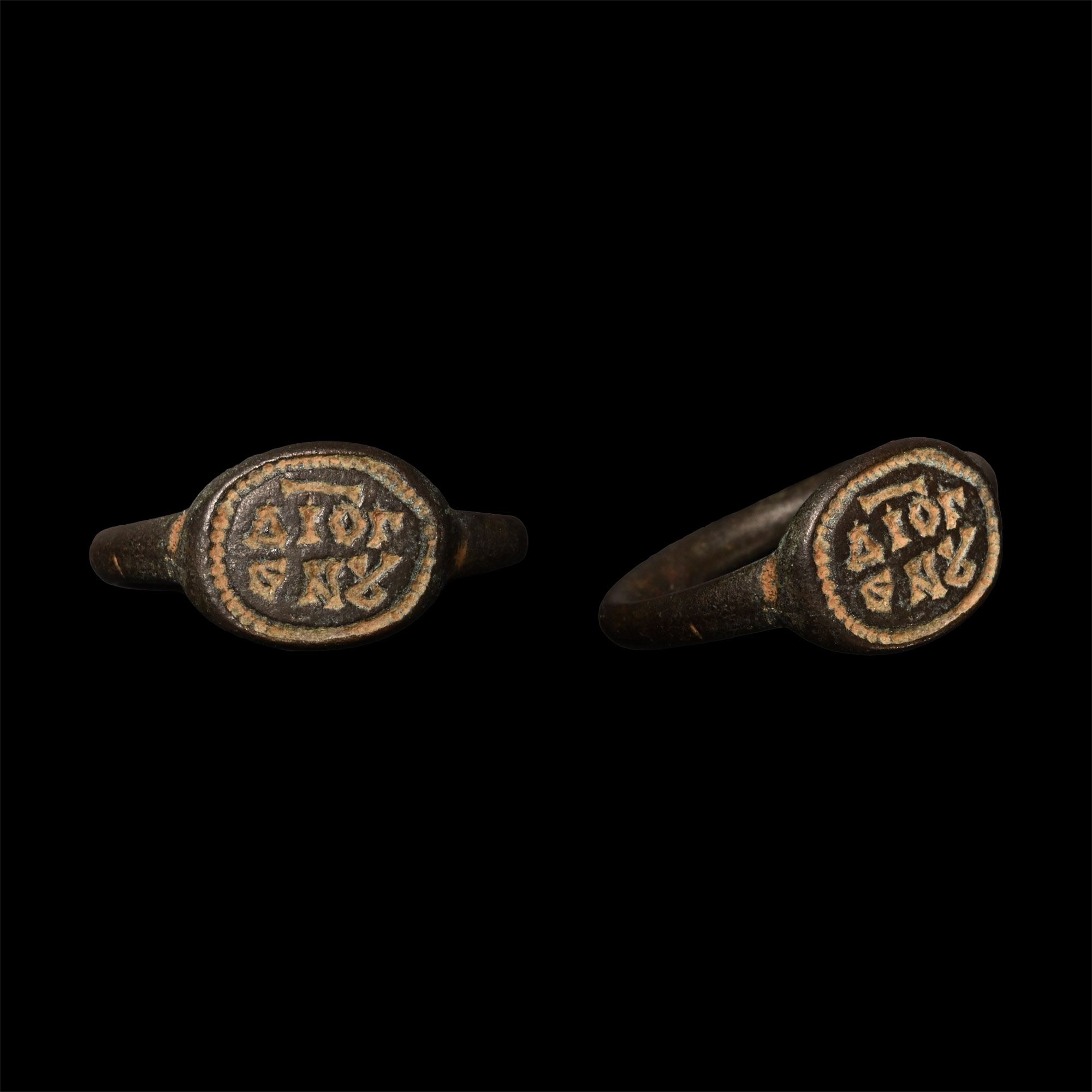
Late Roman Bronze Ring Belonging to Diogenes
4TH-6TH CENTURY A.D.
1 in. (7.21 grams, 25.66 mm overall, 20.51 mm internal diameter (approximate size British S 1/2, USA 9 1/4, Europe 20.63, Japan 19)).
With ellipsoid bezel, pointillé border enclosing Greek text 'ΔΙΟΓ/ΕΝΩ' '[property] of Diogenes'. [No Reserve]
ProvenancePrivate collection, England.
LiteratureCf. Chadour, A.B., Rings. The Alice and Louis Koch Collection, volume I, Leeds, 1994, item 481, for type.
CONDITIONTimeLine Auctions follows a vetting process to ensure the authenticity and legality of all items, reinforcing our commitment to integrity and responsible trading. Each antiquity, antique, and coin lot undergoes thorough examination by a vetting committee of at least ten external specialists, professional trade association members, scientists, and archaeologists: Our Vetting Process
AUCTIONS:
TimeLine is a leading auction house specialising in antiquities, ancient art, collectables, natural history, coins, medals, and books. Our auctions offer museums, collectors, historians, and enthusiasts the opportunity to acquire unique and historically significant pieces.
-
.jpg)
Roman Bronze Hand-Shaped Military Standard Finial
1st-3rd century A.D.Estimate: £4,000 - 6,000 (‡+bp*)
Opening Bid: £2,222
Hollow-formed with fine detailing to the fingers and nails; with fixing points for a military standard (signum) used by each unit under a centurion, originally fixed with the palm facing forwards inside a wreath. 718 grams, 21 cm
Generally intact and good defined, except for the lower part.
Acquired in Europe before 2000. European private collection. Accompanied by an academic report by Dr Raffaele D'Amato. This lot has been checked against the Interpol Database of stolen works of art and is accompanied by a search certificate number no.12003-211851.
Roman military signa decorated by phalerae and surmounted by a right hand were used from the Late Consular Age. The hand (manus) symbolised the fides, i.e. the allegiance between the soldiers and the Res Publica. It is also possible that the hand belonged to a statue in which it was extended as a sign of silence, to allow the speaker to speak. However, the iconography of military hands, and also the resemblance with a bronze hand (military signum) preserved in the Vindonissa museum (Windisch), support the possibility that the object was part of a military standard. -
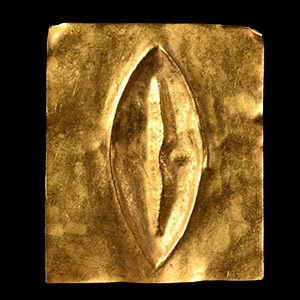
Roman Gold Votive Plaque
2nd-3rd century A.D.Sold for (Inc. bp): £1,105
Rectangular sheet-gold with boss to the centre, repoussé vulva motif. 2.32 grams, 30 mm
Acquired in the mid 1980s-1990s. Private collection, Switzerland, thence by descent. Private collection, since the late 1990s. -
.jpg)
Roman Marble Portrait of a Boy as Worshipper of Isis
Early 3rd century A.D.Sold for (Inc. bp): £17,550
Carved head of a prepubescent worshipper of Isis, with soft facial features, long nose, small downturned mouth, heavy-lidded eyes, the whole giving the face a sombre or mournful appearance; the hair textured to indicate a short cut and combed forward across the scalp, sidelock above the right ear; mounted on a 16th century carved breccia upper body with leather cuirass and pteruges to right shoulder, cloak draped across the shoulders and fastened at the clavicle on the right side with a disc-brooch; socle base; some restoration. 19.6 kg total, 51.5 cm including stand
North German private collection, 1970s, and thence by descent. Antiquities, Bonhams, London, 5 October 2011, no.136. Accompanied by an academic report by Dr Raffaele D’Amato. This lot has been checked against the Interpol Database of stolen works of art and is accompanied by search certificate number no.12185-222445.
The child is depicted as a worshipper of Isis with the right side of the head signalling that the boy was a devotee of the goddess’s cult. The head of the boy is probably a funerary portrait, and it is clearly in the first half of 3rd century style. Its resemblance to the portrait of Gordian III on the so-called sarcophagus of Acilia is impressive, so much so that this was probably the reason for which the head was incorporated within a military bust in the 16th century.
