
Loading, please wait...
LOT 0368
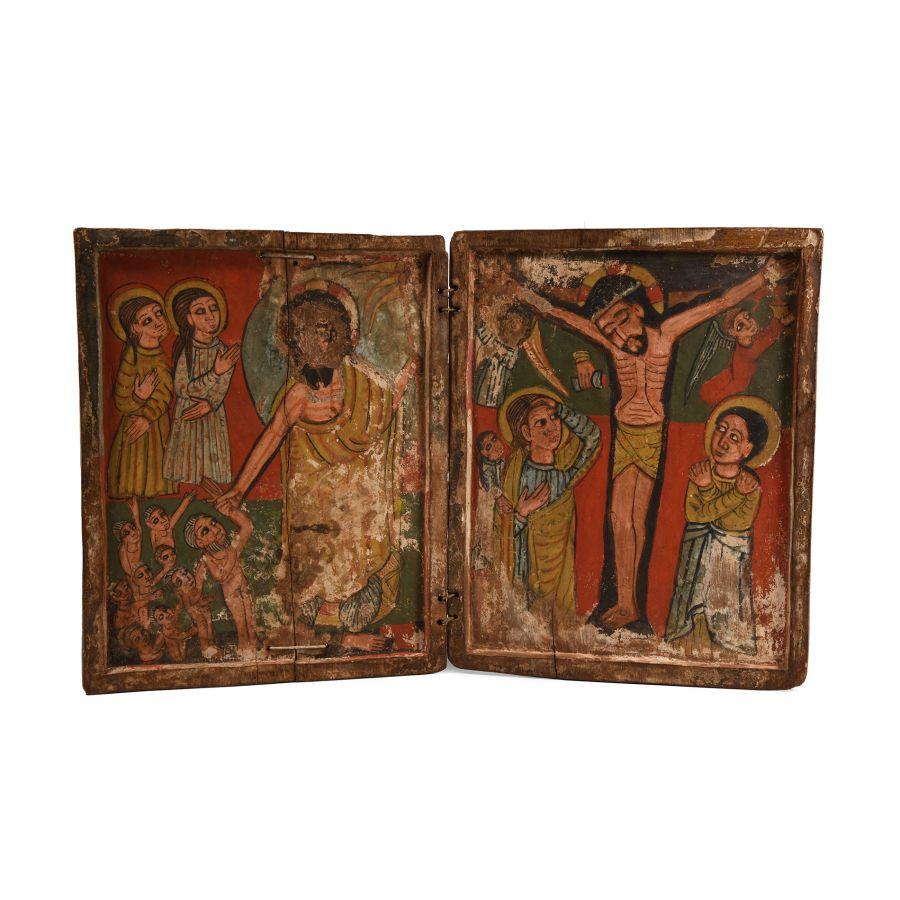
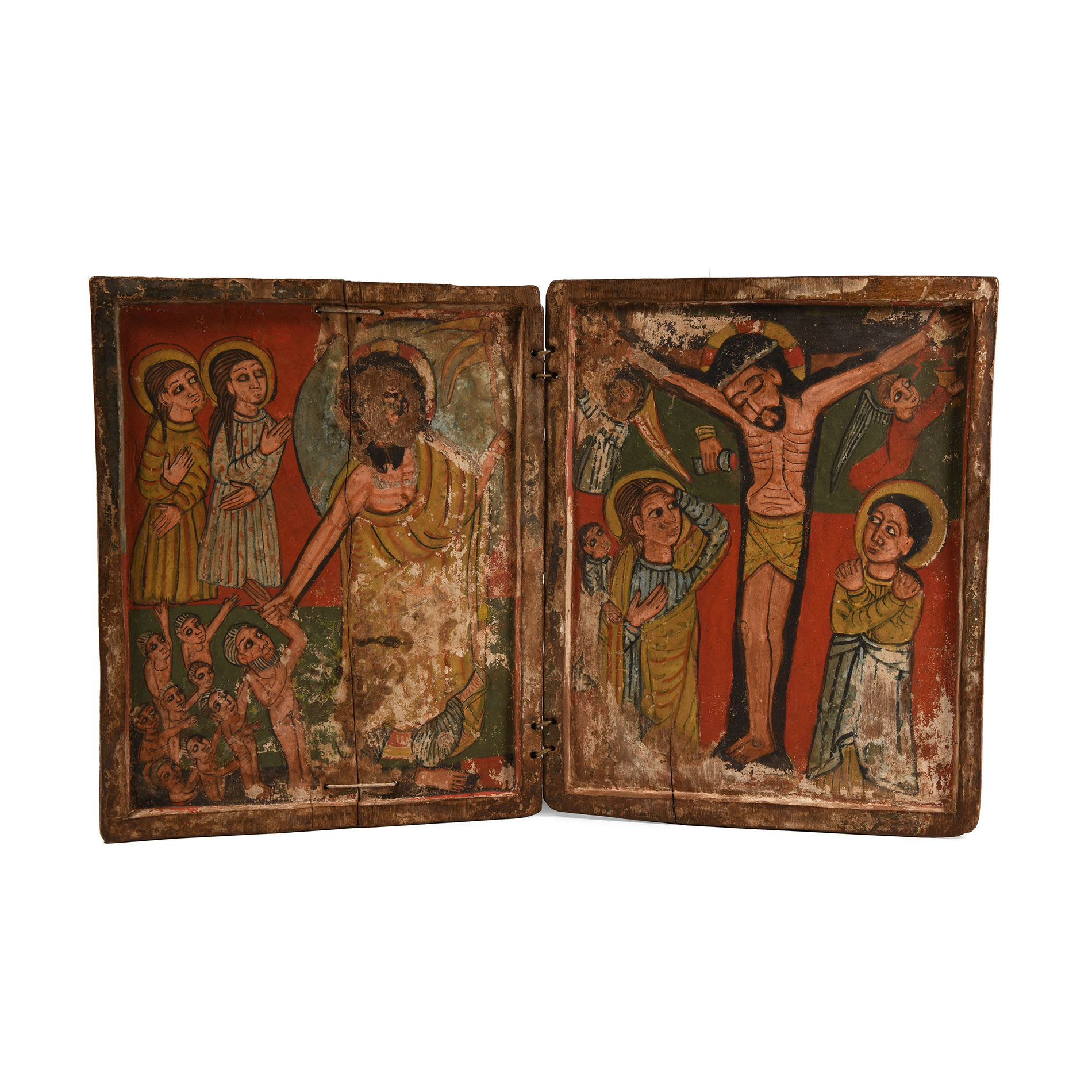
Late Medieval Ethiopian Wooden Diptych Depicting the Crucifixion and Resurrection
CIRCA 1550 A.D.
9 1/2 in. (499 grams, 24 cm high each).
Composed of a pair of recessed panels forming folding doors; the right panel with painted crucifixion scene depicting robed Mary, John the Evangelist and another apostle, angels collecting the blood in cups; the left panel with nude Adam and Eve with deceased reaching up towards resurrected Christ holding the standard of Victory in his left hand, two holy women, the myrrh bearers (Mary Magdalen and Mary, mother of Jesus) to the left. [No Reserve]
ProvenanceEx French private collection, 2000.
Ex central London gallery.
See Chojnacki, S., Major Themes in Ethiopian Painting, indigenous developments, the influence of foreign models and their adaptation, from the 13th to the 19th century, Wiesbaden, 1983, figs.39, 89, 90, 183, for similar Crucifixion and Resurrection scenes.
FootnotesThe icon shows the Western influence on Ethiopian art. The Crucifixion image contains many elements of this iconography which are found in many Oriental and Western Art of Middle Ages, but with significant changes from the previous representations: Jesus is nailed with three nails and not four, the head leaning towards his right shoulder and the hair falling on his shoulders. Following the Western influence, Christ is represented in a spasm of physical pain, and consequently a more detailed anatomy of his chest and abdomen is depicted. This concept of the Crucifixion, common in the Italian Late Middle Age and Renaissance art, found its way to Ethiopia at some time towards the end of the 15th century, or at the beginning of the 16th century. As in the majority of the Resurrection icons of this period, Christ is dressed in a long robe with a cloak or toga draped over one shoulder.
CONDITIONTimeLine Auctions follows a vetting process to ensure the authenticity and legality of all items, reinforcing our commitment to integrity and responsible trading. Each antiquity, antique, and coin lot undergoes thorough examination by a vetting committee of at least ten external specialists, professional trade association members, scientists, and archaeologists: Our Vetting Process
AUCTIONS:
TimeLine is a leading auction house specialising in antiquities, ancient art, collectables, natural history, coins, medals, and books. Our auctions offer museums, collectors, historians, and enthusiasts the opportunity to acquire unique and historically significant pieces.
LOT 0368
Late Medieval Ethiopian Wooden Diptych Depicting the Crucifixion and Resurrection
Sold for (Inc. bp): £286
-
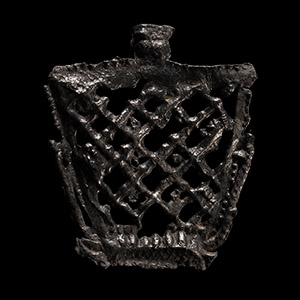
Medieval 'Thames' Pewter Pilgrim's Purse Badge
15th century A.D.Sold for (Inc. bp): £20
Comprising a trapezoidal frame with latticework and tab to the long edge; from a purse pendant. 4.35 grams, 39 mm
Found Thames foreshore spoil, 1980s.
The purse was originally suspended on straps from a badge bearing a fleur-de-lys within a ring. -
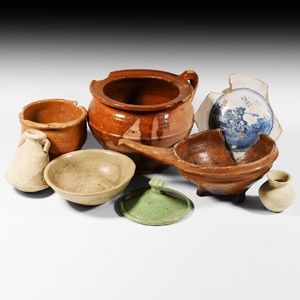
Medieval Ceramic Vessel Group
15th century A.D. and laterSold for (Inc. bp): £13
Composed of complete and fragmentary glazed and buff pots, jars, bowls, a lid and skillet. 3.3 kg total, 6-27 cm
Acquired 1990s-early 2000s. East Anglian private collection. -
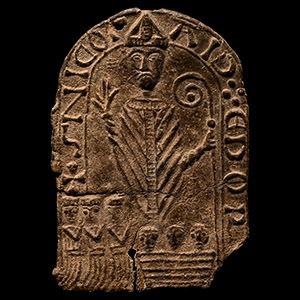
Medieval Pewter Pilgrim Badge of Saint Nicholas
Circa 1300 A.D.Sold for (Inc. bp): £546
Tongue-shaped panel with hatched reverse; facing image of St. Nicholas in episcopal robes holding his crook in his left hand and raising his right hand in bnison; frieze of devotees below; legend to the arch '+ S NICOΓAID ·:· EDOR[.]'. 4.71 grams, 41 mm
From the Forgeais (1822-1878) collection, France, thence by family descent. with Gallery 51, 21 June 2013, lot 71.
