
Loading, please wait...
LOT 0227
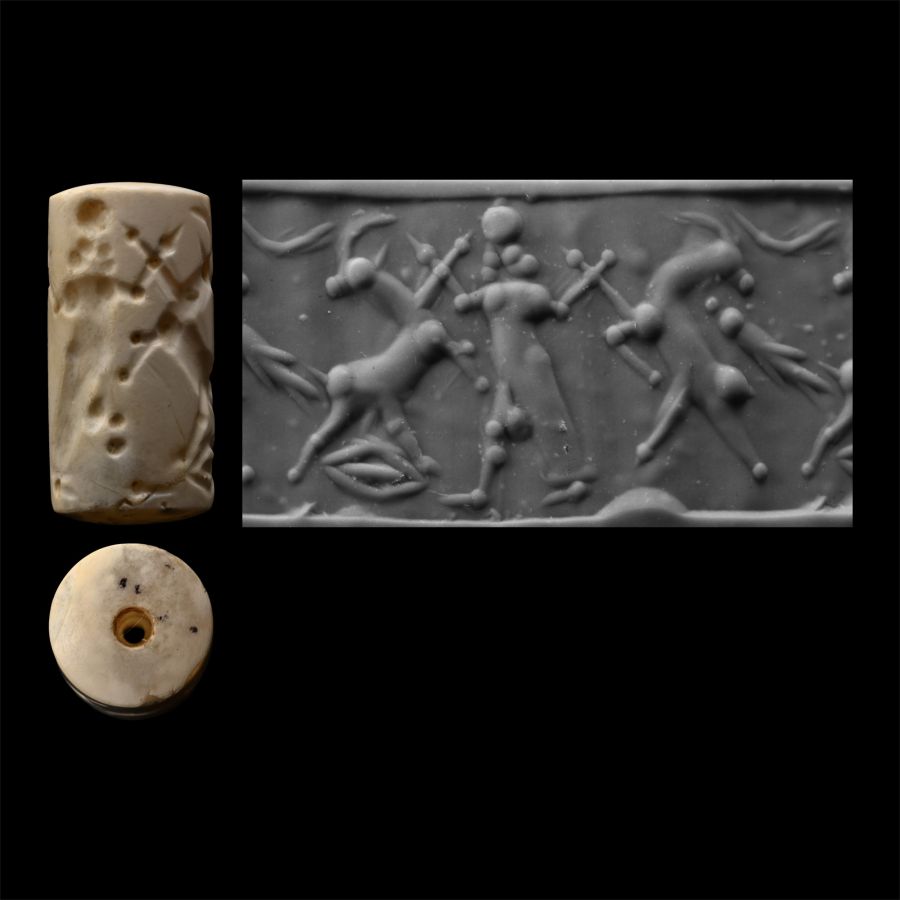
Late Assyrian Chalcedony Cylinder Seal with Standing Deity
CIRCA 800-700 B.C.
7/8 in. (6.19 grams, 22 mm).
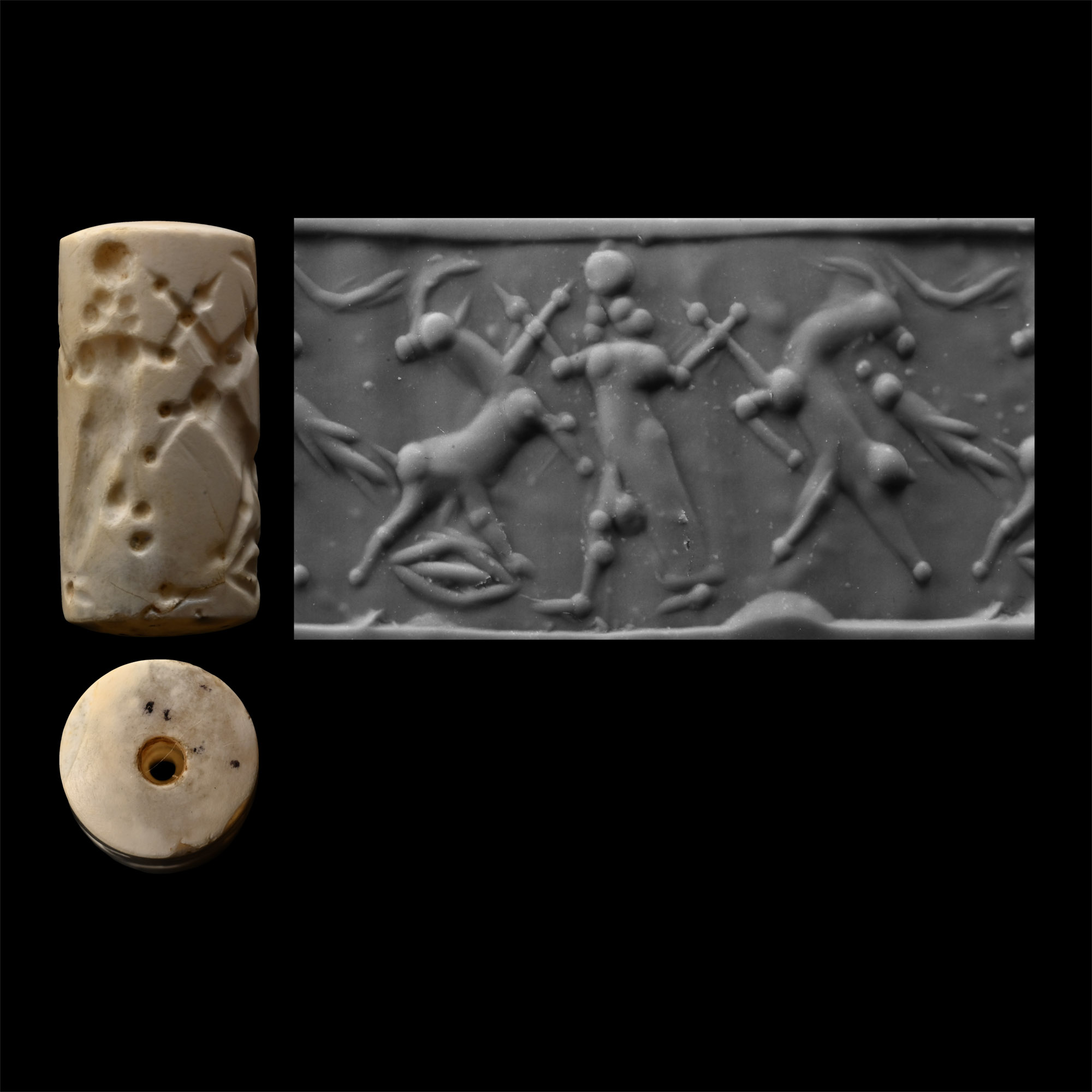
Cylinder with cord and bead handles; accompanied by a copy of an old scholarly note, typed and signed by W.G. Lambert, late Professor of Assyriology, University of Birmingham, 1970-1993, which states: 'Description of Cylinder Seal of Chalcedony with white surface, 23 x 11 mm. Standing deity dressed in long robe, with one leg projecting, holding the front paw on either side of a horned animal standing on hind legs; diamond shape between the legs of one animal; lunar crescent above fish for terminal. Late Assyrian drilled style, c. 800-700 B.C. Condition: fine, save for one small harmless chip.'; supplied with a museum-quality impression. [No Reserve]
ProvenanceUK private collection, acquired 1980-1983.
Accompanied by a copy of a scholarly note, typed and signed by Professor Wilfrid George Lambert in November 1987.
This lot has been cleared against the Art Loss Register database, and is accompanied by an illustrated lot declaration signed by the Head of the Antiquities Department, Dr Raffaele D'Amato.
TimeLine Auctions follows a vetting process to ensure the authenticity and legality of all items, reinforcing our commitment to integrity and responsible trading. Each antiquity, antique, and coin lot undergoes thorough examination by a vetting committee of at least ten external specialists, professional trade association members, scientists, and archaeologists: Our Vetting Process
AUCTIONS:
TimeLine is a leading auction house specialising in antiquities, ancient art, collectables, natural history, coins, medals, and books. Our auctions offer museums, collectors, historians, and enthusiasts the opportunity to acquire unique and historically significant pieces.
LOT 0227
Late Assyrian Chalcedony Cylinder Seal with Standing Deity
Sold for (Inc. bp): £715
-
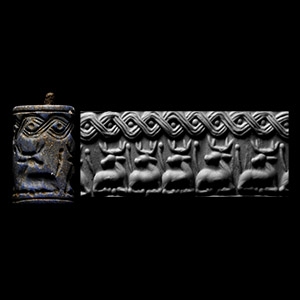
Mesopotamian Lapis Lazuli Cylinder Seal with Animal Frieze
Early 2nd millennium B.C.Sold for (Inc. bp): £1,430
Above: guilloche of two bands with 'eye' motifs in the voids; below: zebu and other animals on a baseline; supplied with a museum-quality impression. 14 grams, 31 mm
From the 'S' collection, acquired 1970-1990s. The collection was seen and studied by W.G. Lambert, late Professor of Assyriology at the University of Birmingham, 1970-1993. This lot has been cleared against the Art Loss Register database, and is accompanied by an illustrated lot declaration signed by the Head of the Antiquities Department, Dr Raffaele D'Amato. -
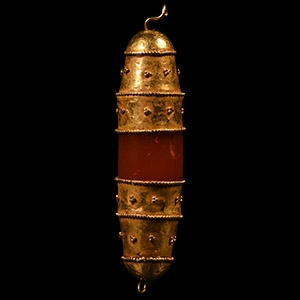
Early Parthian Carnelian Bead with Gold End Caps
1st century B.C.-1st century A.D.Estimate: £1,000 - 1,400 (‡+bp*)
Opening Bid: £450
Columnar bead with sheet-gold cap to each end, each with beaded circlets and applied granule clusters, domed end with loop; possibly assembled. 17.44 grams, 60 mm
Acquired in the mid 1980s-1990s. Private collection, Switzerland, thence by descent. Private collection, since the late 1990s. This lot has been cleared against the Art Loss Register database, and is accompanied by an illustrated lot declaration signed by the Head of the Antiquities Department, Dr Raffaele D'Amato. -
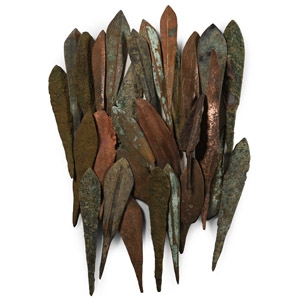
Western Asiatic Bronze Arrowhead Collection
19th - 2nd century B.C.Sold for (Inc. bp): £130
Including triangular, leaf-shaped, barbed, paddle-shaped arrowheads with a flat, comparatively wide mid-rib, and others. 271 grams total, 5.8-10.7 cm
Ex London art market, 1980-1990s. This lot has been cleared against the Art Loss Register database, and is accompanied by an illustrated lot declaration signed by the Head of the Antiquities Department, Dr Raffaele D'Amato.
Some of the represented arrowheads (paddle-shaped) were typical of the Old Babylonian Empire. The shoulders were pronounced and the arrowhead had a rectangular-section tapering tang. This simple form was popular throughout and are comparatively common finds in the Holy Land.
