Loading, please wait...

Late Anglo-Saxon Bronze Ring with Four Ovate Bezels Late Anglo-Saxon Bronze Ring with Four Ovate Bezels Late Anglo-Saxon Bronze Ring with Four Ovate Bezels Late Anglo-Saxon Bronze Ring with Four Ovate Bezels Late Anglo-Saxon Bronze Ring with Four Ovate Bezels Late Anglo-Saxon Bronze Ring with Four Ovate Bezels Late Anglo-Saxon Bronze Ring with Four Ovate Bezels Late Anglo-Saxon Bronze Ring with Four Ovate Bezels Late Anglo-Saxon Bronze Ring with Four Ovate Bezels
Use mousewheel to zoom in and out, click to enlarge
Details

LOT 0331

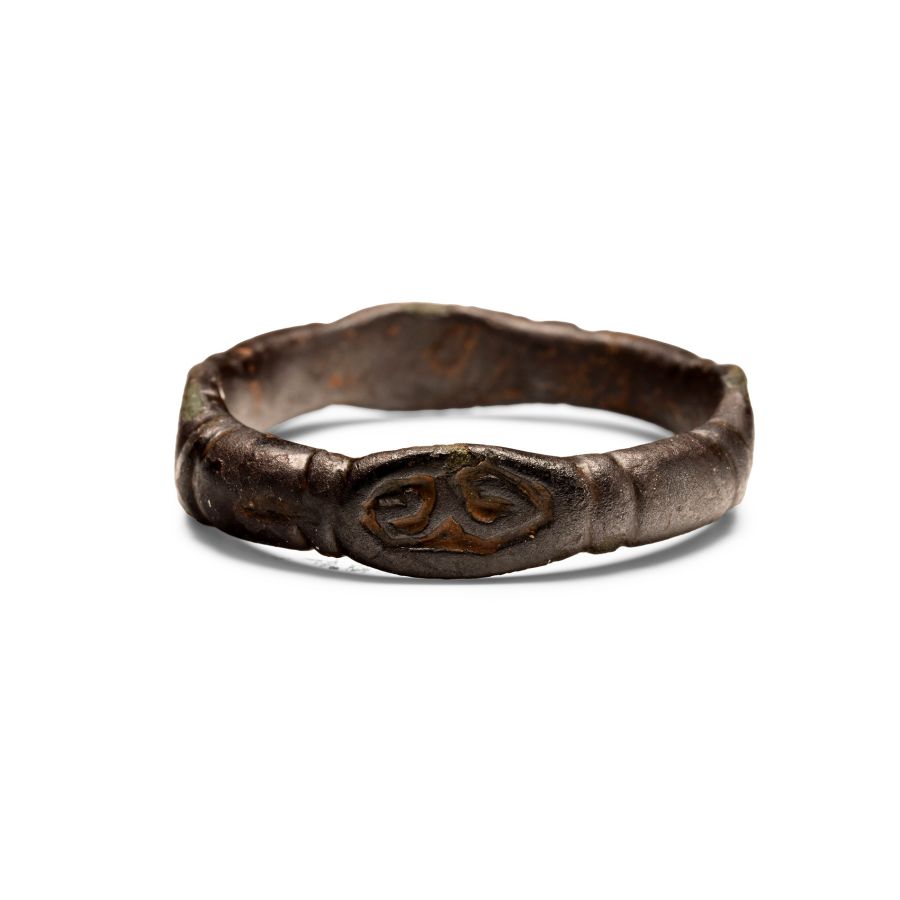
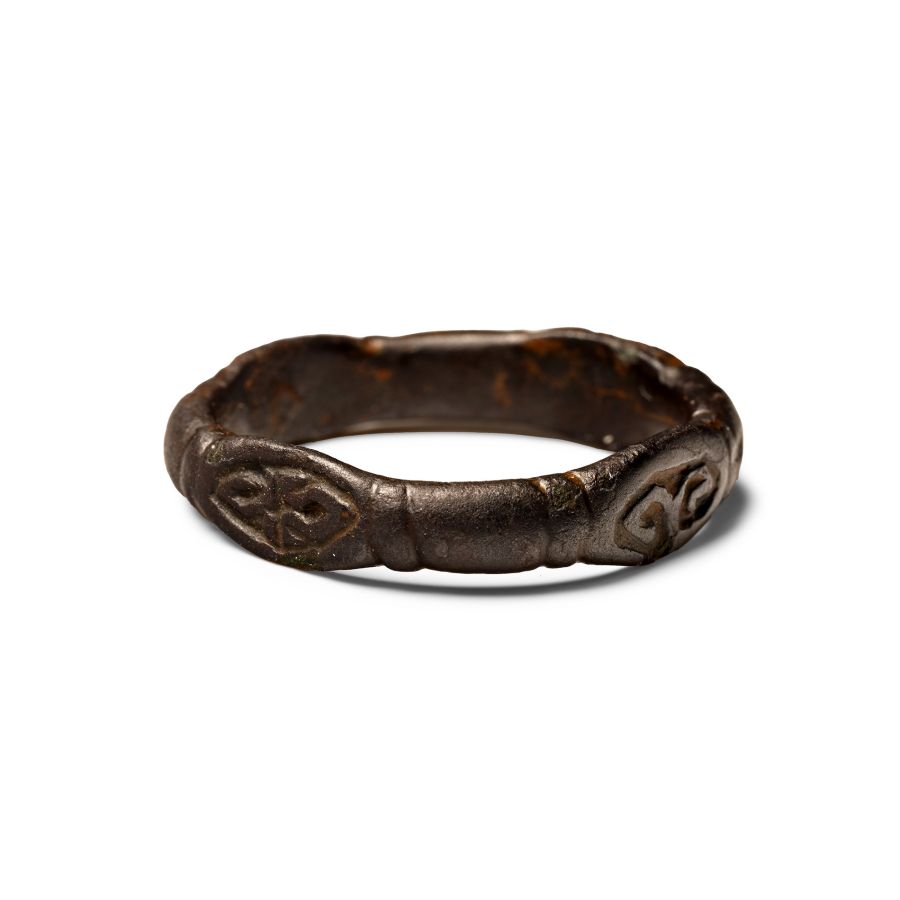
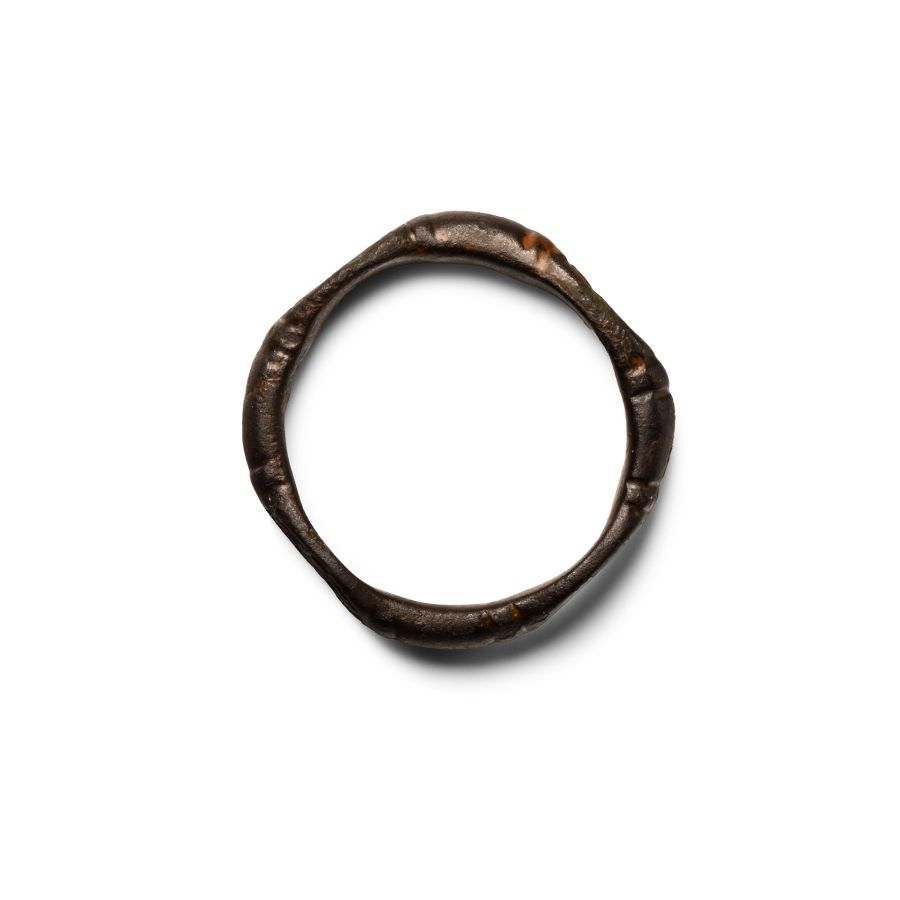
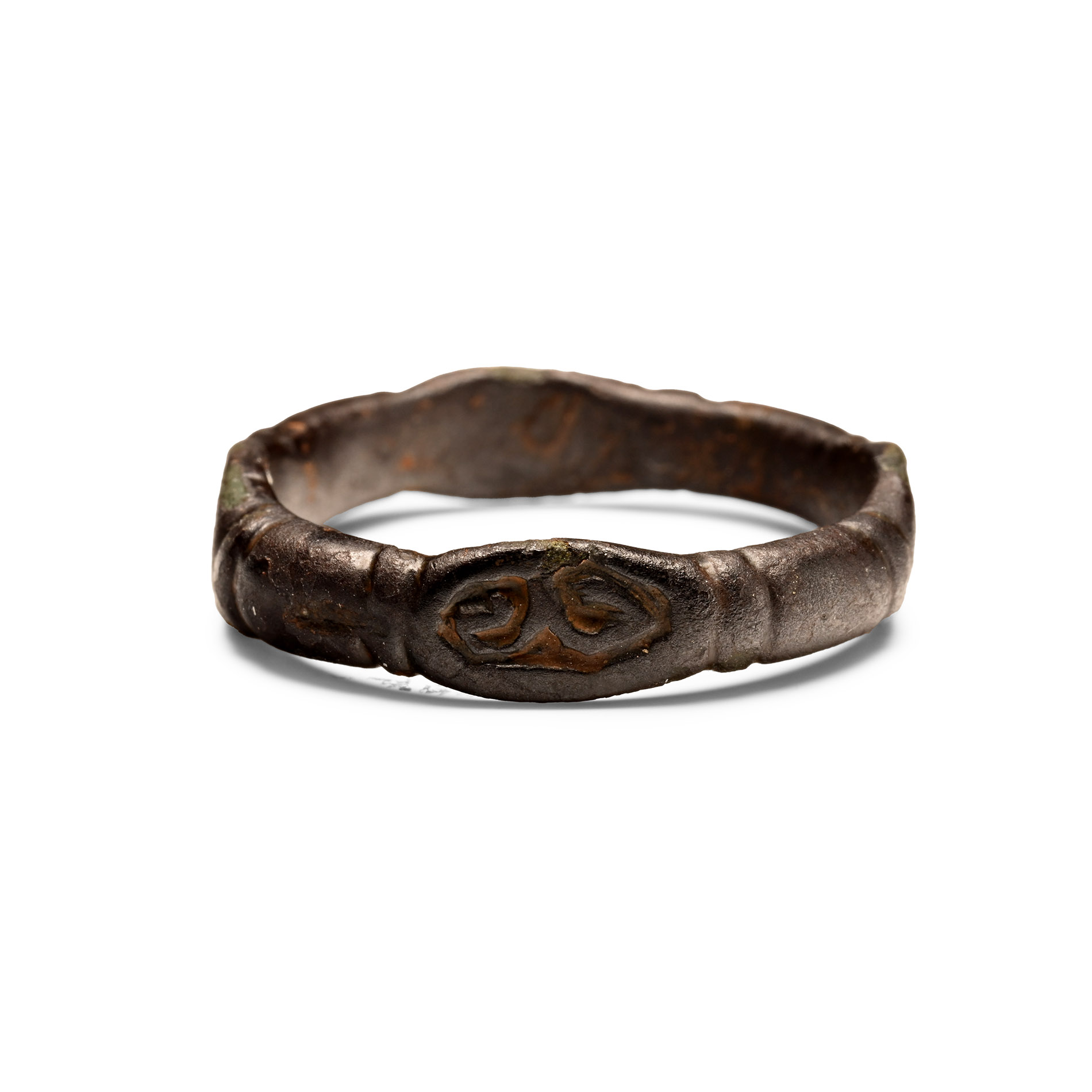
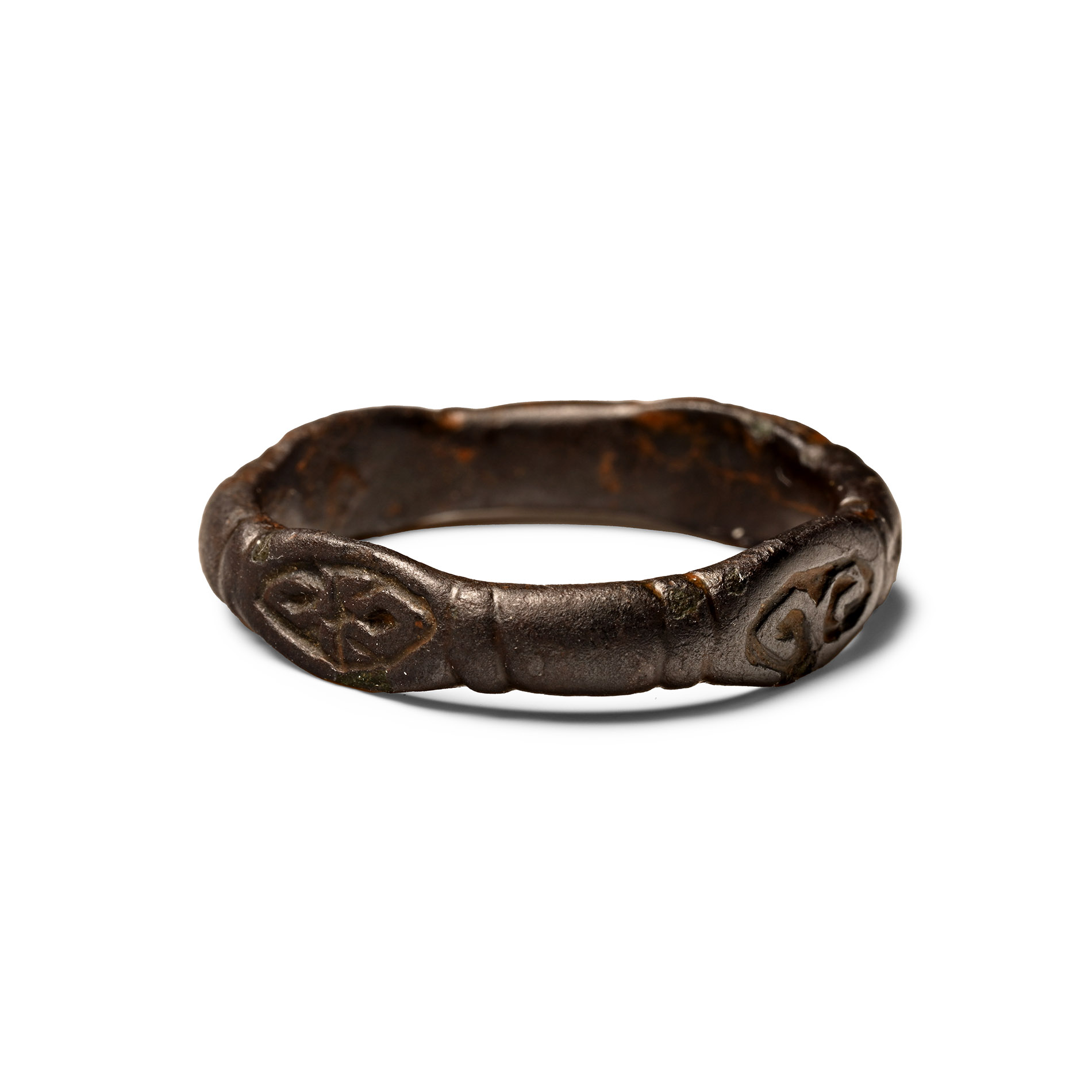
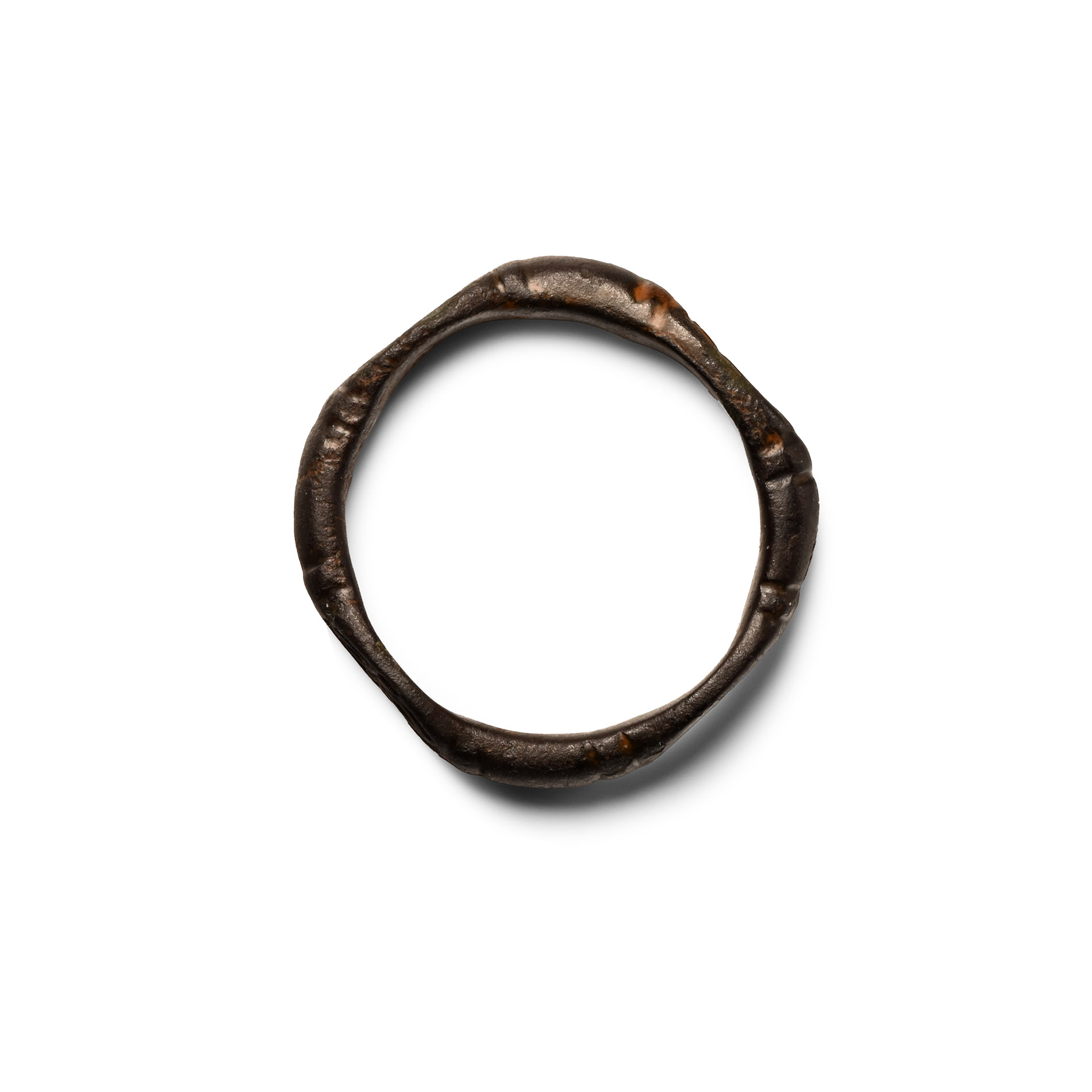
Late Anglo-Saxon Bronze Ring with Four Ovate Bezels

CIRCA 1100-1400 A.D.

1 in. (4.55 grams, 26.17 mm overall, 20.09 mm internal diameter (approximate size British U 1/2, USA 10 1/4, Europe 23.15, Japan 22)).

Comprising a large sub-circular hoop with four evenly spaced ovate bezels giving an octagonal appearance to the hoop; the bezels with a moulded collar to each side and with a deeply incised symbol: one with a Trewhiddle style beast(?); the second with a symbol resembling lower case Omega sign; the third and fourth bezel with two upper case Omega symbols oriented horizontally with the bases at the centre of the bezel. [No Reserve]

Provenance

Found whilst searching with a metal detector near North Yorkshire, UK, in 2020, by Mark Didlick.

Accompanied by a copy of the British Museum's Portable Antiquities Scheme (PAS) report no.YORYM-110C9F.

Literature

See Portable Antiquities Scheme no. YORYM-EA5D0E and HAMP-C25EF3, for earlier rings with ovate bezels.

CONDITION
VETTING:

TimeLine Auctions follows a vetting process to ensure the authenticity and legality of all items, reinforcing our commitment to integrity and responsible trading. Each antiquity, antique, and coin lot undergoes thorough examination by a vetting committee of at least ten external specialists, professional trade association members, scientists, and archaeologists: Our Vetting Process


AUCTIONS:

TimeLine is a leading auction house specialising in antiquities, ancient art, collectables, natural history, coins, medals, and books. Our auctions offer museums, collectors, historians, and enthusiasts the opportunity to acquire unique and historically significant pieces.

LOT 0331

Late Anglo-Saxon Bronze Ring with Four Ovate Bezels

Sold for (Inc. bp): £416

Print page

RELATED LOTS
  • The Hoxne Priory Anglo-Saxon Bronze Anthropomorphic Figurine
    'The Hoxne Priory' Anglo-Saxon Bronze Anthropomorphic Figurine
    600-700 A.D. or later

    Estimate: £2,000 - 3,000 (+bp*)

    Opening Bid: £1,000

    Modelled in the round standing naked with both feet on a drum-shaped base; the head bulbous with small lentoid eyes placed high on the face, wedge-shaped nose and slit mouth; the arms poorly defined but apparently extending to the hips (and perhaps bent flat across the body); the legs separated by a rotary device with small feet, the genital area blank with a shallow socket in the shape of a phallus and testes. 43.6 grams, 75 mm


    Found whilst searching with a metal detector approximately 100 yards from the ruins of Hoxne Priory, Suffolk, UK, on 27th August 2023 by Richard Hudson. Accompanied by a report by Anglo-Saxon and Viking specialist Stephen Pollington. Accompanied by a copy of the British Museum's Portable Antiquities Scheme (PAS) report no.SF-F804CE. Accompanied by a copy of the Suffolk County Council archaeological finds recording service receipt dated 27th August 2023. Accompanied by a handwritten signed letter from the finder explaining the circumstances of finding including copies of photographs taken shortly after finding. This lot has been checked against the Interpol Database of stolen works of art and is accompanied by a search certificate number no.12134-217182.

    The piece is unusual in that the arms are poorly defined and the lower arms and hands not easily discernible, the columnar base is not normally present, and the legs were apparently connected by metal which needed to be drilled out, possibly due to a poorly-prepared mould allowing leakage across from one leg to the other. Metal analysis by X-ray fluorescence (XRF), and the trace elements found therein, seems to support an early Anglo-Saxon date: Cu 59.8, Sn 20.7, Pb 8.1, Fe 7.0, Zn 2.1, As 1.2, Bi 0.8, Ti 0.2. The find spot is near Hoxne, Suffolk, which has a long and interesting history. In 1992, a huge hoard of Roman silverware was discovered in the vicinity, with the largest collection of gold and silver coins of the 4th-5th century found anywhere within the Roman Empire. This suggests that the area was always important economically and socially. The local Priory dates from the mid-tenth century (i.e. mid-Saxon period) but the site was already associated with the kings of East Anglia, who held land here; it is usually said to be the spot where King Edmund defied the Danish leader Hinguar (Ivarr) and met his death. It is probable that the priory's location was chosen because it was already a site of religious worship: Pope Gregory's instruction to the missionaries attempting to convert the Anglo-Saxons was to preserve their festivals and sites of religious worship, but to alter the religious content (Chaney, 1967). It is thus likely that the location of the Priory was already a (pre-Christian) holy place with a temple.

    Lot Details

  • Saxon Gold Jewel Backing Disc
    Saxon Gold Jewel Backing Disc
    6th-8th century A.D.

    Sold for (Inc. bp): £98

    Thin foil panel, possibly used as the backing to mount a jewel. 1.16 grams, 20 mm


    From an old English collection. Acquired from Spink, York, circa 1986. Ian Wilkinson collection, Nottinghamshire, UK.

    The foil is unlikely to have been used as a backing for a garnet cloison or cabochon since it is almost flat, but it may have been intended for treatment with the waffle-pattern texture normally used to mount such jewels.

    Lot Details

  • Anglo-Saxon Gilt Bronze Mount Group
    Anglo-Saxon Gilt Bronze Mount Group
    6th-8th century A.D.

    Sold for (Inc. bp): £117

    Comprising: a zoomorphic mount with raised detailing, stud to reverse; fragment with high-relief interlace motif. 5.3 grams total, 20-23 mm


    Found East Yorkshire, UK, in 2009. Ian Wilkinson collection, Nottinghamshire, UK.

    Lot Details

Stay up-to-date with the latest from TimeLine Auctions by joining our mailing list