
Loading, please wait...
_900x900.jpg "Late Achaemenid Bronze Phiale Mesomphalos")
_200x200.jpg "Late Achaemenid Bronze Phiale Mesomphalos")
.jpg "Late Achaemenid Bronze Phiale Mesomphalos")
LOT 1197
Late Achaemenid Bronze Phiale Mesomphalos
6TH-4TH CENTURY B.C.
5 7/8 in. (233 grams, 17.5 cm).
A broad carinated bowl with radiating repoussé panels, central slightly domed roundel, carination below the rim. [No Reserve]
ProvenanceAcquired 1980-2015.
Ex Abelita family collection.
Cf. Curtiss, J. & Tallis, N., Forgotten Empire. The World of Ancient Persia, London, 2005, item 277.
CONDITIONTimeLine Auctions follows a vetting process to ensure the authenticity and legality of all items, reinforcing our commitment to integrity and responsible trading. Each antiquity, antique, and coin lot undergoes thorough examination by a vetting committee of at least ten external specialists, professional trade association members, scientists, and archaeologists: Our Vetting Process
AUCTIONS:
TimeLine is a leading auction house specialising in antiquities, ancient art, collectables, natural history, coins, medals, and books. Our auctions offer museums, collectors, historians, and enthusiasts the opportunity to acquire unique and historically significant pieces.
-
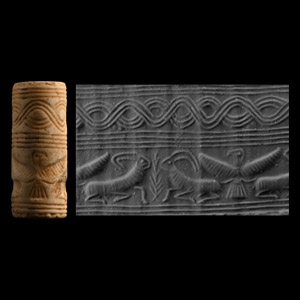
Large Early Dynastic White Stone Cylinder Seal
3rd millennium B.C.Sold for (Inc. bp): £1,170
With design in two registers framed by three bands of parallel horizontal lines; upper register, undulating bands; lower register, bird with wings spread flanked by addorsed ibexes; supplied with a museum-quality impression. 43 grams, 51 mm
Ex S. collection, London, UK, 1980s-2000s. -
.jpg)
Azerbaijan Horse Rhyton
1st millennium B.C.Estimate: £1,000 - 1,400 (+bp*)
Opening Bid: £500
Funicular body with a flaring neck and zoomorphic finial, with circular spout in its chest; chipped. 1.35 kg, 28 cm
Ex London, UK, gallery, 1971-early 2000s. Property of a London gentleman. -
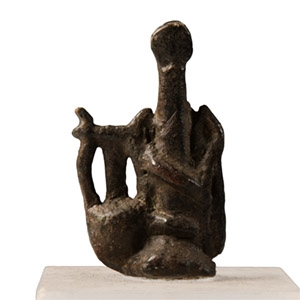
Western Asiatic Bronze Anthropomorphic Idol
1st millennium B.C.Sold for (Inc. bp): £416
Modelled in the round figure with flared foot, stylised anthropomorphic or theriomorphic figure with amphora and mounting peg to reverse; mounted on a custom-made stand. 163 grams total, 92 mm high including stand
From a collection acquired on the UK art market from various auction houses and collections mostly before 2000. From an important Cambridgeshire estate; thence by descent.
