
Loading, please wait...
_900x900.jpg "Larger Than Life-Size Roman Bronze Foot Insert From a Statue")
_200x200.jpg "Larger Than Life-Size Roman Bronze Foot Insert From a Statue")


.jpg "Larger Than Life-Size Roman Bronze Foot Insert From a Statue")
LOT 0118
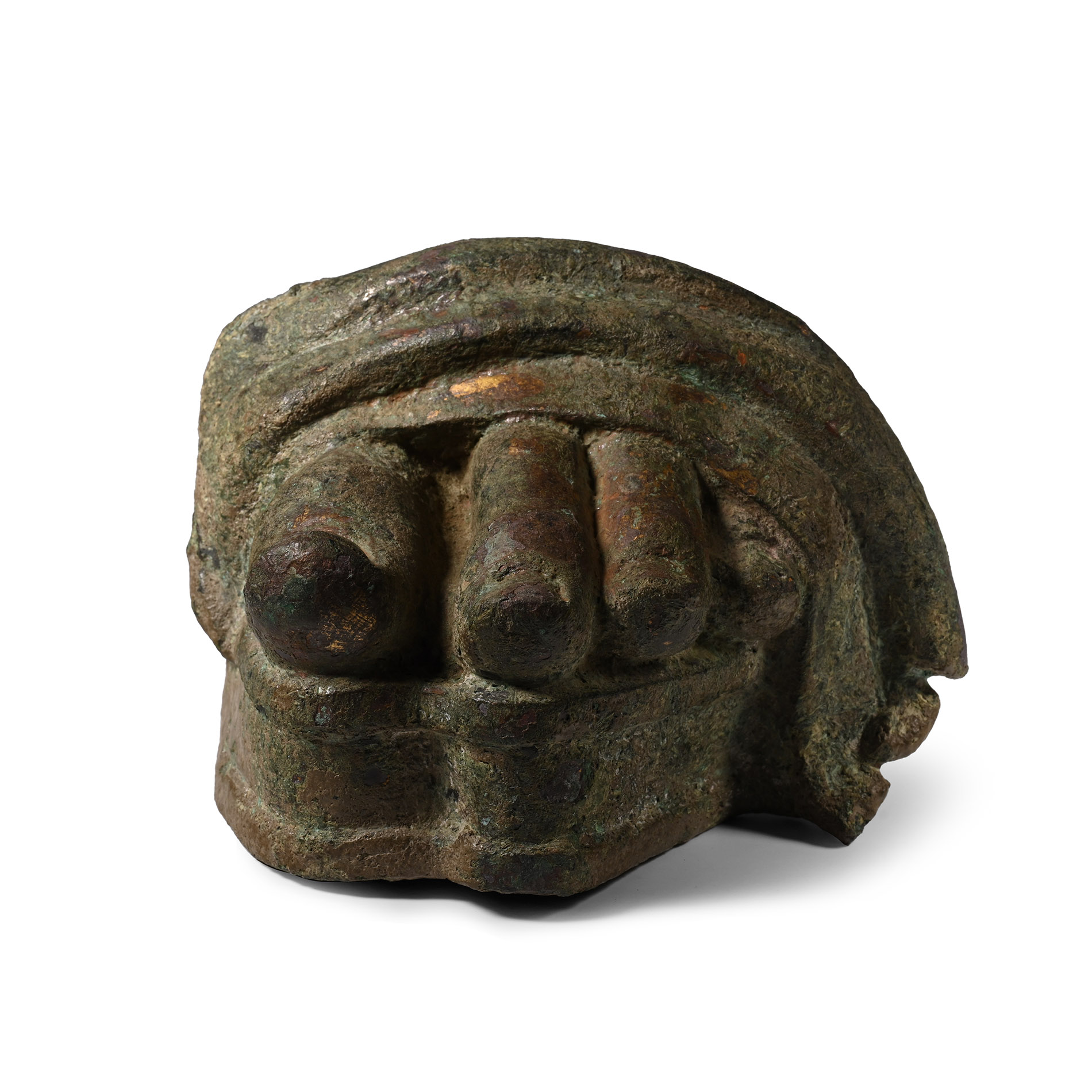
Larger Than Life-Size Roman Bronze Foot Insert From a Statue
1ST-3RD CENTURY A.D.
5 1/2 in. (847 grams total, 14 cm).
Hollow-formed front left sandaled foot with draped hem of a vestis talaris across the rear edge and tiered sole to the footwear, traces of gilding; supplied with a custom-made wooden stand.
ProvenanceAcquired in Germany in 2001.
Acquired by the present owner from the above.
Accompanied by an academic report by Dr Raffaele D’Amato.
This lot has been checked against the Interpol Database of stolen works of art and is accompanied by search certificate number no.12192-222323.
For a possible similar sandaled foot of goddess Tutela see Boucher, S., Inventaire des Collections Publiques Françaises - 17 Vienne: Bronzes Antiques, Paris, 1971, pp.52-55, no.13; for similar pieces see Boucher, S., Tassinari, S., Musée de la civilisation Gallo-Romaine a Lyon, Bronze Antiques, Lyon, 1976, nos.83-85; also Cooley, A.E., Cooley, M.G.L., Pompeii and Herculaneum, New York, 2014; Sebesta, J.L., & Bonfante, L.,The World of Roman Costume, Madison, 2001.
FootnotesThe detailed bronze foot exhibits an incredible rendering of the smallest details; its dimensions suggest that the statue to which it belonged was nearly a human size sculpture, possibly a goddess, based on the footwear. Statues of the gods and goddesses were usually gilded.
CONDITIONTimeLine Auctions follows a vetting process to ensure the authenticity and legality of all items, reinforcing our commitment to integrity and responsible trading. Each antiquity, antique, and coin lot undergoes thorough examination by a vetting committee of at least ten external specialists, professional trade association members, scientists, and archaeologists: Our Vetting Process
AUCTIONS:
TimeLine is a leading auction house specialising in antiquities, ancient art, collectables, natural history, coins, medals, and books. Our auctions offer museums, collectors, historians, and enthusiasts the opportunity to acquire unique and historically significant pieces.
LOT 0118
Larger Than Life-Size Roman Bronze Foot Insert From a Statue
Estimate £4,000 - 6,000€4,640 - 6,960 (for guidance only)$5,400 - 8,100 (for guidance only)
-
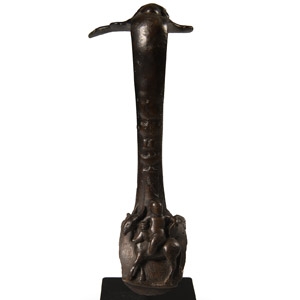
Roman Bronze Tankard Handle with Drunken Putto on Donkey
2nd century A.D.Sold for (Inc. bp): £221
Comprising a crescent plaque above with facing mask a a thumb-pad, lateral scrolls; perpendicular D-section bar with ribbing to the outer face; rectangular lower attachment panel with scrolled upper corners, high-relief putto (?) holding a patera in one hand and tankard in the other, riding an ass side-saddle; mounted on a custom-made stand. 318 grams total, 17 cm including stand
From a collection acquired on the UK art market from various auction houses and collections mostly before 2000. From an important Cambridgeshire estate; thence by descent.
This type of bronze handles are usually depicting mythological scenes. The scene of the putto riding a donkey is often linked to Bacchic processions. The face of the character riding the donkey could also correspond to that of Silenus, who in the same processions is often represented riding such an animal. -
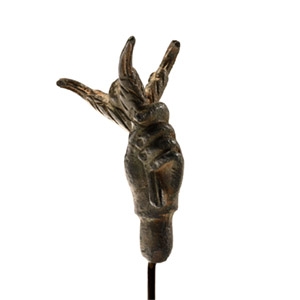
Roman Bronze Eros Statuette Fragment
1st-2nd century A.D.Sold for (Inc. bp): £91
Modelled in the round, the left hand of Cupid-Eros gripping the stem of a bloom with three radiating leaves; mounted on a custom-made stand. 46 grams total, 72 mm including stand
From a collection acquired on the UK art market from various auction houses and collections mostly before 2000. From an important Cambridgeshire estate; thence by descent. -
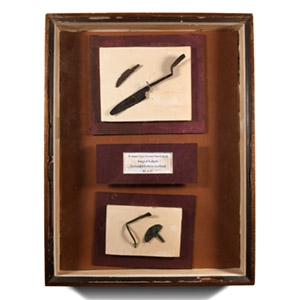
Roman Bronze Battlefield Surgical Scalpels
Circa 83-87 A.D.Sold for (Inc. bp): £546
Mounted in an old custom glazed presentation case with explanatory labels; found Inchtuthil, Scotland. 1.42 kg total, 38 x 29.2 cm
From the Roman legionary fortress Inchtuthil, Perthshire, 83-87 A.D. Private UK collection. Acquired in the 1980s. Property of a Cambridgeshire gentleman.
