
Loading, please wait...
LOT 1506
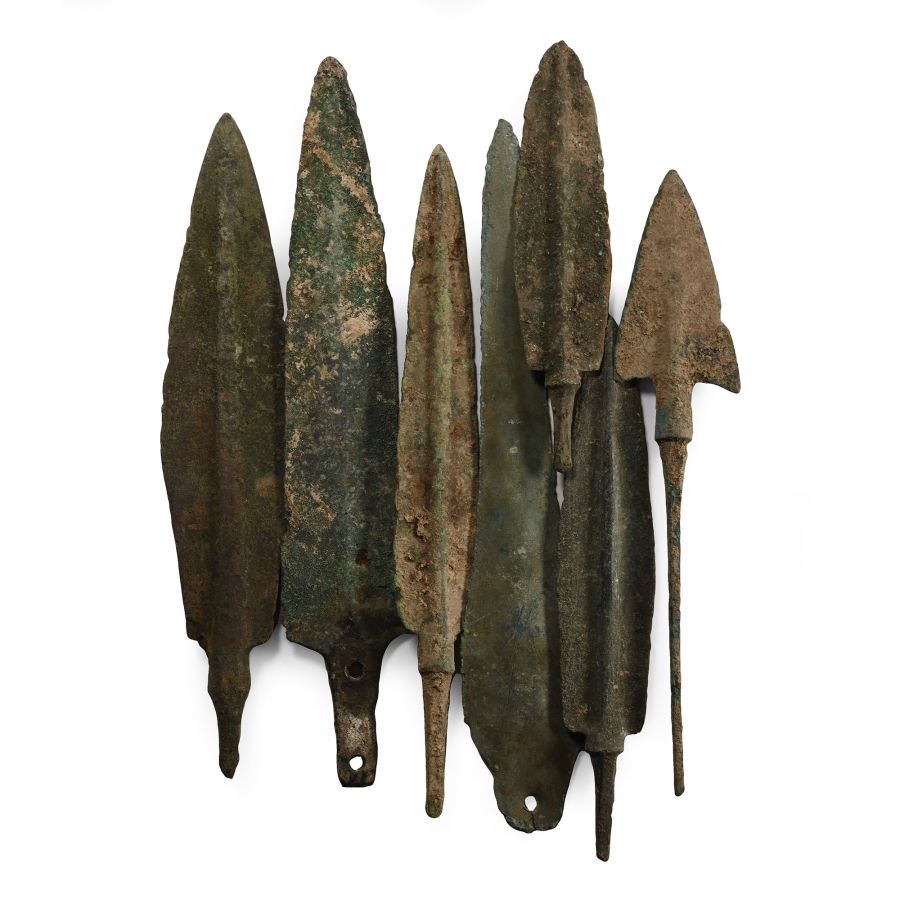
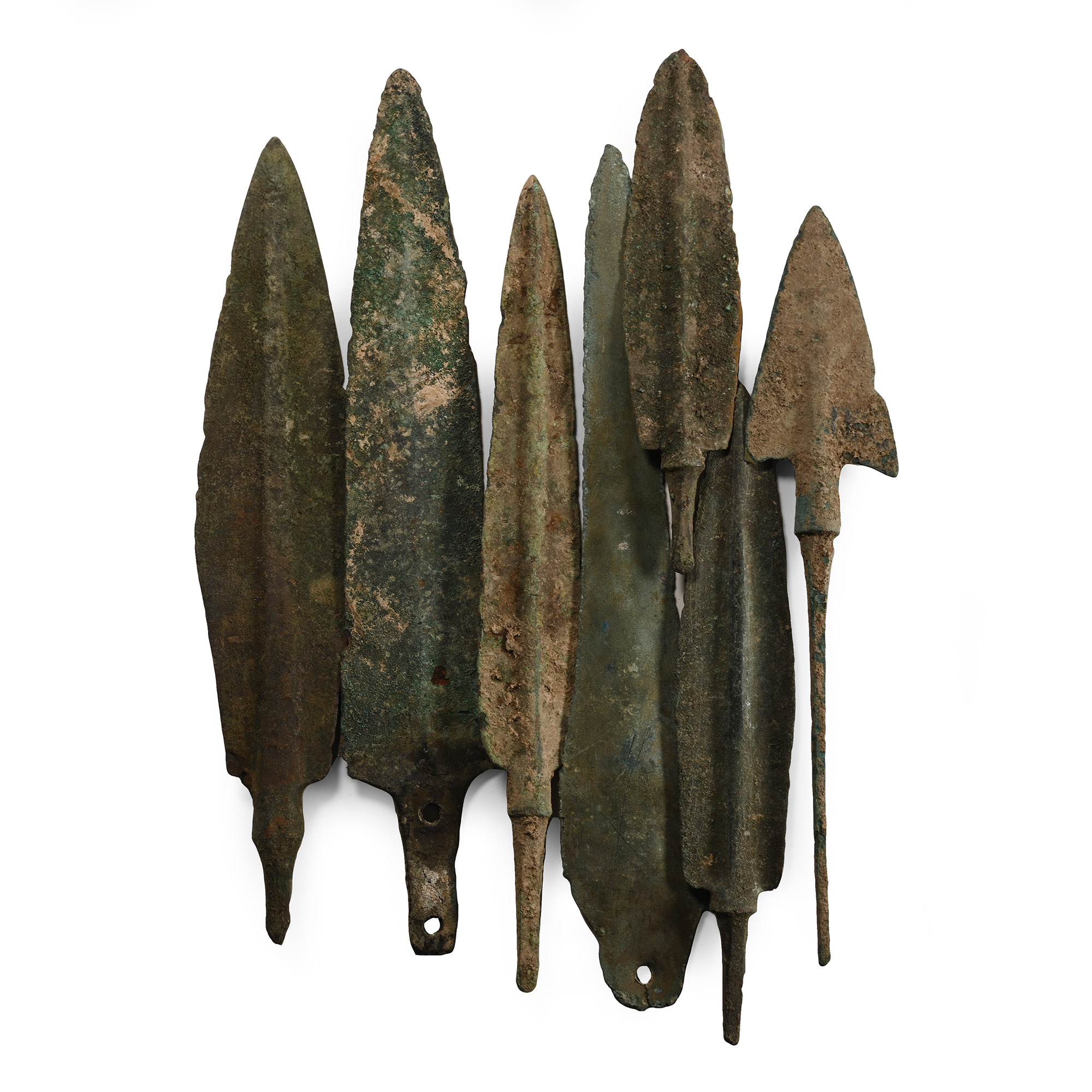
Large Western Asiatic Bronze Arrowhead and Dagger Collection
1800-700 B.C.
4 1/8 - 6 3/4 in. (251 grams total, 10.5-17 cm).
Including mainly triangular and leaf-shaped types of arrowheads, and two small daggers with pierced tang. [7]
ProvenanceEx London art market, 1980-1990s.
This lot is accompanied by an illustrated lot declaration signed by the Head of the Antiquities Department, Dr Raffaele D'Amato.
See Muscarella, O.W., Bronze and Iron Ancient Near Eastern Artifacts in the Metropolitan Museum of Art, New York, 1988, pp.289ff, for similar arrowheads; for the daggers see Maxwell-Hyslop, R., 'Daggers and swords in Western Asia: a Study from Prehistoric Times to 600BC,' in Iraq, Volume 8, 1946, pp.1-65, pl.III, type 27.
FootnotesSmall tanged blades without a rivet, which have sometimes been identified as spearheads, are knives, while the rivetted form could have been used as a dagger or for domestic purposes. Both forms are characteristic of the Hyksos period in Palestine. A curious blade from Byblos (Level 19) represents the earlier form of this type.
CONDITIONTimeLine Auctions follows a vetting process to ensure the authenticity and legality of all items, reinforcing our commitment to integrity and responsible trading. Each antiquity, antique, and coin lot undergoes thorough examination by a vetting committee of at least ten external specialists, professional trade association members, scientists, and archaeologists: Our Vetting Process
AUCTIONS:
TimeLine is a leading auction house specialising in antiquities, ancient art, collectables, natural history, coins, medals, and books. Our auctions offer museums, collectors, historians, and enthusiasts the opportunity to acquire unique and historically significant pieces.
LOT 1506
Large Western Asiatic Bronze Arrowhead and Dagger Collection
Sold for (Inc. bp): £156
-
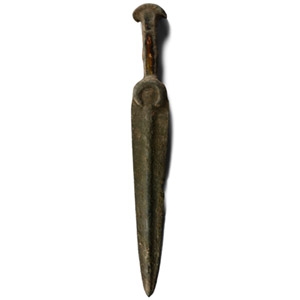
Marlik Type Bronze Dagger with Integral Hilt
14th-10th century B.C.Sold for (Inc. bp): £247
The blade with raised mid-rib and penannular guard, integral flanged hilt with organic inserts for the grip and crescentic pommel. 368 grams, 31.5 cm
Ex London art market, 1980-1990s. This lot is accompanied by an illustrated lot declaration signed by the Head of the Antiquities Department, Dr Raffaele D'Amato.
These daggers were cast in one-piece mould. Some scholars (Negahban) states that blade and grip were cast in one piece mould, and that the penannular guard was later cast onto the blade. However the main characteristic was the hilt and pommel open to accept organic inlays, here preserved. -
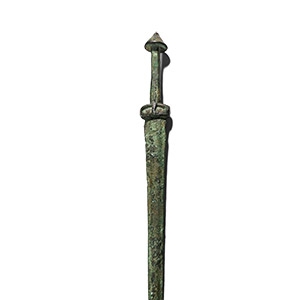
Luristan Long Sword with Handle
Circa 9th-8th century B.C.Sold for (Inc. bp): £1,170
With a slender double-edged blade and a narrow handle with conical pommel. 809 grams, 76.3 cm
Ex Deutsch Auctioneers, Vienna, 25 February 2020, no.7. with Galerie Rhéa, Zurich, Switzerland. This lot is accompanied by an illustrated lot declaration signed by the Head of the Antiquities Department, Dr Raffaele D'Amato.
The Luri people produced a quantity of fine metalwork, which according to Dr Khorasani, could be due to a settled period which arose as a result of the defeat of the Elamites by the Babylonians, leaving the Luristani people in relative peace for a period of time after 1200 BC. According to Khorasani, 'A culture of innovation and experimentation flourished, and the repertoire of the Luristan smiths expanded in the period between 1150–1050 BC.' -
.jpg)
Luristan Bronze Dagger
13th-6th century B.C.Sold for (Inc. bp): £468
Double-edged triangular blade, integral hilt with lateral flanges with remains of bone handle. 196 grams, 31 cm
From the estate of a deceased gentleman, Surrey, UK, 1980s. This lot is accompanied by an illustrated lot declaration signed by the Head of the Antiquities Department, Dr Raffaele D'Amato.
The dirk belongs to the type III in the Medvedskaya classification, used in Near East from the 13th to the 6th century B.C. The type is the 32a of the Maxwell-Hyslop study.
