
Loading, please wait...
LOT 1176
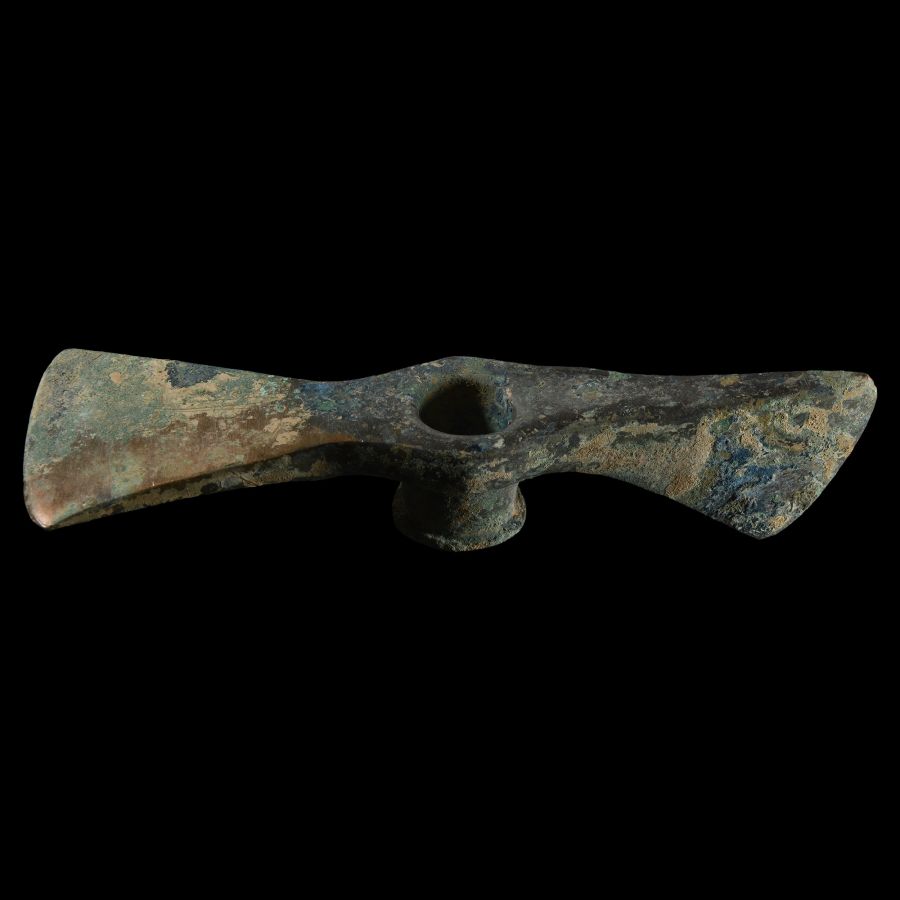
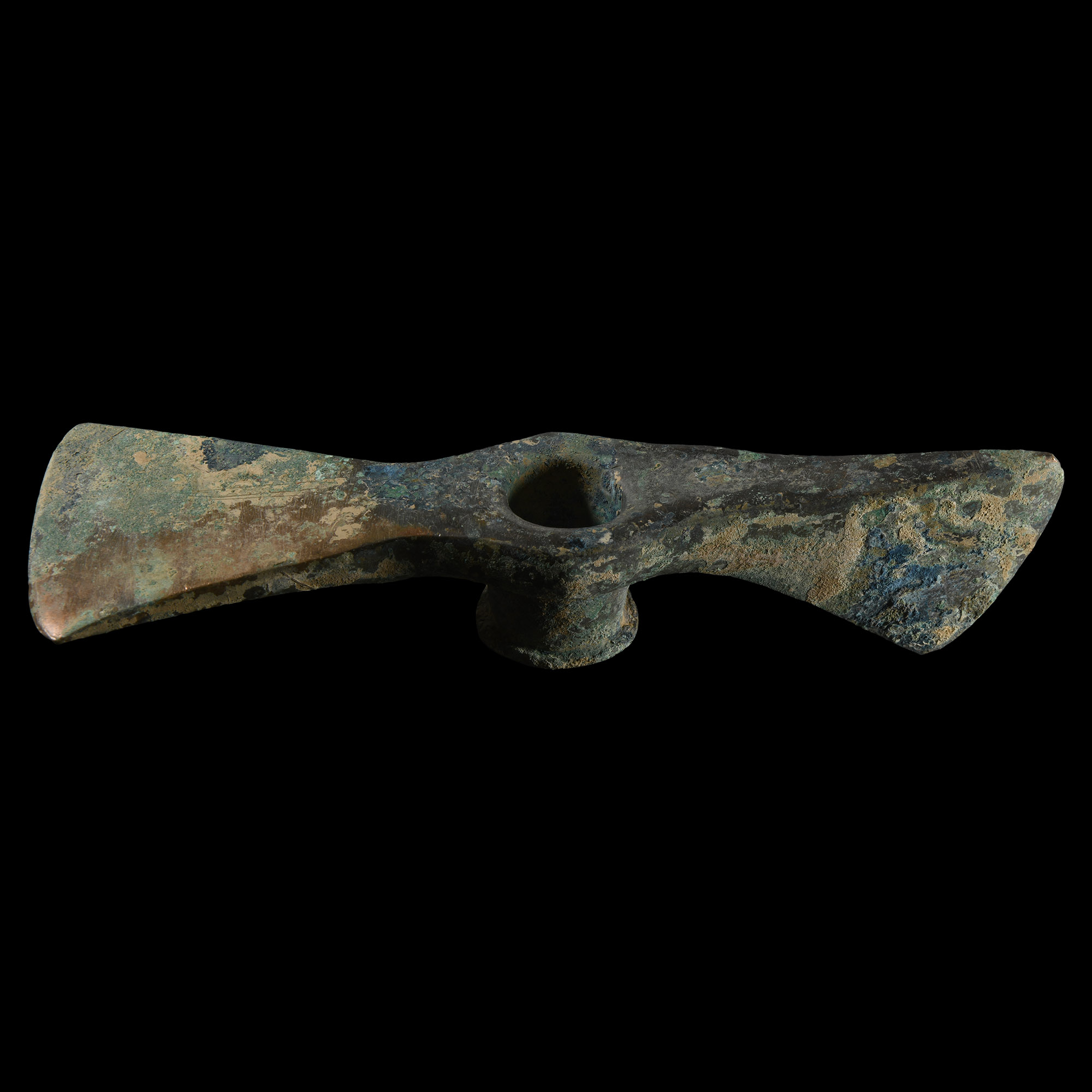
Large Western Asiatic Bronze Adze-Axehead
2ND-1ST MILLENNIUM B.C.
9 7/8 in. (1.1 kg, 25 cm).
Composed of a central cylindrical socket with collar to base and gently triangular flanges to upper face, a wedge-shaped adze-head to one side and a wedge-shaped axe head to the other, both with gently convex cutting edges.
ProvenanceAcquired 1980-2015.
Ex Abelita family collection.
TimeLine Auctions follows a vetting process to ensure the authenticity and legality of all items, reinforcing our commitment to integrity and responsible trading. Each antiquity, antique, and coin lot undergoes thorough examination by a vetting committee of at least ten external specialists, professional trade association members, scientists, and archaeologists: Our Vetting Process
AUCTIONS:
TimeLine is a leading auction house specialising in antiquities, ancient art, collectables, natural history, coins, medals, and books. Our auctions offer museums, collectors, historians, and enthusiasts the opportunity to acquire unique and historically significant pieces.
-
.jpg)
Cromwellian Pikeman's Pot Helmet
1642-1651 A.D.Sold for (Inc. bp): £2,340
Of Morion Cabasset Type, the iron bowl composed of two rivetted parts with a crest; plume holder to the rear; wide sloping brim with smooth border and rivets; repaired. 1.16 kg, 35 cm
Ex Michael D Long Ltd, UK. The Kusmirek Collection, UK. Accompanied by an academic report by Dr Raffaele D'Amato. This lot has been checked against the Interpol Database of stolen works of art and is accompanied by search certificate number no.11769-204122.
A complete set of pikeman's armour consisted of a gorget, back and breast plates, and tassets. With the outbreak of the Civil War, obsolete equipment which had been stored in the Tower of London or in private armouries was brought into service together with more modern equipment. Helmets of this type were often furnished of cheek-pieces made of horizontal rows of blades. -
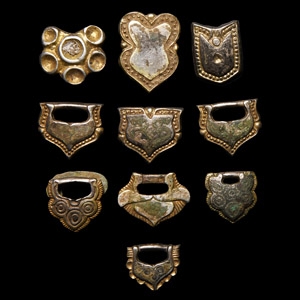
Volga Silver-Gilt Sword Belt Mount Group
11th-12th century A.D.Sold for (Inc. bp): £195
Comprising: two matching ogival plates with pellet borders; a trefoil plate with border of radiating lines framing three concentric circle and oval motifs; a plate with five lobes decorated with dashed lines and six concentric oval motifs at the centre; ogival plate with scalloped border, trefoil motif at centre; ogival plate with pellet border divided into three 'petals' by larger single pellets, scrolling vegetal motif; a floral style plate composed of discoid dimples; irregular hexagonal plate, the shape repeated at the centre, pellet border; trilobate plate with three single pellets to the perimeter and pellet border; ogival plate with expanded waist, raised 'wings' and rounded lozenge against a background of radiating lines; nine with three attachment lugs to reverse, one with two lugs. 31.8 grams total, 17-26 mm
Fine condition.
Acquired in the 1980s-1990s. Ex an important central London gallery, London W1.
The belt fittings find various comparisons with non-ferrous belt appliqués found in the territories of the Volga Bulgars, like specimens from the Semenovsky village. These items were parts of long warrior belts, the leather surfaces decorated all over with such bronze and silver appliqués. Symbols of ranks and elite warrior aristocracy, these belts also served a utilitarian purpose of suspending weapons such as a bow, quiver or a sabre. -
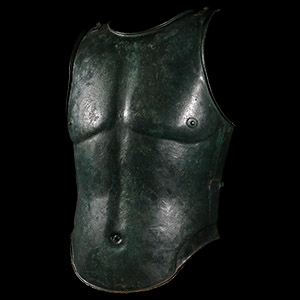
Roman Style Bronze Cuirass
20th century A.D.Sold for (Inc. bp): £715
Modelling a muscular male torso with naturalistic anatomical detailing. 1.49 kg, 53 cm high
Acquired 1990s-early 2000s. East Anglian private collection.
