
Loading, please wait...
_900x900.jpg "Large Viking Age Silver Bucket with Animal Figures")
_200x200.jpg "Large Viking Age Silver Bucket with Animal Figures")
_900x900.jpg "Large Viking Age Silver Bucket with Animal Figures")
_200x200.jpg "Large Viking Age Silver Bucket with Animal Figures")
.jpg "Large Viking Age Silver Bucket with Animal Figures")
.jpg "Large Viking Age Silver Bucket with Animal Figures")
LOT 0361
Large Viking Age Silver Bucket with Animal Figures
8TH-9TH CENTURY A.D.
10 1/2 in. (1.2 kg, 26.5 cm wide).
A spectacular Sogdian sheet-silver bucket with drum-shaped body, narrow discoid repoussé base, bands of repoussé foliage to the body beneath a raised collar and fluted neck and rim; handle held by two securing hoops formed as miniature rams.
ProvenanceFrom an old private collection.
with Oxus Fine Arts Pte. Ltd, Singapore.
Acquired by the current owner in London, 2012.
This lot has been checked against the Interpol Database of stolen works of art and is accompanied by a search certificate number no.12288-220840.
See Sasanian Silver. Late Antique and Early Medieval Arts of Luxury From Iran. August-September 1967, The University of Michigan Museum of Art, Michigan, 1967; Marshak, B.I., Sogdiiskoe serebro. Ocherki po vostochnoi torevtike, Moscow, 1971; Fehervari, G., Islamic Metalwork of the Eighth to the Fifteenth Century in the Keir Collection, London, 1976; Darkevich, V.P., Khudozhestvennyi metall Vostoka VIII-XIIIvv. Proizvedeniia vostochnoi torevtiki na territorii evropeiskoi chasti SSSR i Zaural'ia (Extensive analysis and description of the Eastern metal work of the 8th-13th centuries found in European Russia and Siberia), Moscow, 1976.
FootnotesDr. Grigoriev, in his studies on Sogdian silver artworks, has traced specific Sogdian features of metalwork prototypes on the basis of the ceramic replicas. Some of these features were distinguished on gold and silver vessels which possess many other characteristics bringing them together. In our bucket, the style and the decoration of the flowers resemble those of the bucket with deer from Shirokovskoe (Perm, see Marshak, 1971, T,35), while the bands of repoussé foliage to the body beneath the raised collar and fluted neck and rim recall the decoration of the dish with deer from Rep’evka, in Samara Province (Darkevich, 1976, n.12).
CONDITIONTimeLine Auctions follows a vetting process to ensure the authenticity and legality of all items, reinforcing our commitment to integrity and responsible trading. Each antiquity, antique, and coin lot undergoes thorough examination by a vetting committee of at least ten external specialists, professional trade association members, scientists, and archaeologists: Our Vetting Process
AUCTIONS:
TimeLine is a leading auction house specialising in antiquities, ancient art, collectables, natural history, coins, medals, and books. Our auctions offer museums, collectors, historians, and enthusiasts the opportunity to acquire unique and historically significant pieces.
LOT 0361
Large Viking Age Silver Bucket with Animal Figures
Estimate £30,000 - 40,000€34,800 - 46,400 (for guidance only)$40,500 - 54,000 (for guidance only)
-
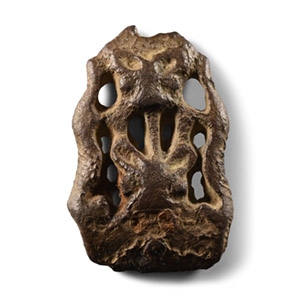
Anglo-Scandinavian Viking Bronze Stirrup Mount with Bear's Heads
11th century A.D.Sold for (Inc. bp): £130
Openwork mount of Williams's Class A Type 16, tongue-shaped with tendrils and two facing bears' heads, vestigial ledge to rear and ferrous stud. 27.1 grams, 47 mm
Found Norfolk, UK. From an old private collection of Norfolk, UK, gentleman, formed since 1998.
The form with two stacked facing masks is unusual, although mounts of Class B regularly feature multiple heads. -
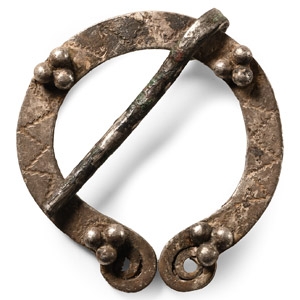
Viking Period Silver Penannular Brooch
10th-12th century A.D.Sold for (Inc. bp): £72
Flat-section with pointillé zigzag to the obverse, coiled finials, four granule cluster, sturdy round-section pin. 4.71 grams, 30 mm
UK private collection before 2000. Acquired on the UK art market. Property of a London gentleman. -
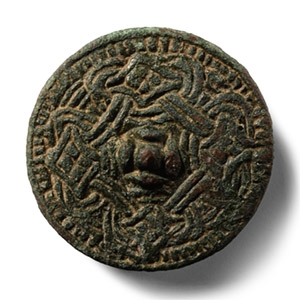
'The Holt' Anglo-Scandinavian Viking Bronze Borre Brooch
11th century A.D.Sold for (Inc. bp): £910
With low-relief Borre style looped tendrils motif, lug and catch to the reverse. 10.4 grams, 29 mm
Found near Holt, Norfolk, UK. From an old private collection of Norfolk, UK, gentleman, formed since 1998.
