
Loading, please wait...
LOT 1501
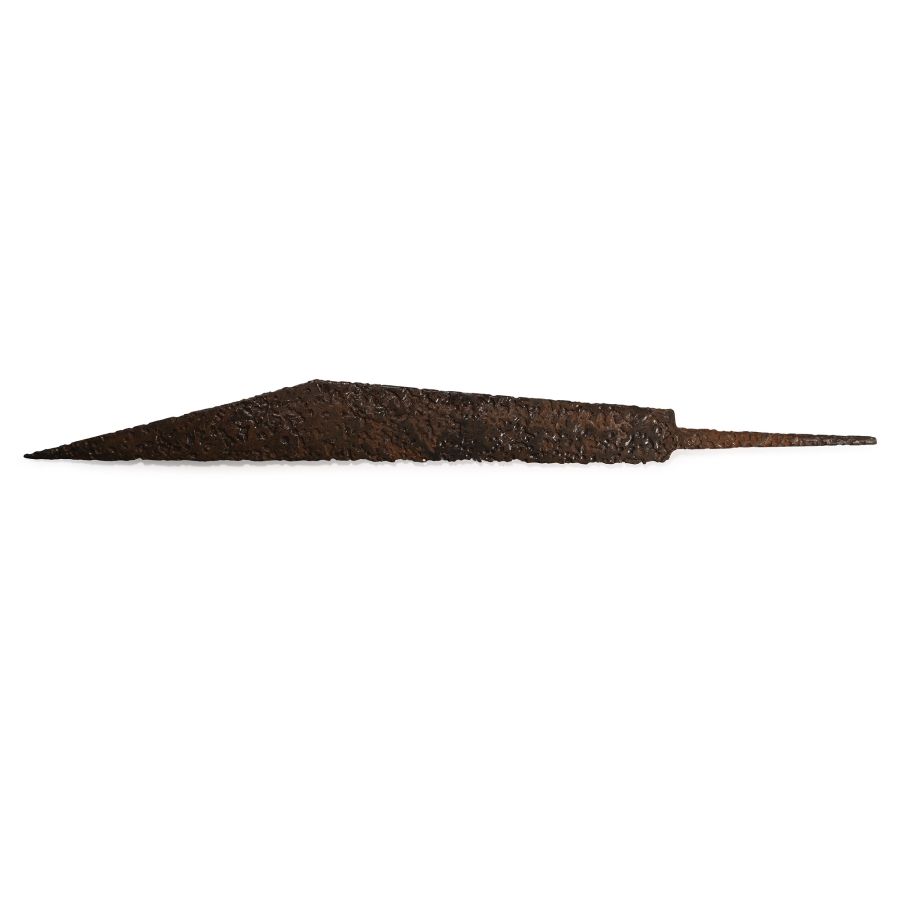
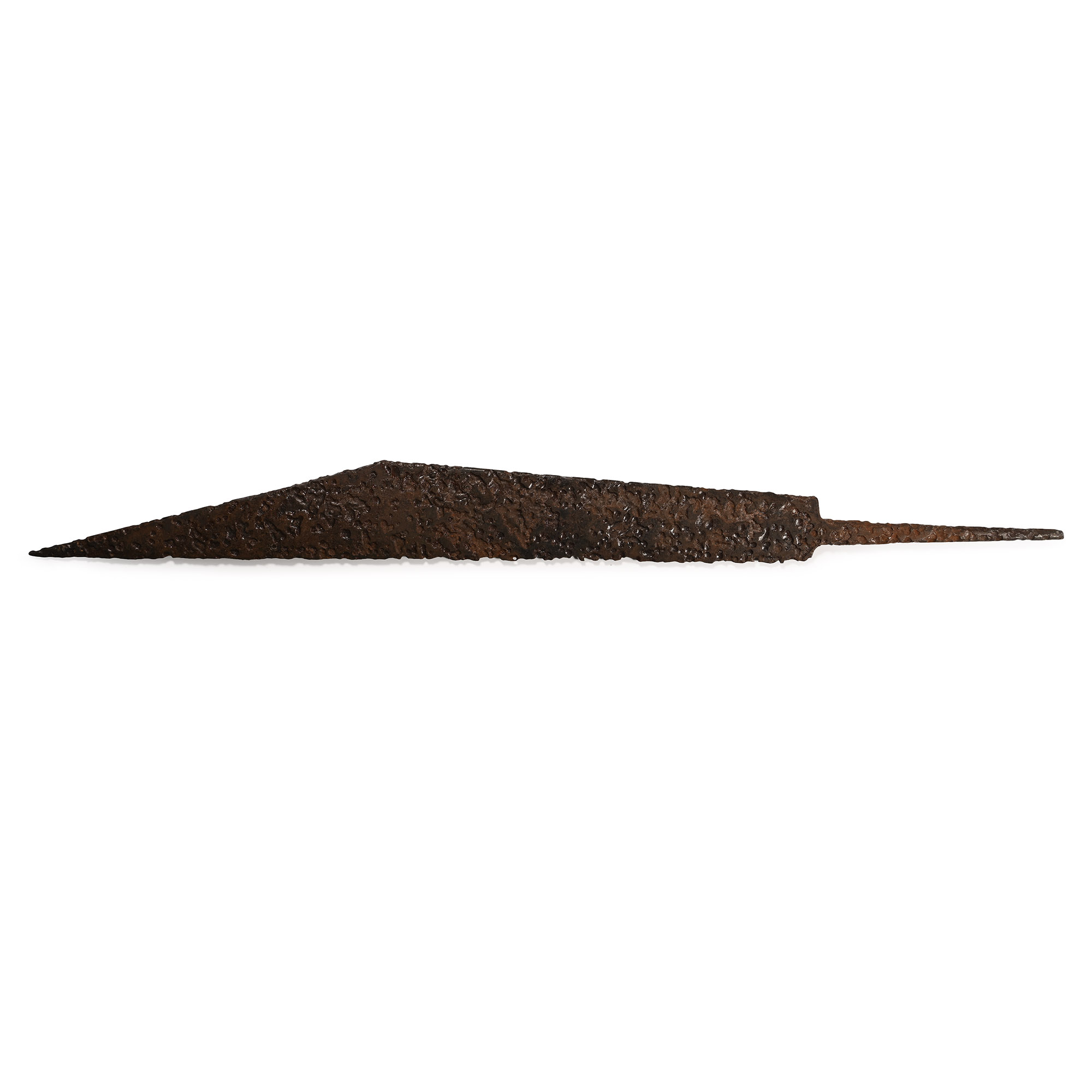
Large Viking Age Iron Broken-Backed Knife 'Seax' Blade
8TH-10TH CENTURY A.D.
14 5/8 in. (208 grams, 37.5 cm).
With scooped forward edge, straight single edge and arched triangular back; transverse mounting tang. [No Reserve]
ProvenanceFrom a North American collection formed in the 1970s-1990s.
This lot is accompanied by an illustrated lot declaration signed by the Head of the Antiquities Department, Dr Raffaele D'Amato.
Exhibited at the Harwich Museum, Harwich, Essex, UK, 12th March-9th June 2025; accompanied by a copy of a photograph of the artefacts on display.
LiteratureCf. The British Museum's Portable Antiquities Scheme (PAS) no.GLO-B663A3, for a similar knife; and Underwood, R., Anglo-Saxon, Weapons & Warfare, Stroud, 1999, p.69.
FootnotesThis knife seems to be of type IV, like the one found in the Thames at Wandsworth. Based on its similarities with a specimen from Canterbury, it could be dated to the 8th century A.D. Underwood classifies these kind of knives under the typology C (angled back-curved cutting edge) dating them from the mid 6th to early 8th century A.D.
CONDITIONTimeLine Auctions follows a vetting process to ensure the authenticity and legality of all items, reinforcing our commitment to integrity and responsible trading. Each antiquity, antique, and coin lot undergoes thorough examination by a vetting committee of at least ten external specialists, professional trade association members, scientists, and archaeologists: Our Vetting Process
AUCTIONS:
TimeLine is a leading auction house specialising in antiquities, ancient art, collectables, natural history, coins, medals, and books. Our auctions offer museums, collectors, historians, and enthusiasts the opportunity to acquire unique and historically significant pieces.
-
.jpg)
Achaemenid Akinakes with Horse-Head Hilt and Gold Chain
6th-4th century B.C.Sold for (Inc. bp): £9,100
The upper part of the hilt shaped as a horse-head with an applied sheet-gold mane, wearing a gold bridle of Greek typology adorned with rosettes, mouthpiece formed of wire with garnet beads, and a large garnet cabochon set at the front of the bridle; the upper hilt connected to the straight blade with a restored grip; accompanied by a perspex scabbard with original gold sheet attached; possibly a marriage; mounted on a custom-made display stand. 392 grams, 36.5 cm (473 grams total, 37.6 cm high including stand)
Private collection of a London gentleman, acquired between 1965–2020. This lot has been checked against the Interpol Database of stolen works of art and is accompanied by search certificate number no.12619-235454. This lot has been cleared against the Art Loss Register database, and is accompanied by an illustrated lot declaration signed by the Head of the Antiquities Department, Dr Raffaele D'Amato.
The akinakes was the short dagger of the Scythians and the Achaemenid Persians. Many examples of this characteristic weapon have been found in every corner of the Persian Empire. The hilt was often made of bronze, gold or gilded. It is visible in the hands of the Medes and Persians in the reliefs of Persepolis. These weapons, straight and double-edged, were about 35 cm long. The scabbards could be covered with gold, hung from the belt at the waist and, according to Herodotus, attached to the right thigh with a thong. -
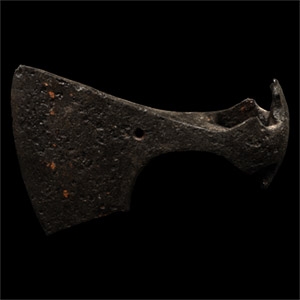
Viking Age Bearded Battle Axehead
Early 11th-12th century A.D.Sold for (Inc. bp): £234
A Baltic hand-forged iron axehead with scooped socket, broad blade with extension to the lower edge, hole to the blade. 532 grams total, axe: 14.7 cm
Acquired on the London art market, 1990s. Private collection, London. This lot is accompanied by an illustrated lot declaration signed by the Head of the Antiquities Department, Dr Raffaele D'Amato.
The more common weapons of Finno-Ugrian people were axes, commonly found from all Finnic areas, as well as spears. Among Baltic-Finnic people, especially in Finland and Karelia, knives called 'puukko' were common, as well as axes, spears, flat bows and longbows, while swords were usually imported from Germanic areas, Sweden or from elsewhere Scandinavia, some having often typically Scandinavian animal ornaments. Iron axeheads of this typology show a sub-trapezoidal asymmetrical blade, often perforated through the centre. They are characterised by two projecting spurs from the top and the bottom of the back of the shaft-hole. -
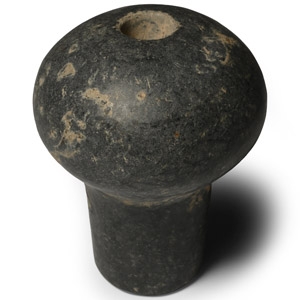
Western Asiatic Stone Macehead
3rd-2nd millennium B.C.Sold for (Inc. bp): £169
With plain globular body, circular short shaft expanding to a circular flat base. 386 grams, 83 mm
From the collection of a London, UK, gentleman, 1990s. This lot is accompanied by an illustrated lot declaration signed by the Head of the Antiquities Department, Dr Raffaele D’Amato. This lot is accompanied by an illustrated lot declaration signed by the Head of the Antiquities Department, Dr Raffaele D'Amato.
