
Loading, please wait...
LOT 0316
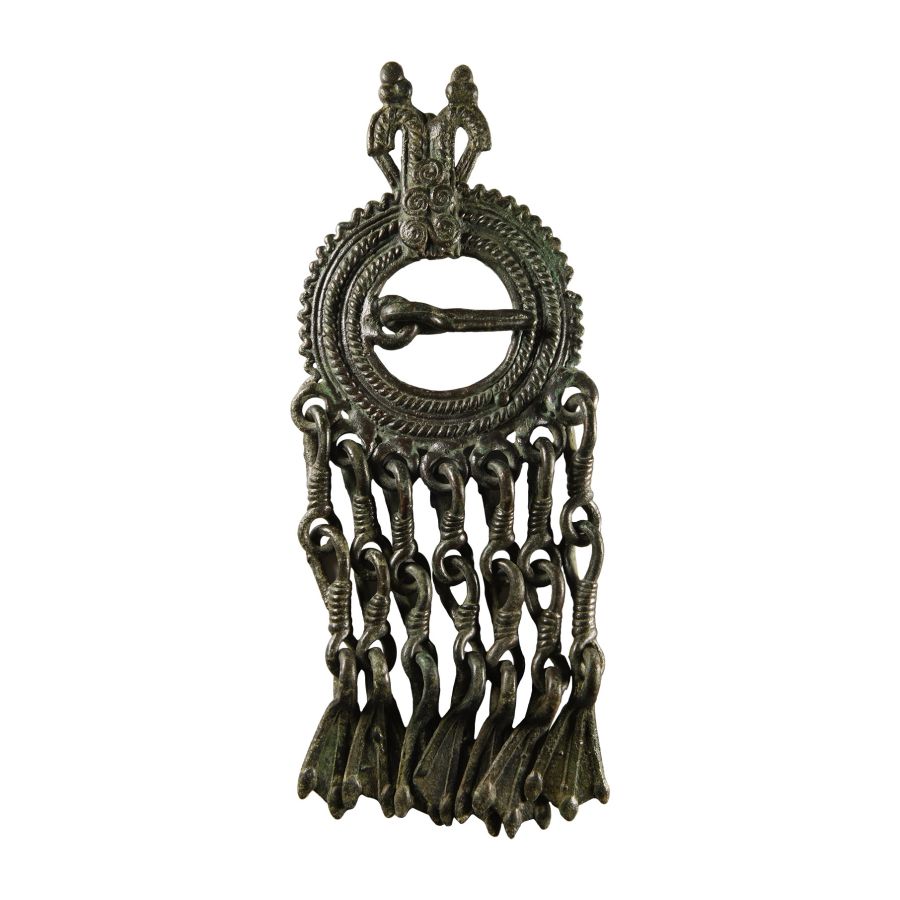
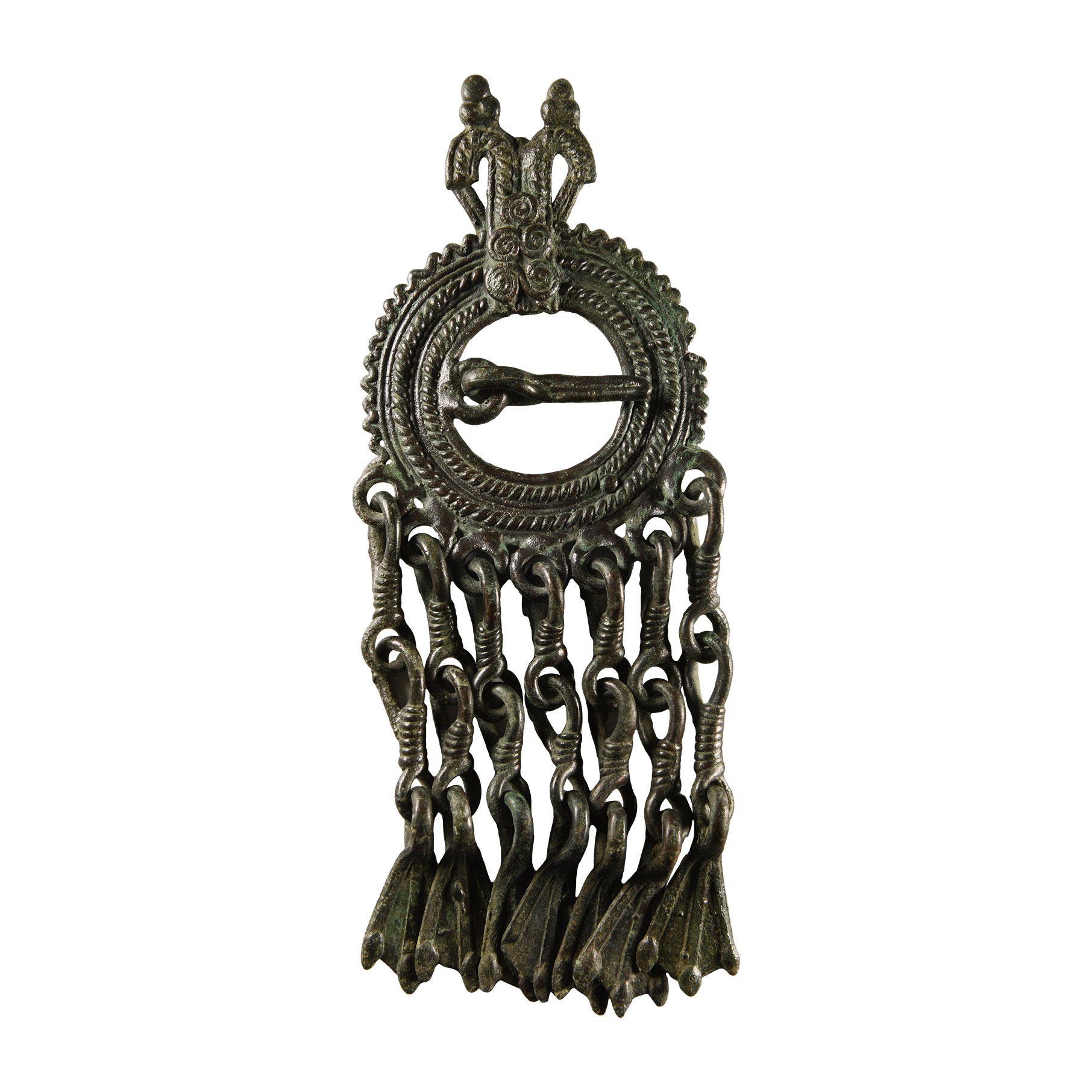
Large Viking Age Bronze Brooch with Duck-Foot Pendants
8TH-10TH CENTURY A.D.
6 1/2 in. (157 grams, 16.5 cm).
Comprising a broad hoop with beaded base and rim, small bronze pin, bands of applied beading; above, plaque with applied scrolls and beading, granule clusters; to the lower edge an arc of loops each with a pendant chain and duck-foot dangle; Finno-Ugric type.
ProvenanceFrom the private collection of a London gentleman, from his grandfather's collection formed before the early 1970s.
LiteratureCf. Sedov, B.B., Finno-Ugri i Balti v Epokhi Srednevekovija, Moscow, 1987, tables XX, and LI, for development of the type.
CONDITIONTimeLine Auctions follows a vetting process to ensure the authenticity and legality of all items, reinforcing our commitment to integrity and responsible trading. Each antiquity, antique, and coin lot undergoes thorough examination by a vetting committee of at least ten external specialists, professional trade association members, scientists, and archaeologists: Our Vetting Process
AUCTIONS:
TimeLine is a leading auction house specialising in antiquities, ancient art, collectables, natural history, coins, medals, and books. Our auctions offer museums, collectors, historians, and enthusiasts the opportunity to acquire unique and historically significant pieces.
-
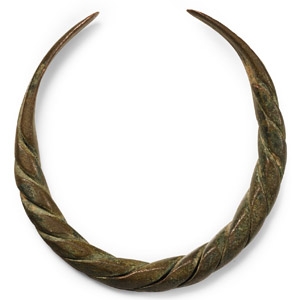
Viking Age Bronze Twisted Bracelet
9th-11th century A.D.Sold for (Inc. bp): £78
Formed with twisted rods, flat finials with incised geometric ornament. 36.3 grams, 63 mm
Private collection, Arundel, West Sussex, UK, 1975-late 1990s. -
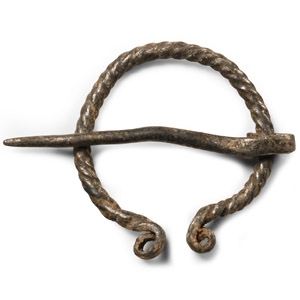
Viking Period Twister Silver Brooch with Pendant
9th-11th century A.D.Sold for (Inc. bp): £72
Comprising a twisted penannular body with scrolled finials and a free-running tapering pin. 3.03 grams, 35 mm
UK private collection before 2000. On the UK art market. Property of a London gentleman. -
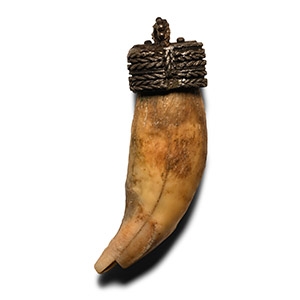
Viking Age Silver Pendant with Bear's Tooth
9th-11th century A.D.Sold for (Inc. bp): £312
Comprising the canine tooth of a wolf or large dog, with silver filigree collar and suspension loop. 15.5 grams, 56 mm
From the private collection of a London gentleman, from his grandfather's collection formed before the early 1970s.
