
Loading, please wait...


LOT 0312
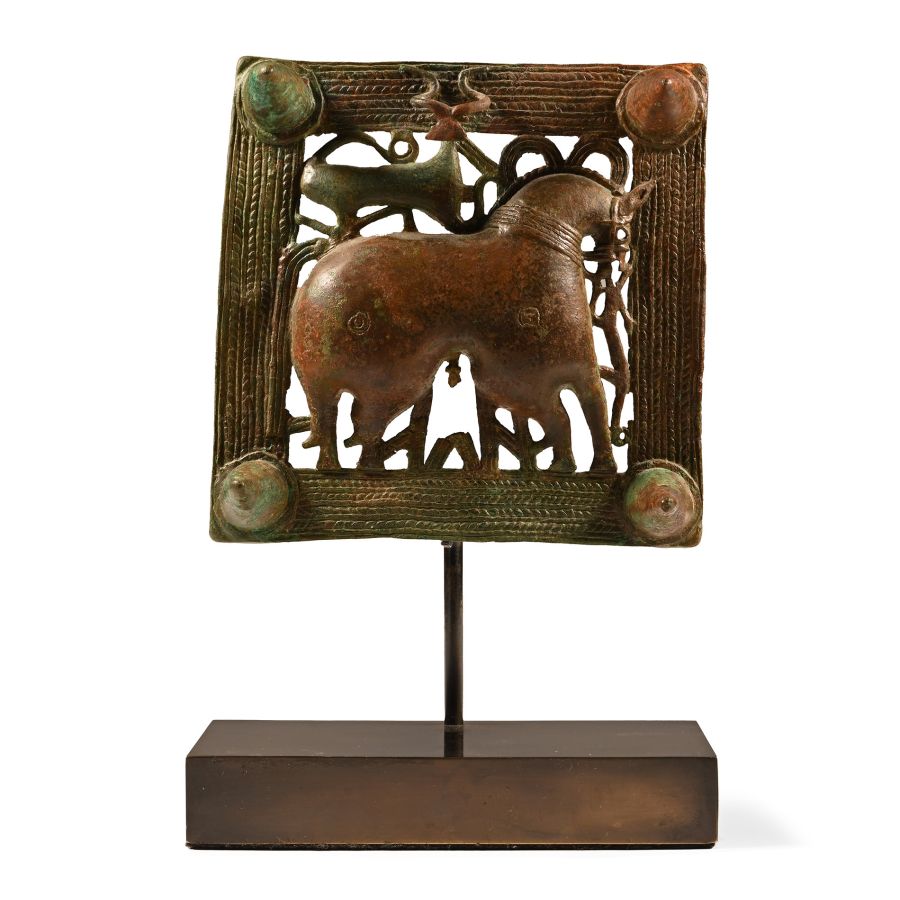
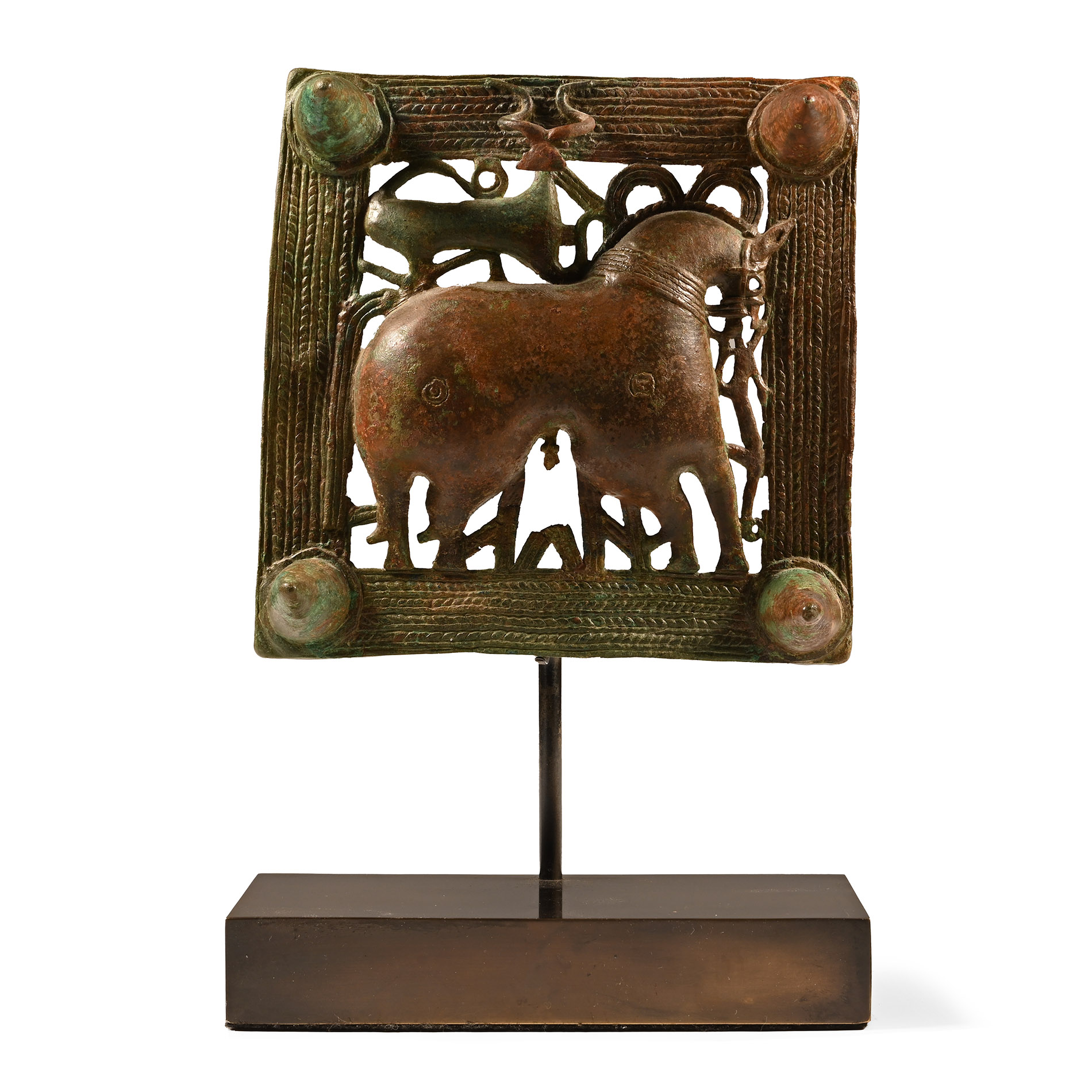
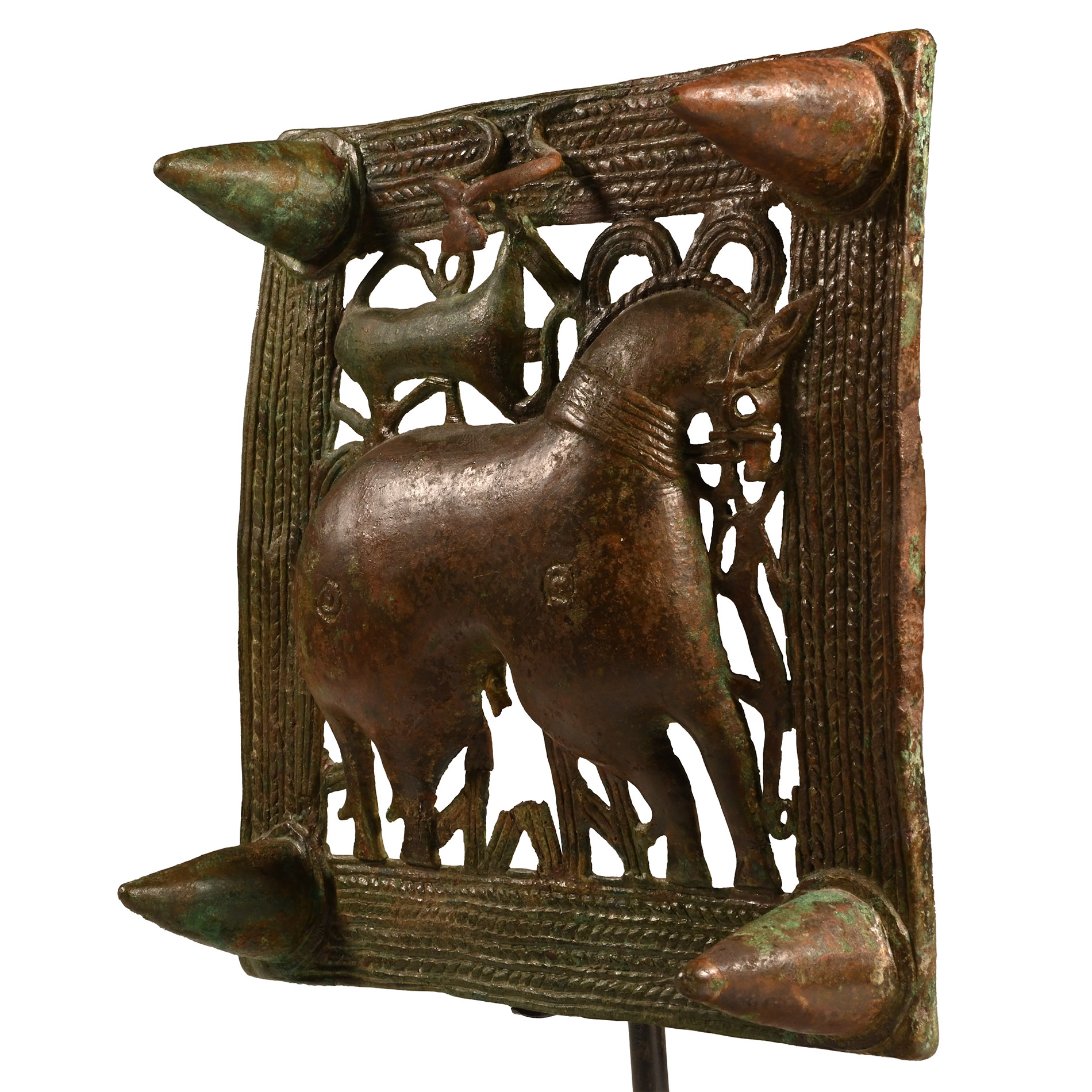
Large Transcaucasian Armour Belt Clasp
1ST CENTURY B.C.-2ND CENTURY A.D.
9 5/8 in. (752 grams total, 24.5 cm high including stand).
Openwork belt fastening-plate comprising: square frame with parallel bands of ropework, a tall conical boss with basal flange at each corner; central figure of an advancing horse with head bowed, hollow to the reverse, with braided halter to the neck and bridle to the muzzle; incised ring-and-dot motif to shoulder and hip; above the horse's back a small quadruped with head turned to face the viewer, triangular muzzle and two curved horns (perhaps an ibex); openwork vegetation around the beasts and between the horse's legs, long-tailed animal gripping the halter (perhaps a squirrel); fixing loop and triangular catch to the reverse; mounted on a custom-made stand.
ProvenanceGerman art market.
European private collection, 1970s-early 2000s.
Acquired from the above; thence by descent.
Private collection, London, UK.
Accompanied by an academic report by Dr Raffaele D'Amato.
This lot has been checked against the Interpol Database of stolen works of art and is accompanied by a search certificate number no.12284-221444.
Cf. Denwood, P., Archaeology in Asia, volume 7, University of London, June 27-29, London, 1977, p.106, no.138; Ettinghausen, R., Das Pferd in der Orientalischen Kunst in Du: das Kulturmagazin, Bd.6, Zurich, 1978, pp.64-73; Muscarella, O.W., Bronze and Iron: Ancient Near Eastern Artifacts in The Metropolitan Museum of Art, New York, 1988, p.439, no.584.
FootnotesMany bronze belt fittings of this type are in the collection of the Metropolitan Museum of Art, New York, (Muscarella, 1988, items 581-4). Muscarella (p.440) notes that a total of 181 were known at the time of his publication (1988).
CONDITIONTimeLine Auctions follows a vetting process to ensure the authenticity and legality of all items, reinforcing our commitment to integrity and responsible trading. Each antiquity, antique, and coin lot undergoes thorough examination by a vetting committee of at least ten external specialists, professional trade association members, scientists, and archaeologists: Our Vetting Process
AUCTIONS:
TimeLine is a leading auction house specialising in antiquities, ancient art, collectables, natural history, coins, medals, and books. Our auctions offer museums, collectors, historians, and enthusiasts the opportunity to acquire unique and historically significant pieces.
-
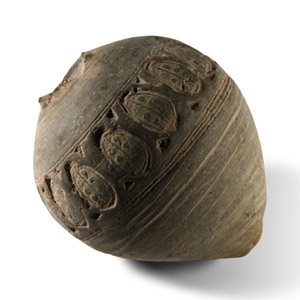
Byzantine 'Greek Fire' Ceramic Fire Bomb or Hand Grenade
9th-11th century A.D.Sold for (Inc. bp): £98
A piriform ceramic missile with band of impressed roundels to the shoulder and filler-hole above, intended to be filled with explosive liquid and wick, used as a hand grenade. 567 grams, 10.5 cm
From a military inspired collection formed from the 1990s. Accompanied by an academic paper by military specialist Dr Raffaele D'Amato, dated 15 July 2019 and titled 'Eastern Roman Empire - Greek Fire Bomb or Hand Grenade (μεσαίον kακάβιον) 9th-11th century AD'.
Apart from the use of siphons or manual flame-throwers called cheirosiphona, special corps of Roman soldiers employed terracotta grenades, in the form of small jars, abundantly evidenced in archaeological excavations. They were called μεσαία kακαβιά or κυτροκακάβια where the former had a bulbous shape and the latter a more cylindrical form. -
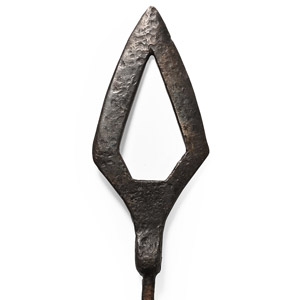
Large Medieval Iron Incendiary Fire Arrowhead
Circa 12th-14th century A.D.Sold for (Inc. bp): £442
A tanged arrowhead with openwork lozengiform blade, the centre with a truncated vesica-shaped void. 52 grams, 21 cm
Acquired on the French art market. From the private collection of a Buckinghamshire, UK, gentleman.
The central void was included to allow cloth soaked in tallow to be bound around the arrowhead; this was ignited before shooting. -
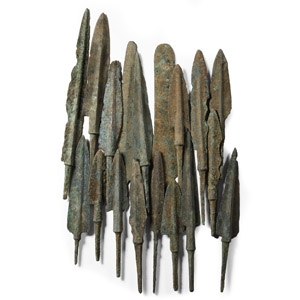
Luristan Bronze Arrowhead Collection
Circa 2nd millennium B.C.-9th century B.C.Sold for (Inc. bp): £234
Including triangular, leaf-shaped, barbed, square-section, and other types. 446 grams total, 10-17.5 cm
Ex London, UK, collection, 1990s.
It is significant to remember that the use of winged and barbed heads in Anatolia was common since the second millennium B.C., but apparently their employment began earlier in this area, where types like these occur alongside the non-barbed, predominantly ribbed and tanged types.
