
Loading, please wait...
LOT 1087
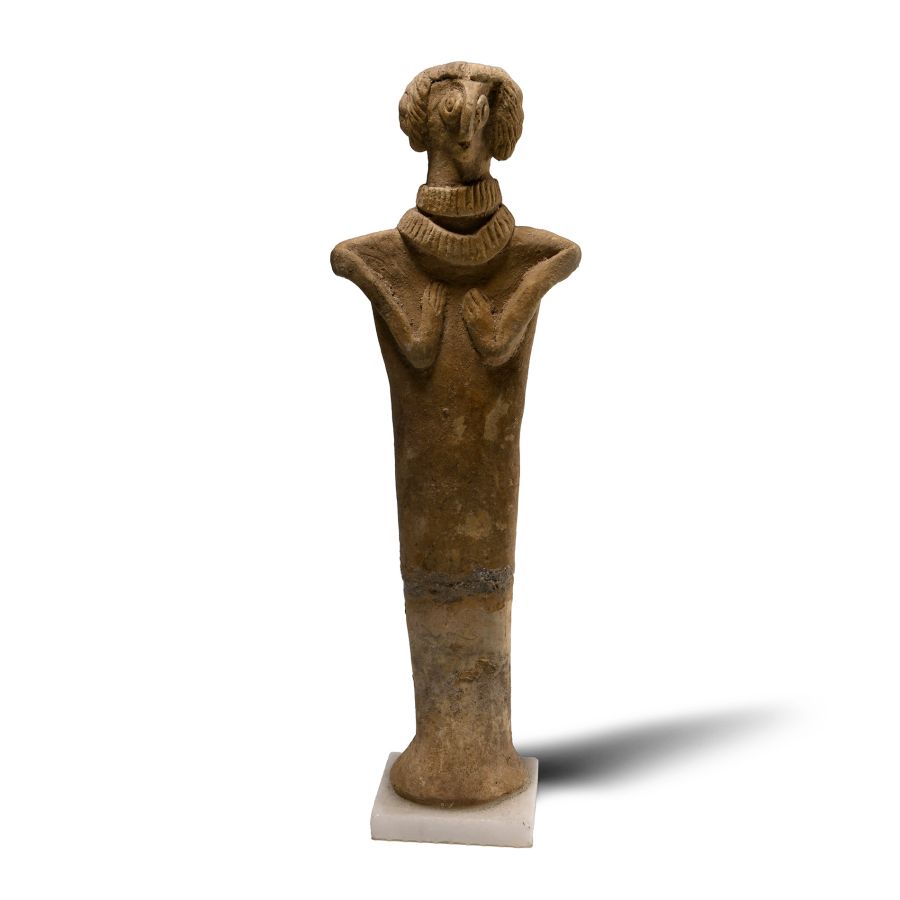
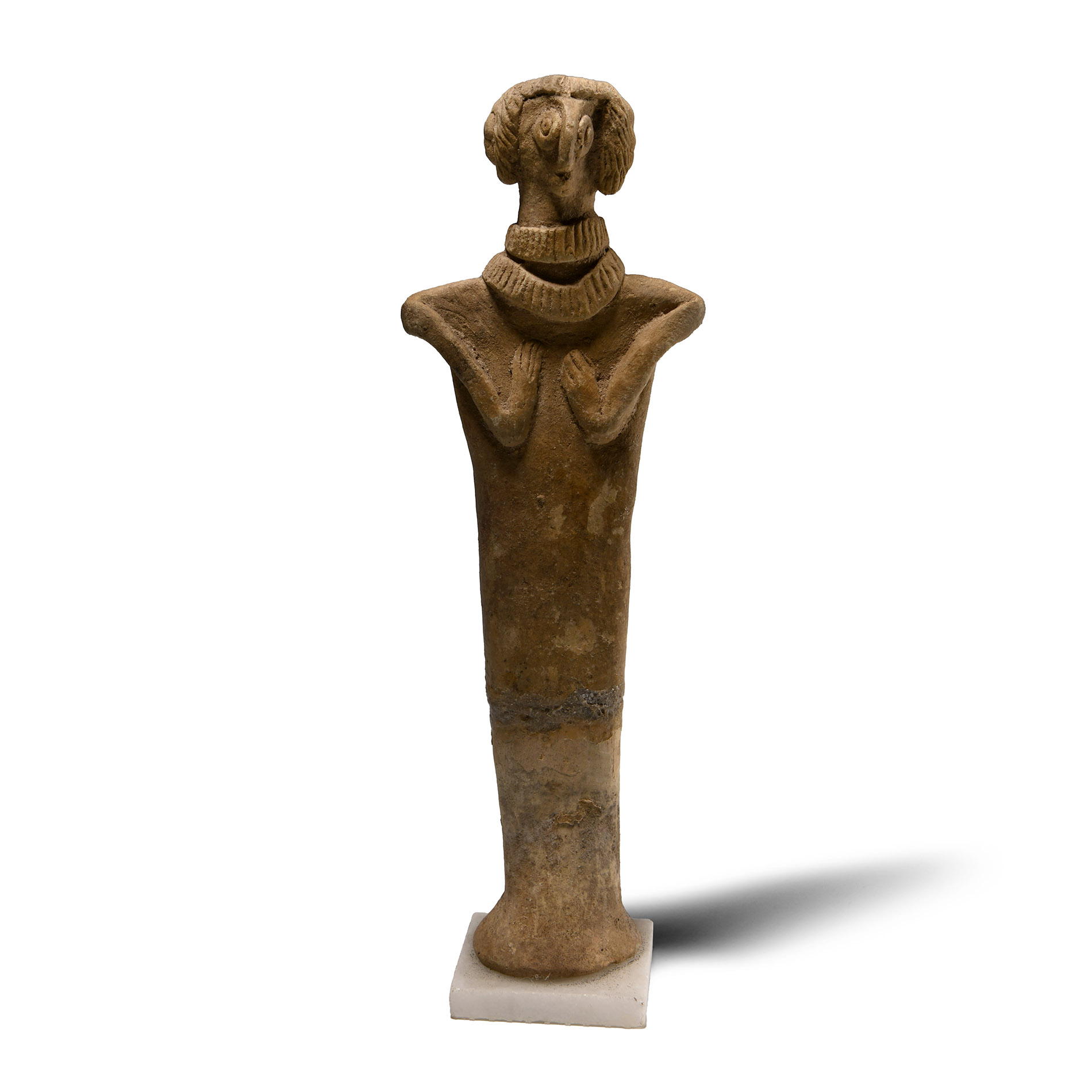
Large Syro-Hittite Terracotta Goddess Idol
1500-500 B.C.
9 in. (260 grams total, 23 cm high including stand).
Standing female deity (Astarte?), wearing a long cloak and two broad necklaces; arms bent and hands placed on the chest; mounted on a custom-made stand; repaired. [No Reserve]
ProvenanceFrom a collection acquired on the UK art market from various auction houses and collections mostly before 2000.
From an important Cambridgeshire estate; thence by descent.
TimeLine Auctions follows a vetting process to ensure the authenticity and legality of all items, reinforcing our commitment to integrity and responsible trading. Each antiquity, antique, and coin lot undergoes thorough examination by a vetting committee of at least ten external specialists, professional trade association members, scientists, and archaeologists: Our Vetting Process
AUCTIONS:
TimeLine is a leading auction house specialising in antiquities, ancient art, collectables, natural history, coins, medals, and books. Our auctions offer museums, collectors, historians, and enthusiasts the opportunity to acquire unique and historically significant pieces.
-
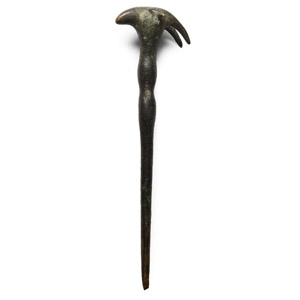
Hasanlu Bronze Pin with Ram's Head Finial
9th-8th century B.C.Sold for (Inc. bp): £130
With a tapering round-section shank, finial topped with a ram's head. 110 grams, 16.5 cm
From the collection of late George Withers, UK. Acquired from Dore and Rees, UK. Property of Mr A.B., an American collector.
The corpus of pins from Hasanlu includes simple plain pins, pins with lion's head and other zoomorphic pins. The zoomorphic pins were either cast onto a bronze shank or the pin was inserted into a hollow of the head. A third category was that of the pins cast in one piece, like our specimen, representing a goat or mouflon, an animal often depicted in the North-West Persian material culture. -
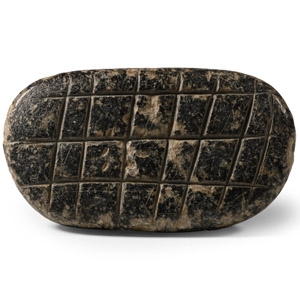
Western Asiatic Black Stone Seal with Cross
4th millennium B.C.Estimate: £200 - 300 (+bp*)
Opening Bid: £100
Carved in the round, ellipsoid in plan with handle formed as a recumbent beast; underside with incised hatching; incised cross to one edge of the handle. 124 grams, 64 mm
Collected from 1970-1999. From the collection of the late Mr S.M., London, UK. -
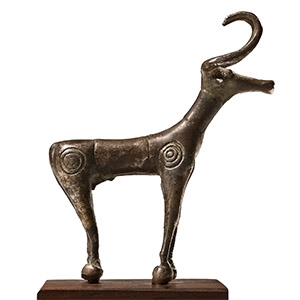
Syro-Hittite Silver Standing Stag
12th-8th century B.C.Sold for (Inc. bp): £13,000
Modelled in the round standing with head raised, recurved horns or antlers, slender muzzle with mouth detailing, incised ring-and-dot motif to shoulders and hips; mounted on a custom-made stand. 69.2 grams total, 80 mm high including stand
London art market, 1978. This lot has been checked against the Interpol Database of stolen works of art and is accompanied by a search certificate number no.12263-220844.
Stylistically, the item shares features with the Hattian stag figurine found in the royal tombs in Alacahöyük (now in the Museum of Anatolian Civilizations, Ankara, Turkey) and dating from the period 2100-2000 B.C. The use of ring-and-dot embellishments to the flanks is suggestive of some cultural continuity. The animal depicted is probably an ibex rather than a European stag. However, a date of manufacture in the period after the fall of the Hittite Empire in the 12th century B.C. seems more probable.
