
Loading, please wait...
LOT 0380
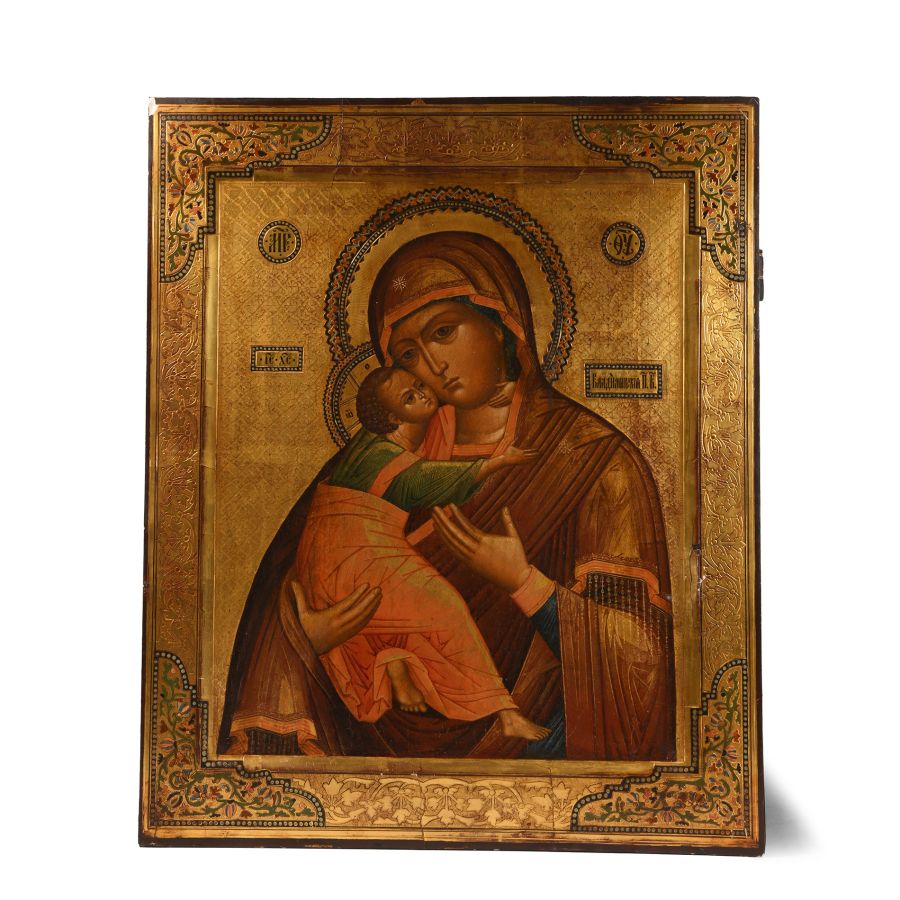
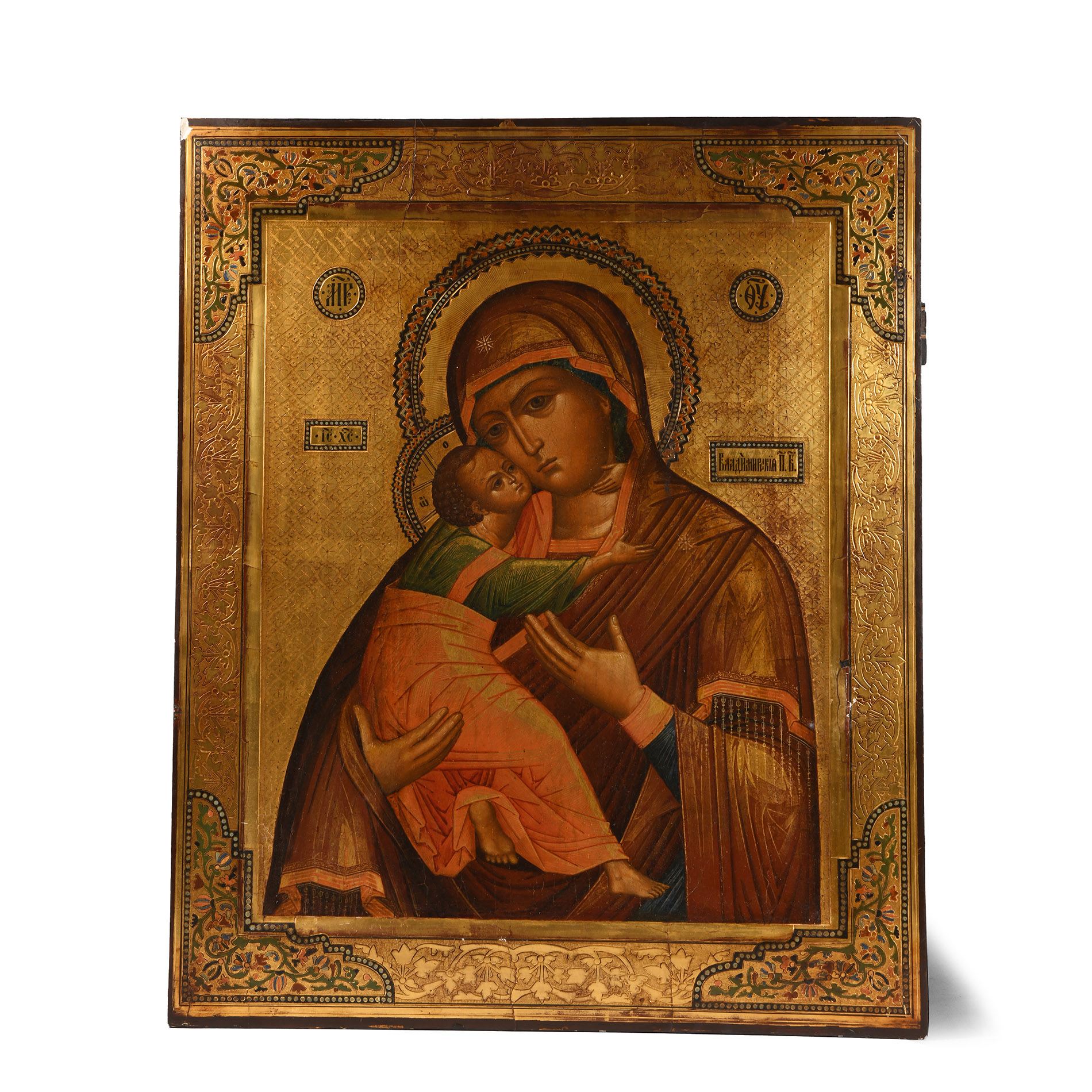
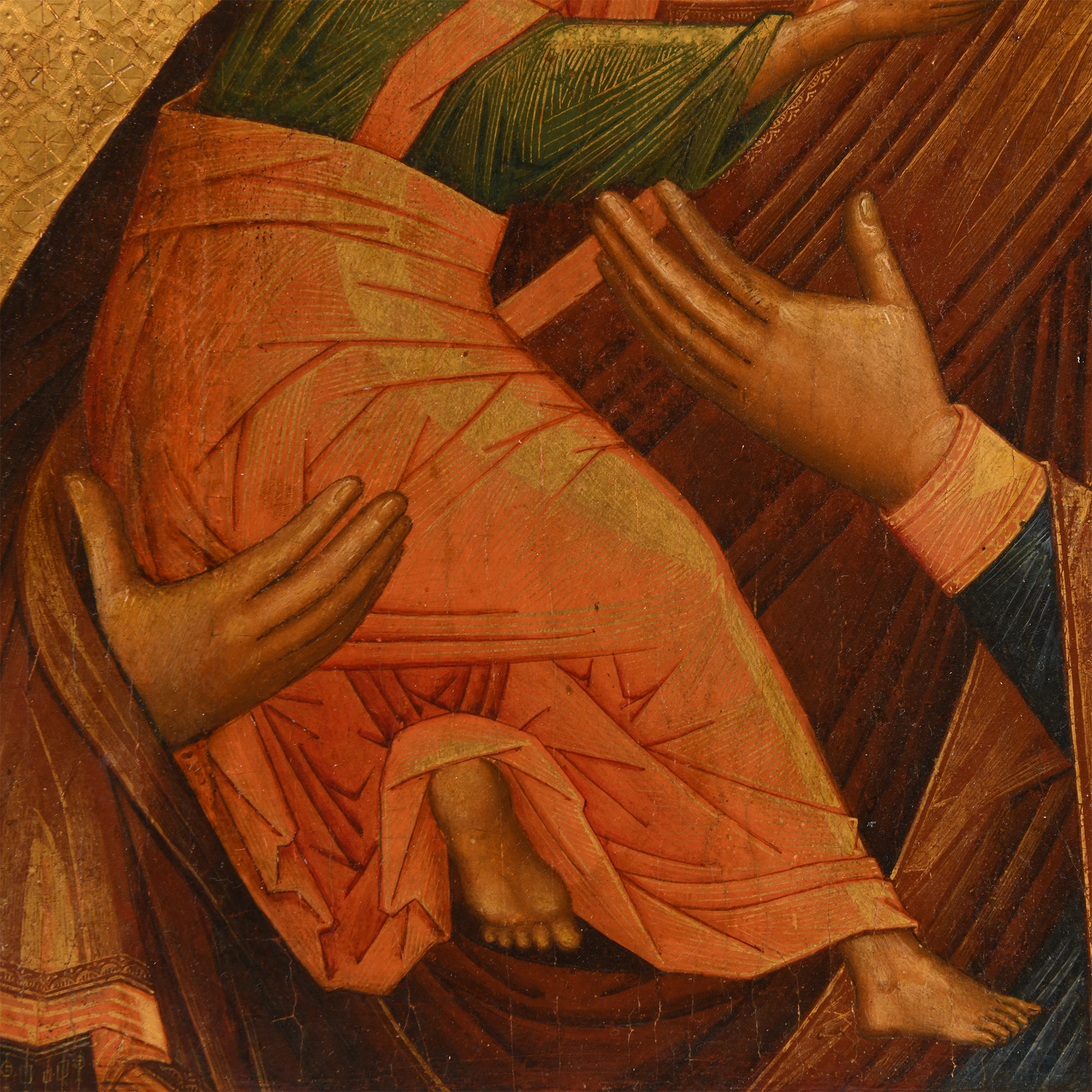
Large Russian Virgin of Vladimir Icon
CIRCA 1860 A.D.
22 1/4 x 18 1/8 in. (6.5 kg, 56.5 x 46 cm).
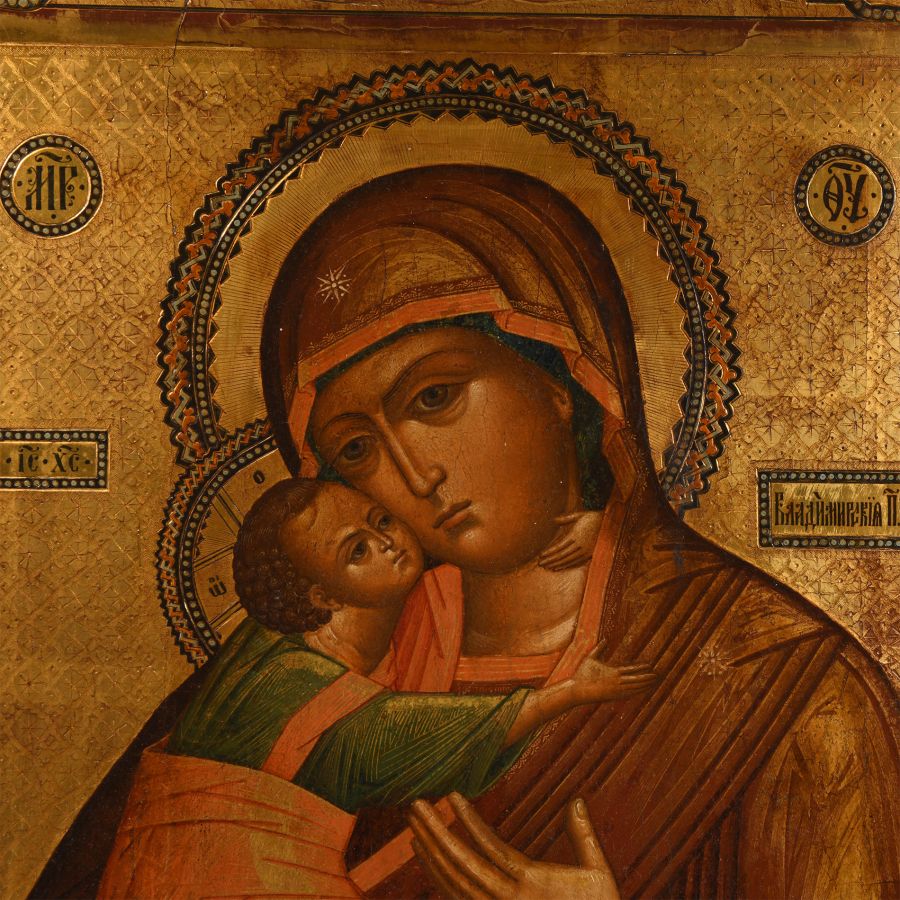
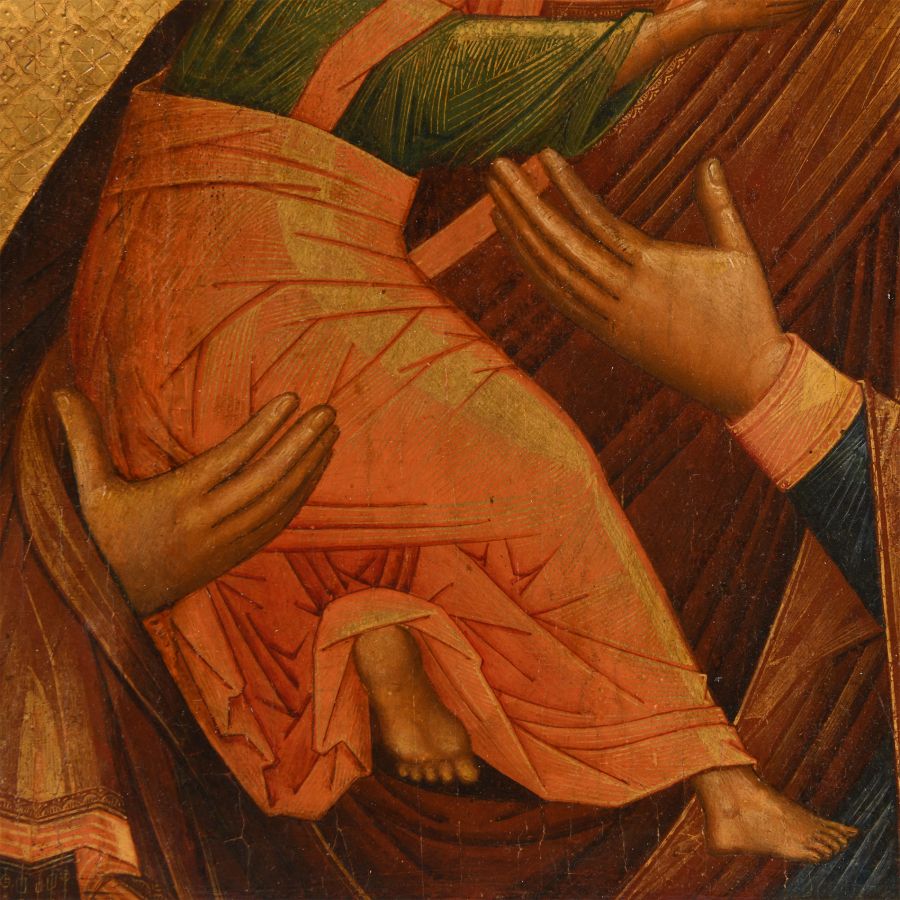
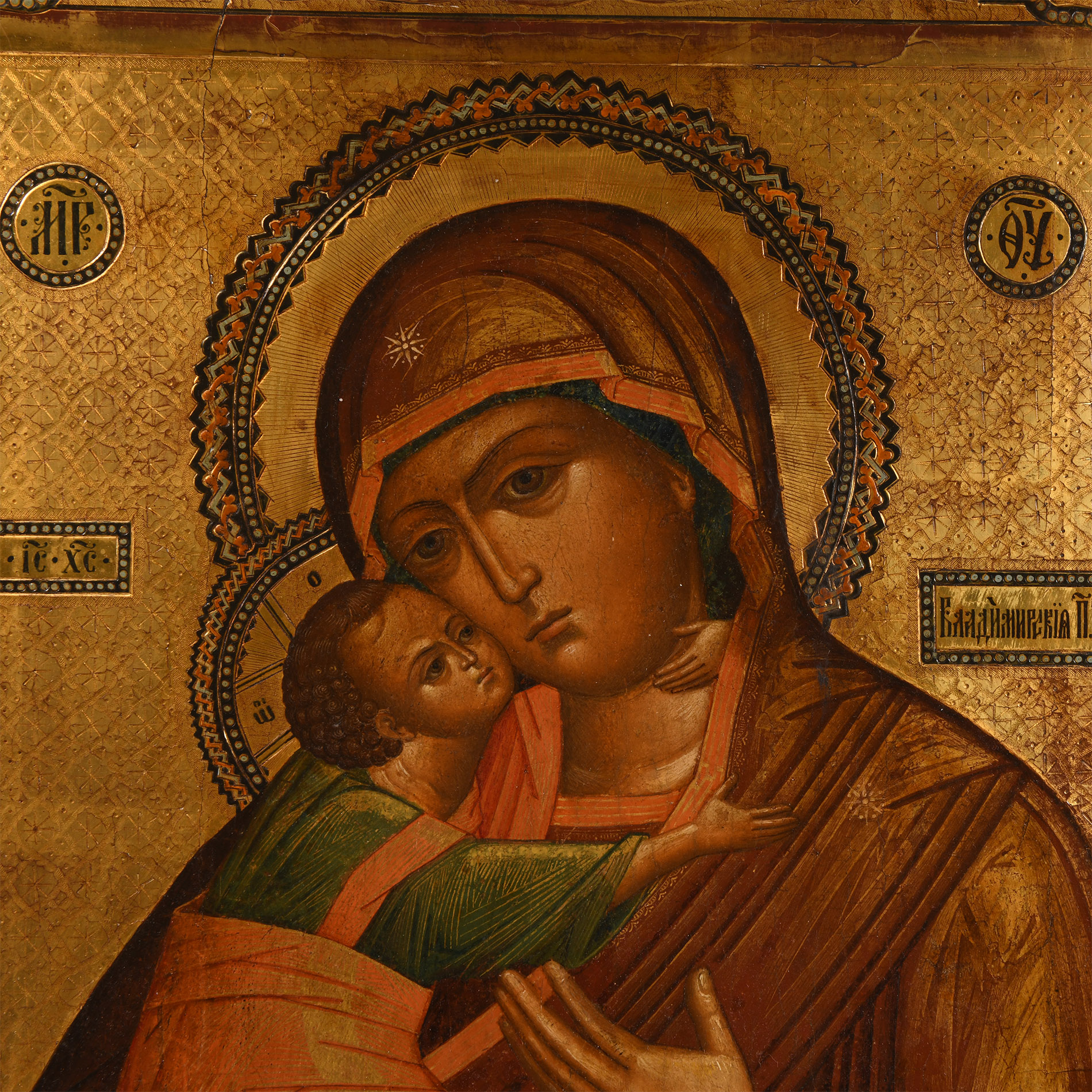
Depicting nimbate Mary Theotokos with veiled head and wearing a maphorion mantle over a dark blue robe with gold cuffs, inclined towards the infant Jesus supported by her right hand, his left arm wrapped around her neck and the right hand resting on her chest; gilt field and border with colourful enamelled detailing to the corners, roundels and rectangles with monograms and titling, on each side of her head 'ΜΡ ΘΥ' (Μήτηρ (τοῦ) Θεοῦ = Mother of God), over her left shoulder Cyrillic inscription 'Влади́мирская Б.М.' (Vladimir Mother of God), over the child inscription in Greek letters 'ΙϹ ΧϹ' (ΙΗϹΟΥϹ ΧΡΙϹΤΟϹ = Jesus Christ), three letters (only two visible) inside the nimbus of Christ representing the continuous divine self-existence of Christ as God ('O ѾN' = The Only One who always exists); Moscow School.
ProvenanceEx property of a London lady, part of her family's collection.
Accompanied by an academic report by Dr Raffaele D’Amato.
This lot has been checked against the Interpol Database of stolen works of art and is accompanied by a search certificate no. 11543-196361.
See Weizmann, K. et al., The Icon, New York, 1982; Popescu, G.A., Cristiani d'Oriente, spiritualità, arte e potere nell'Europa Post-Bizantina, Milano, 1999; Geelmuyden Bulgurlu, V., Ulf, A., Lindgren, N., Bodin, H., Balicka-Witakowska, E., Five essays on icons, Stockholm & Istanbul, 2005, fig.6, p.31.
FootnotesThis splendid specimen was probably originally housed in an aristocratic Russian home. The icon of the Virgin Mother of Vladimir with the infant Jesus (the original preserved in the Tretyakov Gallery, Moscow), probably the most famous icon of all of Russia, was thought to have been created in Constantinople in the early part of 1100s. This image is sometimes referred to as the ‘tenderness icon’, with artists attempting to show the close relationship of mother and son with their cheeks touching as they embrace.
CONDITIONTimeLine Auctions follows a vetting process to ensure the authenticity and legality of all items, reinforcing our commitment to integrity and responsible trading. Each antiquity, antique, and coin lot undergoes thorough examination by a vetting committee of at least ten external specialists, professional trade association members, scientists, and archaeologists: Our Vetting Process
AUCTIONS:
TimeLine is a leading auction house specialising in antiquities, ancient art, collectables, natural history, coins, medals, and books. Our auctions offer museums, collectors, historians, and enthusiasts the opportunity to acquire unique and historically significant pieces.
LOT 0380
Large Russian Virgin of Vladimir Icon
Estimate £5,000 - 7,000€5,800 - 8,120 (for guidance only)$6,750 - 9,450 (for guidance only)
-
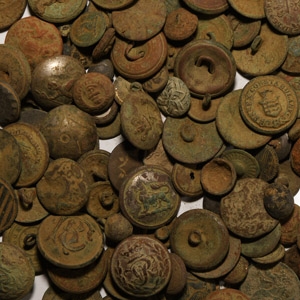
Post Medieval Bronze Military and Other Button Group
19th-20th century A.D.Sold for (Inc. bp): £65
including heraldic and regimental designs, constabulary and other types. 355 grams total, 9-26 mm
Found Cambridgeshire, UK. -
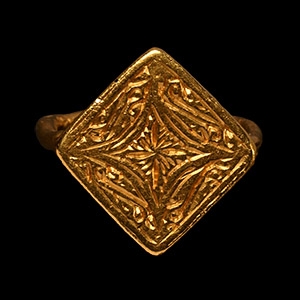
Gold Ring with Diamond-Shaped Bezel Engraved with a Star
17th century A.D.Sold for (Inc. bp): £598
Slender hoop supporting a square bezel with domed underside with incised hatched detailing, hatched band to the rim, reserved motif to the upper face comprising a four-pointed star in reserved frame with scrolls surrounding. 7.20 grams, 22.25 mm overall, 15.94 mm internal diameter (approximate size British I 1/2, USA 4 1/2, Europe 8.07, Japan 7)
From an old French collection believed to have been formed in the 1960s. Acquired privately as part of a collection in the early 1990s. Accompanied by a copy of a previous illustrated catalogue information page. -
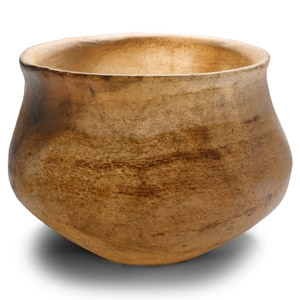
Bactrian Style Alabaster Bowl
20th century A.D.Sold for (Inc. bp): £26
Biconvex in profile with gently flared rim to the mouth. 924 grams, 12 cm wide
From a collection acquired on the UK art market from various auction houses and collections mostly before 2000. From an important Cambridgeshire estate; thence by descent.
