
Loading, please wait...
_900x900.jpg "Large Romano-British Bronze Dolphin Mount")
_200x200.jpg "Large Romano-British Bronze Dolphin Mount")
.jpg "Large Romano-British Bronze Dolphin Mount")
LOT 0144
Large Romano-British Bronze Dolphin Mount
2ND-3RD CENTURY A.D.
4 3/4 in. (126 grams, 12.3 cm).
Modelled in the round, with dentilled fin and tail, hollow to the underside, scale detailing.
ProvenanceFound Lincolshire, UK.
LiteratureCf. Rolland, H., Bronzes Antiques de Haute Provence, Paris, 1965, items 386-387, for similar.
FootnotesThe dolphin was believed to ferry the souls of the dead to the afterlife. This type of bronze figure was probably intended to form a doorknob.
CONDITIONTimeLine Auctions follows a vetting process to ensure the authenticity and legality of all items, reinforcing our commitment to integrity and responsible trading. Each antiquity, antique, and coin lot undergoes thorough examination by a vetting committee of at least ten external specialists, professional trade association members, scientists, and archaeologists: Our Vetting Process
AUCTIONS:
TimeLine is a leading auction house specialising in antiquities, ancient art, collectables, natural history, coins, medals, and books. Our auctions offer museums, collectors, historians, and enthusiasts the opportunity to acquire unique and historically significant pieces.
-
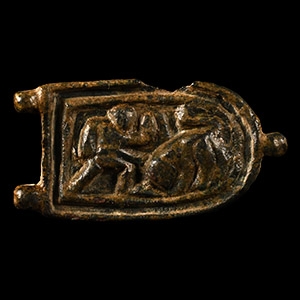
Late Roman Bronze Buckle-Plate with Combat Scene
Circa 5th century A.D.Estimate: £150 - 200 (+bp*)
Opening Bid: £80
Tongue-shaped in plan with knop finial and three pierced lugs to the reverse; raised rim enclosing a scene with advancing gladiator and a lion(?) preparing to attack. 19.1 grams, 49 mm
Ex London and Home Counties gentleman, R.W., 1970s. This lot is accompanied by an illustrated lot declaration signed by the Head of the Antiquities Department, Dr Raffaele D'Amato.
All E38 buckles probably originally had a kidney-shaped bow (T-shaped), a prong with a rectangular, undecorated shield, and a U-shaped hinge fitting with a finial depicting a man fighting a lion. This could be a rider stabbing the prone animal with his lance, or a gladiator with a raised shield killing a lion with a sword or lance. The reliefs are surrounded by a border of varying design. Depending on the width of the fitting, the number of rear pierced pegs varies between from two to three. -
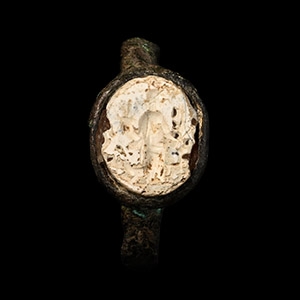
Roman Bronze Ring with Seated Fortuna Gemstone
2nd-3rd century A.D.Sold for (Inc. bp): £33
D-section hoop and ellipsoid bezel with inset gemstone, intaglio motif of a seated goddess holding a sword blade-uppermost. 2.03 grams, 21.6 mm overall, 15.7 mm internal diameter (approximate size British J 1/2, USA 5, Europe 9.32, Japan 9)
with Archaeologia, Switzerland, before 1983. Ex private North American collection. London private collection, 2016. -
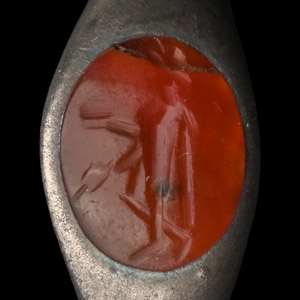
Roman Silver Ring with Apollo Gemstone
Circa 2nd century A.D.Sold for (Inc. bp): £195
A round-section hoop expanding to broad shoulders, flat plaque with inset carnelian cloison, intaglio image of Apollo (Sol), cloaked, advancing with a patera in each hand. 4.53 grams, 22.48 mm overall, 17.58 mm internal diameter (approximate size British H, USA 3 3/4, Europe 6.18, Japan 6)
From an important collection of jewellery formed over 40 years by a German collector.
