
Loading, please wait...
LOT 0890
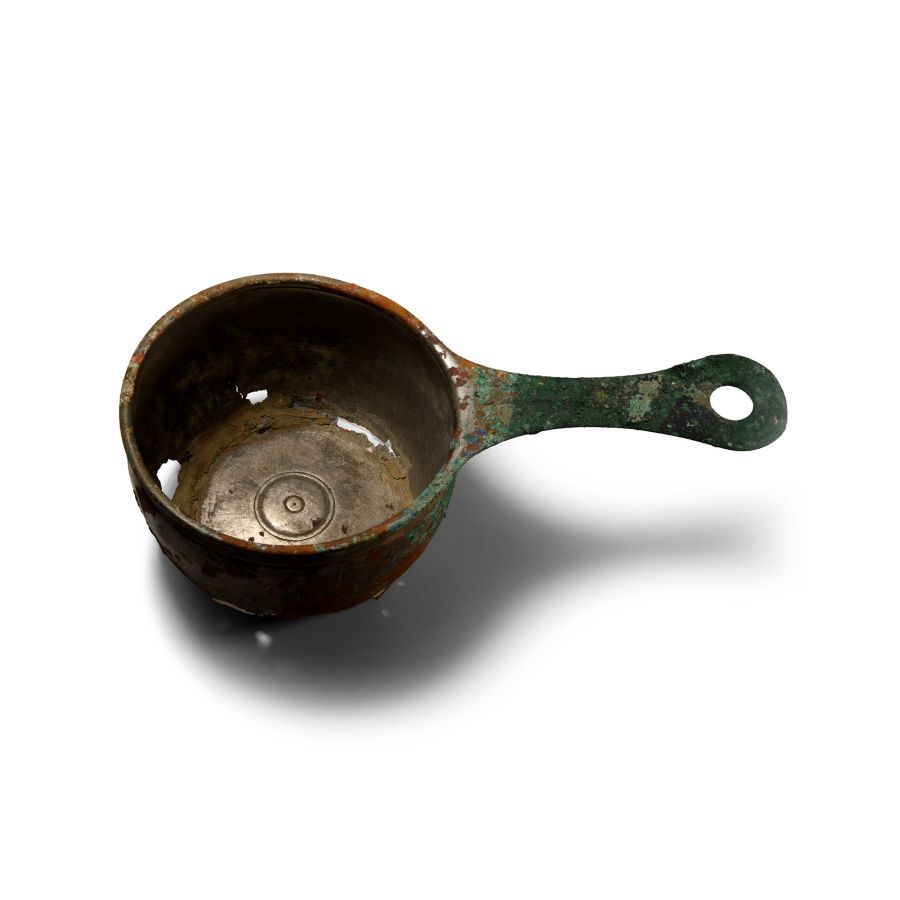
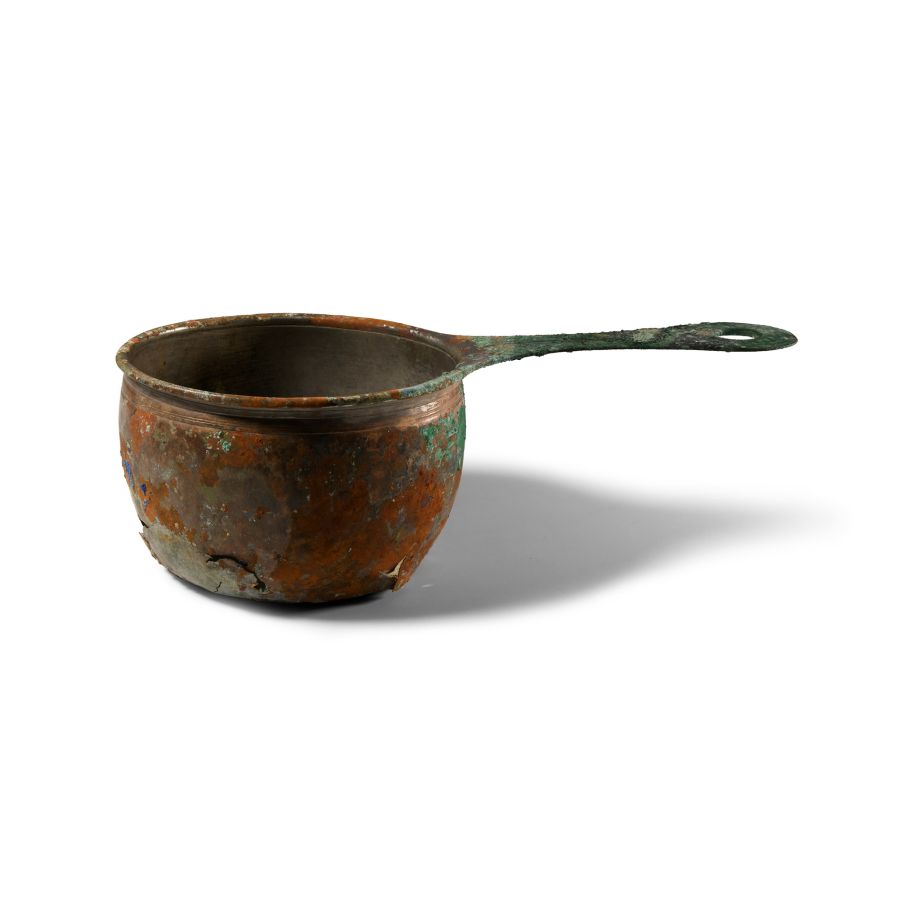
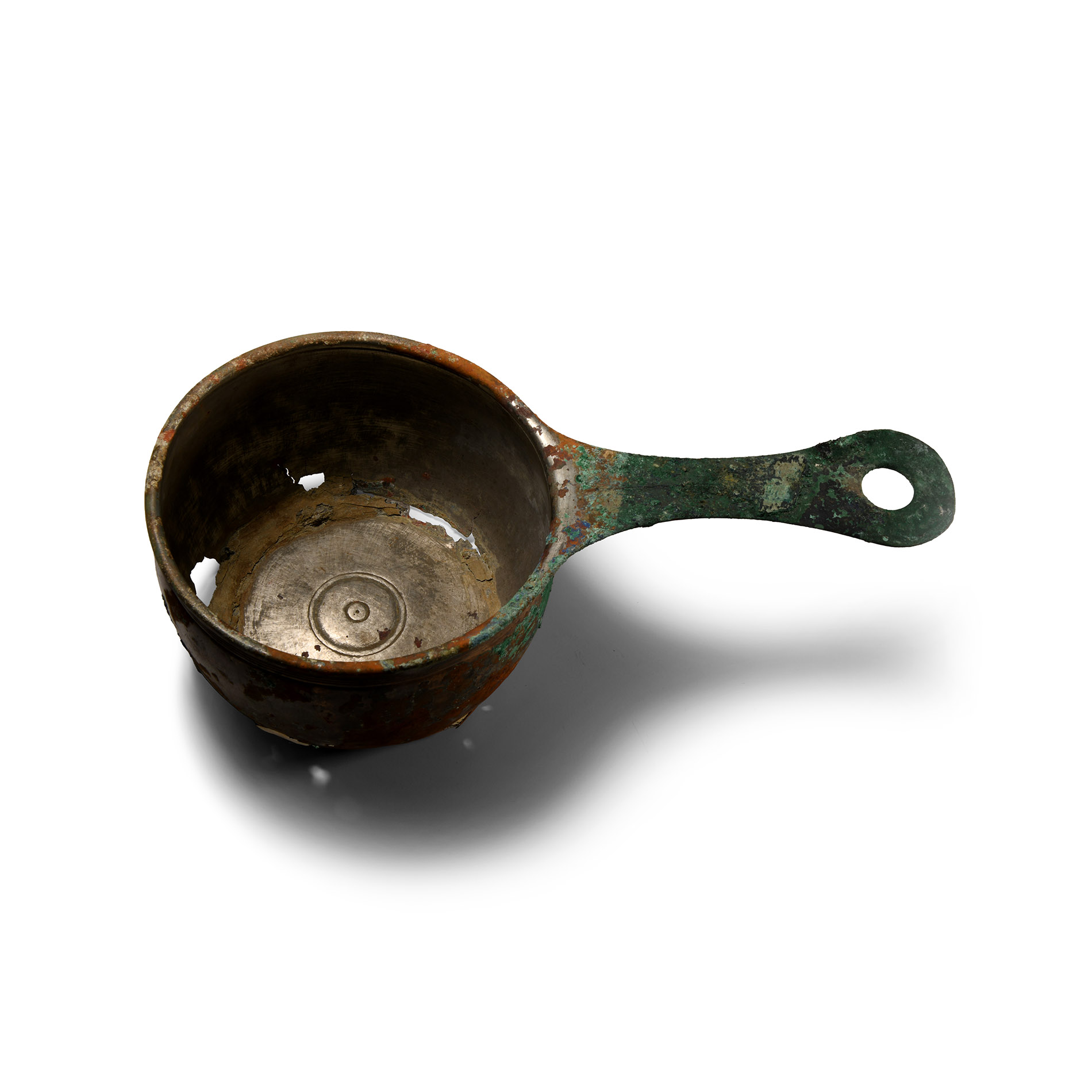
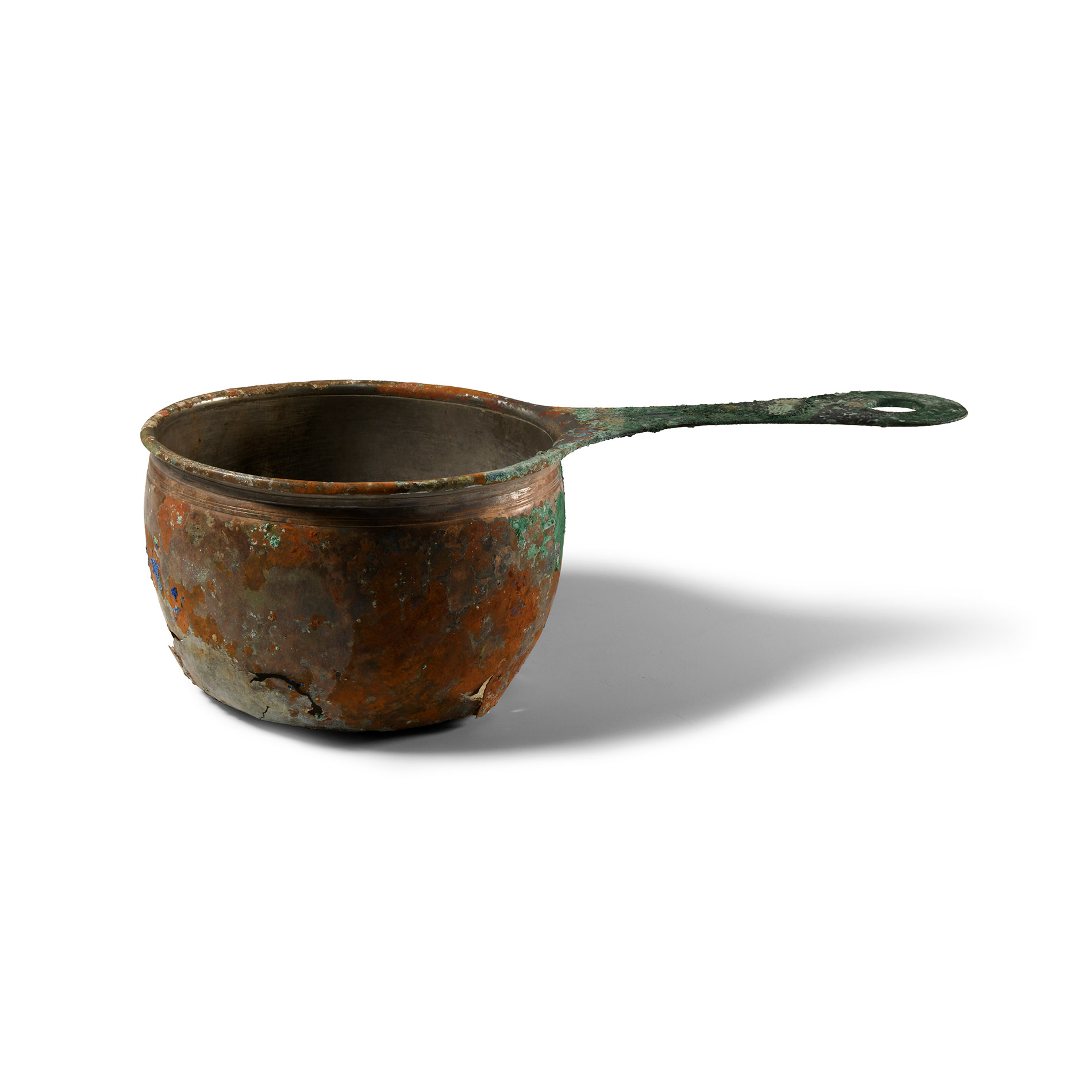
Large Roman Tinned Bronze Patera
1ST CENTURY A.D.
13 in. (903 grams, 33 cm wide).
With a deep bowl and flat-section handle with integral loop; shallow concentric grooves around the exterior of the neck, rolled rim, concentric rings to the underside; finished on a lathe; cracked and split.
ProvenanceAcquired in Europe before 1993.
Private collection, Europe.
This lot has been checked against the Interpol Database of stolen works of art and is accompanied by search certificate number no.11788-206494.
Cf. The British Museum's Portable Antiquities Scheme, record id. GLO-048BB1, for a very similar example and additional information; Tassinari, S., La Vaisselle de Bronze, Romaine et Provinciale, au Musée des Antiquités Nationales, XXIXe supplément de Gallia, Paris, 1975, items 3, 5, 9, for similar types.
FootnotesIn contrast to their elaborate counterparts, paterae such as this were likely carried as part of the standard kit of Roman soldiers, used as a general cooking and eating utensil. The regular heap up (sarcina) of the legionaries is well represented on the reliefs of Trajan's column. It was composed of a T stake (furca), to which a linen bag (sacculus) was hung, as well as the leather haversack for 15-20 days supplies (trinum nundinum) and personal effects, a pot (ollula), a cup (patera), and a basket for work on the fields.
CONDITIONTimeLine Auctions follows a vetting process to ensure the authenticity and legality of all items, reinforcing our commitment to integrity and responsible trading. Each antiquity, antique, and coin lot undergoes thorough examination by a vetting committee of at least ten external specialists, professional trade association members, scientists, and archaeologists: Our Vetting Process
AUCTIONS:
TimeLine is a leading auction house specialising in antiquities, ancient art, collectables, natural history, coins, medals, and books. Our auctions offer museums, collectors, historians, and enthusiasts the opportunity to acquire unique and historically significant pieces.
LOT 0890
Large Roman Tinned Bronze Patera
Estimate £1,000 - 1,400€1,160 - 1,620 (for guidance only)$1,350 - 1,890 (for guidance only)
-
Graeco-Roman Green Jasper Gemstone with Medusa
1st century B.C.-1st century A.D.Estimate: £3,000 - 4,000 (+bp*)
Opening Bid: £1,600
An exceptional intaglio engraved with head of Medusa in three-quarter view, depicted with a sorrowful expression, full lips and large eyes gazing up; voluminous hair composed of entangled snakes framing her face, large wings to the brow flanking a pair of rearing serpents, a knot of serpents below her chin. 1.34 grams, 20.82 mm
Acquired in Switzerland 1970-1980. From a London, UK, collection. This lot has been checked against the Interpol Database of stolen works of art and is accompanied by search certificate no.12034-214098.
In ancient mythology, Medusa was one of three monstrous winged female creatures who had venomous snakes living in her hair. In classical antiquity, representations of the head of Medusa appeared in the apotropaic device known as the Gorgoneion, designed to ward-off evil and bad luck. -
Roman Silver Ring with Poseidon Gemstone
1st-2nd century A.D.Sold for (Inc. bp): £351
With elliptical cell, inset carnelian cabochon with intaglio figure of Poseidon standing naked, only covered by a cloak on his shoulders, holding a trident with left hand, and a net with a stylised dolphin(?) with the right hand; possibly a marriage. 4.97 grams, 26.02 mm overall, 18.30 mm internal diameter (approximate size British P, USA 7 1/2, Europe 16.23, Japan 15)
UK private collection formed before 2000. Ex North London, UK, gallery.
On issues of the Roman colonial coinage of Patras, the image of nude standing Poseidon holding a trident and dolphin is reproduced simultaneously with the most common representations of the god shown standing with one foot resting on a support (rock or dolphin). This type of standing nude Poseidon holding a trident in his left hand and a dolphin in his right is also pictured on the reverse of coins of Agion. -
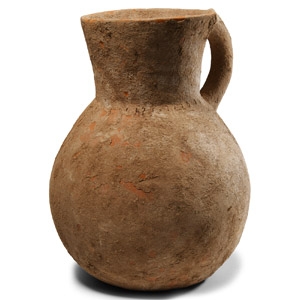
Large Roman Terracotta Jug
1st-4th century A.D.Sold for (Inc. bp): £78
With broad mouth, flared rim and loop handle to the shoulder. 1.4 kg, 24.5 cm high
Acquired 1980-2015. Ex Abelita family collection.
