
Loading, please wait...
_900x900.jpg "Large Roman Sheet-Silver Brooch Pair")
_200x200.jpg "Large Roman Sheet-Silver Brooch Pair")
.jpg "Large Roman Sheet-Silver Brooch Pair")
LOT 0090
Large Roman Sheet-Silver Brooch Pair
4TH-5TH CENTURY A.D.
6 in. (71.3 grams total, 15-15.2 cm).
Each formed as a figure-of-eight-shaped plaque with beaded edge and central bridge, bronze reinforcement to the reverse and ferrous attachment pin. [2]
ProvenanceAcquired on the European art market in the 1990s.
Ex property of a Suffolk collector.
TimeLine Auctions follows a vetting process to ensure the authenticity and legality of all items, reinforcing our commitment to integrity and responsible trading. Each antiquity, antique, and coin lot undergoes thorough examination by a vetting committee of at least ten external specialists, professional trade association members, scientists, and archaeologists: Our Vetting Process
AUCTIONS:
TimeLine is a leading auction house specialising in antiquities, ancient art, collectables, natural history, coins, medals, and books. Our auctions offer museums, collectors, historians, and enthusiasts the opportunity to acquire unique and historically significant pieces.
-
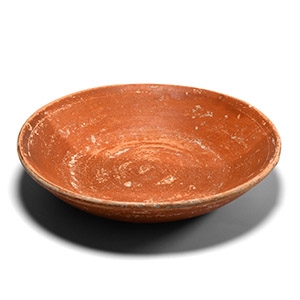
Roman Redware Dish
3rd-4th century A.D.Sold for (Inc. bp): £72
Composed of a tapering sidewall and old blue and white collector's note with handwritten identification notes dating the piece to found(?) in 1923. 87 grams, 11.5 cm wide
With old label attached dated 1923. Property of an East Sussex, UK, teacher. -
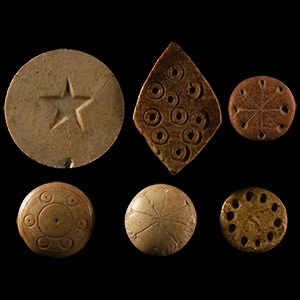
Roman Bone and Other Gaming Piece Collection
1st-4th century A.D.Sold for (Inc. bp): £117
Most discoid in form and displaying a variety of designs: a ring of dimples; dot-in-ring motifs within roundels; 'stars' with dimpled terminals; a five-pointed star; a lozenge-shaped counter displaying punched ring-and-dot motifs to one face. 24.4 grams total, 21-41 mm
Gabby family collection since the late 1960s; thence by descent. -
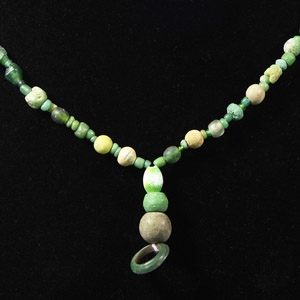
Roman Glass Bead Necklace
2nd-5th century A.D. and laterSold for (Inc. bp): £72
Composed of various shades of green glass beads, including annular, spherical and barrel-shaped beads together with other types; restrung. 13.9 grams, 73.5 cm long
Ex W.J. collection, 1990s.
