
Loading, please wait...
LOT 0073
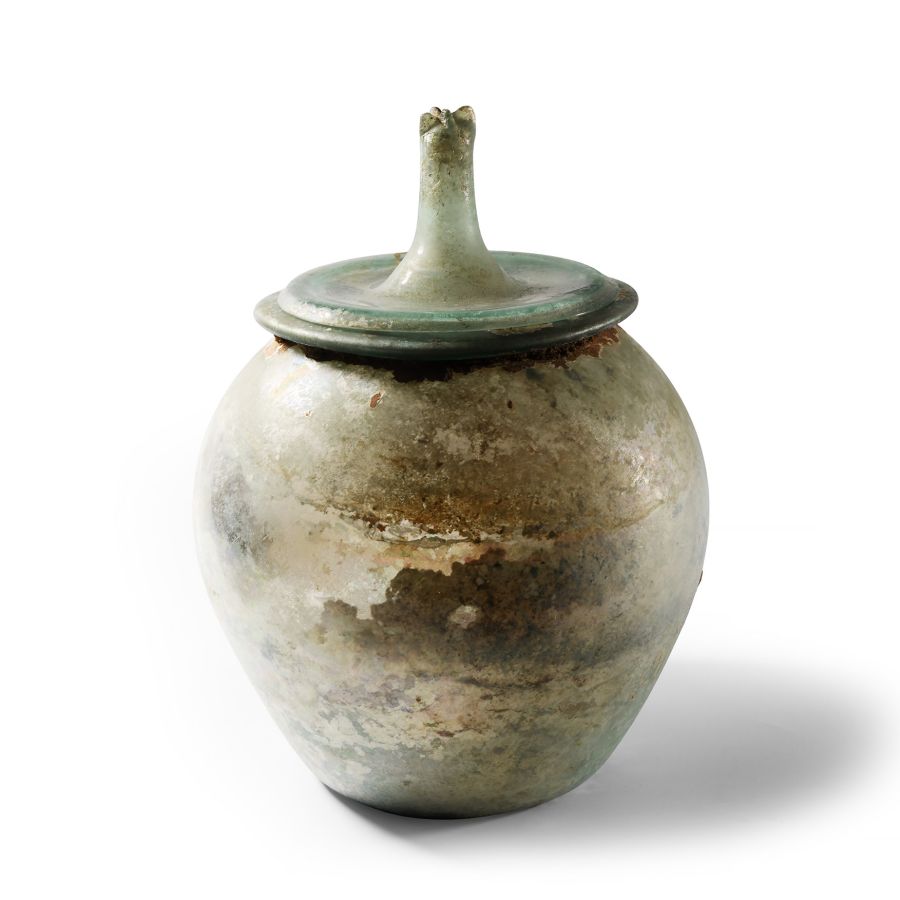
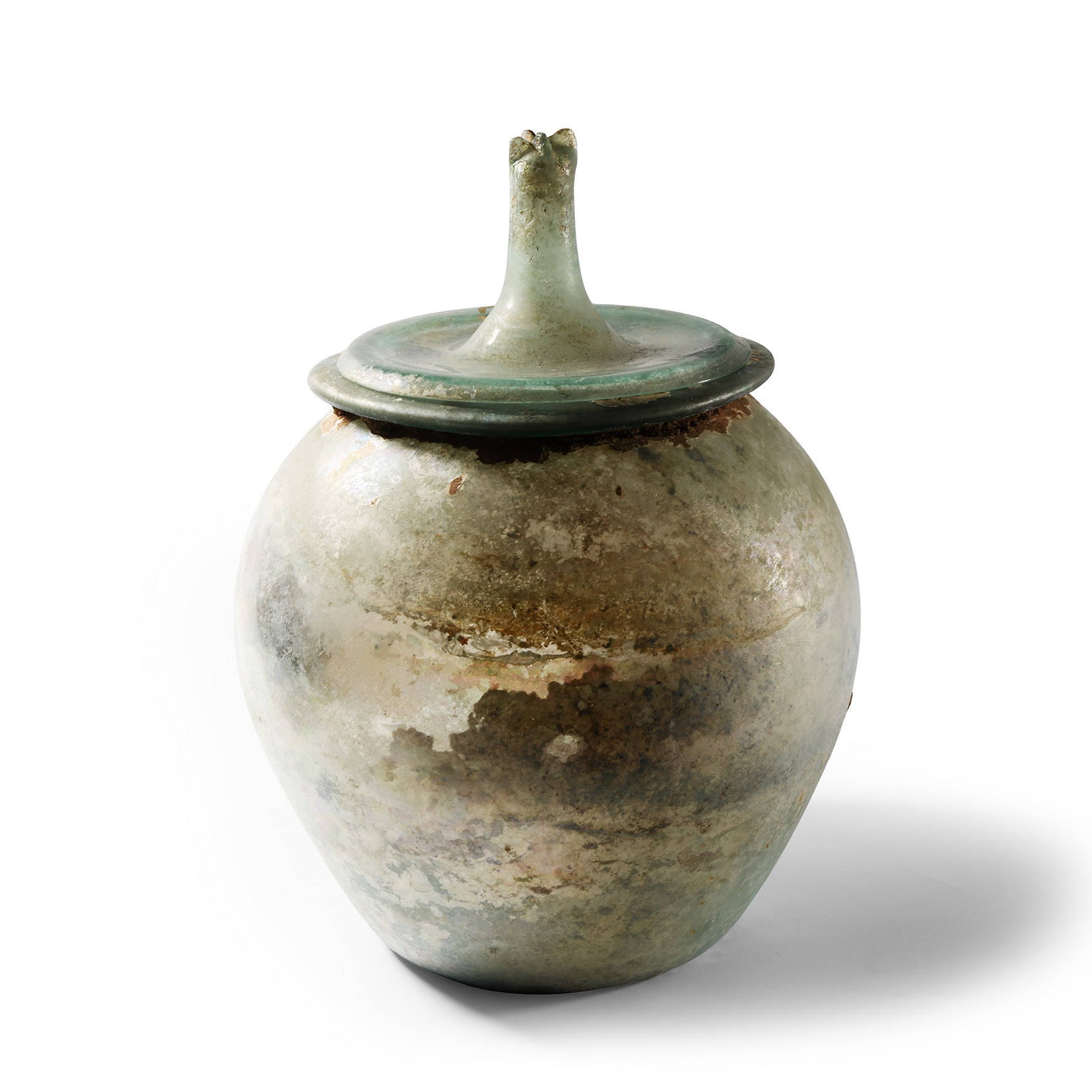
Large Roman Pale Green Glass Cinerary Urn
1ST-2ND CENTURY A.D.
11 5/8 in. (831 grams total, 29.5 cm high).
Of piriform shape with everted rim, gently chamfered upper lip and concave underside; lid with bevelled rim, gently dished upper face rising to a central dome and cylindrical handle with piecrust pleats; iridescent surfaces.
ProvenanceEx Sangiorgi collection, acquired in the 19th century.
with Christie's, 3 June 1999, lot 121.
The remains of a 19th/early 20th century label can be seen on the glass on one side.
with Christie's, New York, 9 December 1999, lot 476.
American private collection, Westchester, New York, acquired in 1999.
with Bonhams, London, 30 September 2015, lot 91.
Accompanied by an academic report by Dr Raffaele D'Amato.
This lot has been checked against the Interpol Database of stolen works of art and is accompanied by search certificate no.203222.
Cf. The Metropolitan Museum, New York, accession number 81.10.8, for similar; cf. a very similar example with lid, discovered in the Conjunto Arqueológico de Carmona, Carmona (Sevilla), Spain, in Boletín del Museo Arqueológico Nacional, Madrid, IX,1991, figs.1-14; cf. The British Museum, museum number 1993,0102.11, for similar; cf. The Corning Museum of Glass, accession number 70.1.44, for similar. cf. also Metropolitan Museum of Art Twelfth Annual Report of the Trustees of the Association for eight months ending December 31, New York, 1881, pp.215-216.
FootnotesA similar jar in the British Museum was found in Warwick Square, London, inside a lead canister, and was originally filled with bone ashes. The Romans often re-used glass jars, originally made for storing liquids and foodstuffs, as cremation vessels, but this kind of jar seems too fragile and was therefore probably purpose-made. The lead canister, which was found with the jar from London, protected the glass and bones.
Georgio Sangiorgi is one of the most famous names associated with the field of ancient glass collecting. Working from the Galleria Sangiorgi in the Palazzo Borghese, Sangiorgi acquired the most magnificent collection of ancient glass, seeking only the finest examples.
TimeLine Auctions follows a vetting process to ensure the authenticity and legality of all items, reinforcing our commitment to integrity and responsible trading. Each antiquity, antique, and coin lot undergoes thorough examination by a vetting committee of at least ten external specialists, professional trade association members, scientists, and archaeologists: Our Vetting Process
AUCTIONS:
TimeLine is a leading auction house specialising in antiquities, ancient art, collectables, natural history, coins, medals, and books. Our auctions offer museums, collectors, historians, and enthusiasts the opportunity to acquire unique and historically significant pieces.
-
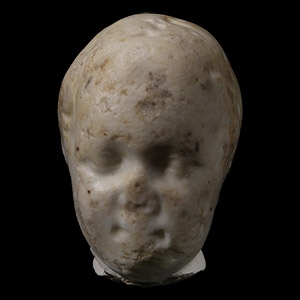
Marble Head of a Boy
Roman, 1st-4th century A.D. or laterSold for (Inc. bp): £312
Modelled facing in the round with naturalistic features. 6.2 kg, 21 cm high
Acquired 1960s-1990s. Late Alison Barker collection, a retired London barrister. -
.jpg)
Roman Bronze Plaque with Eros on Lion
Circa 2nd-4th century A.D.Estimate: £1,500 - 2,000 (+bp*)
Opening Bid: £600
Modelled in relief with openwork elements, stylised detailing to both figures; hollow reverse. 182 grams, 10.2 cm high
Acquired 1990s-early 2000s. East Anglian private collection.
Hollow cast bronze images of Eros riding a lion are linked to the Eastern Levant and have been found for example in Tamna, probably a Roman import. The importance of the long-distance contacts within the Eastern Mediterranean areas was rapidly reflected in provincial artistic styles, probably as soon as in Hellenistic times, at the beginning of the third century B.C., possibly even earlier. The unquestionable Greek influence led a number of scholars to define three main styles for the bronzes discovered in the eastern Roman provinces: a local type and iconography locally produced, Greek or Roman imports, and Oriental, Hellenistic, or Roman style, locally produced. -
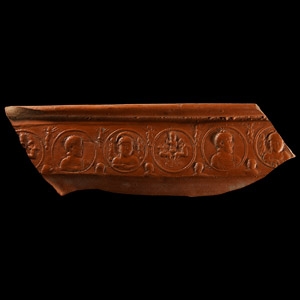
Roman Redware Sherd with Constantinian Portraits
4th century A.D.Sold for (Inc. bp): £416
From the upper part of the vessel, displaying a frieze of profile busts and figural scenes within roundels, winged Victory holding a wreath and standing on globe between the roundels; the central roundel with Sol Invictus and a sun chariot. 155 grams, 18.5 cm
Acquired 1960s-1990s. From the late Alison Barker collection, a retired London barrister.
This terra sigillata fragment appears to have been part of a large tray, celebrating the imperial triumph of an early 4th century emperor, possibly Constantine or a member of his family such as Crispus. The combination of triumphal symbols (palms, quadriga, radiated crown) with imperial figures is typical of the tetrarchy and early Constantinian era, where elements of dying paganism were still used to celebrate imperial glory. Note the detailed late Roman clothing, with a closed chlamys-paludamentum on the right shoulder and, in the profile figure, a thorax with hemispherical shoulder protections.
