Loading, please wait...

Use mousewheel to zoom in and out, click to enlarge

Details

LOT 0877

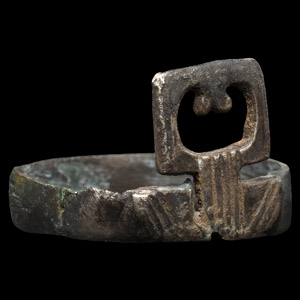
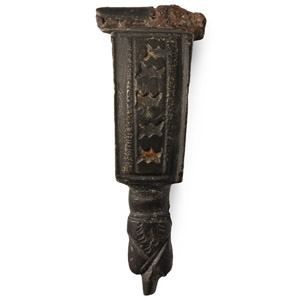
Large Roman Bronze Gaming Dice

1ST-4TH CENTURY A.D.

3/4 in. (38.8 grams, 18 mm).

Cuboid with impressed points to each face. [No Reserve]

Provenance

Property of a Cambridgeshire, UK, collector.
From his private collection since the 1970s; thence by descent circa 2000.
Ex private collection of a Bedfordshire gentleman.

CONDITION

VETTING:

TimeLine Auctions follows a vetting process to ensure the authenticity and legality of all items, reinforcing our commitment to integrity and responsible trading. Each antiquity, antique, and coin lot undergoes thorough examination by a vetting committee of at least ten external specialists, professional trade association members, scientists, and archaeologists: Our Vetting Process


AUCTIONS:

TimeLine is a leading auction house specialising in antiquities, ancient art, collectables, natural history, coins, medals, and books. Our auctions offer museums, collectors, historians, and enthusiasts the opportunity to acquire unique and historically significant pieces.

LOT 0877

Large Roman Bronze Gaming Dice

Sold for (Inc. bp): £104

Print page

RELATED LOTS

  • Roman Wooden Tablet with Testamentary Dispositions of Iulius Pomp(onius)
    Roman Wooden Tablet with Testamentary Dispositions of Iulius Pomp(onius)
    Mid 4th century A.D.

    Sold for (Inc. bp): £2,600

    The third and last tablet of a Roman will made by Iulius Pomp(onius?), parts of lost surface on the inner face, two small holes both at the upper and lower rim (for binding the tablets of this document together); on the inner face the recess inscribed with twenty-one lines of Roman cursive script consisting of testamentary dispositions regarding a special category of fields (gemiones), ending with the mancipatory formula of Roman testaments; on the outer face two sulci and signatures of witnesses. 106 grams, 20.2 x 16.2 cm


    Acquired by Albert Sfez in the early 1950s. Formerly the property of Monsieur Alain Sfez, a Belgium collector; acquired by gift from his father Albert Sfez, in 1965. Acquired by a London dealer in 1973. From an important London collection since 1975; thence by descent. Accompanied by a copy of an illustrated academic report by Professor Dr phil. Peter Rothenhöfer. This lot has been checked against the Interpol Database of stolen works of art and is accompanied by search certificate number no.12601-230811.

    Professor Dr phil. Peter Rothenhöfer writes: 'Without any doubts this tablet is an original document from Roman times. Because only few Roman testaments have survived this document is of great importance both for Roman Legal and Social History'.

    Lot Details

  • Roman Marble Head of a Woman
    Roman Marble Head of a Woman
    3rd-4th century A.D.

    Estimate: £6,000 - 8,000 (+bp*)

    Opening Bid: £3,000

    Carved in three-quarter view, with hair dressed in a chignon with frontal band and wavy segments; soft facial features with much detailing remaining to the proper right eye and mouth; likely a frieze fragment; mounted on an old collector's display stand with typed label 'Marble, woman's head / Egypt / C.25-100 A.D. / Cat.No. 6169'. 8.45 kg, 39 cm high


    Acquired in trade from the San Franciscanum Museum, Israel, prior to 1980. with Archaeologia, pre 1983, Switzerland and Canada. Accompanied by an academic report by Dr Raffaele D’Amato. This lot has been checked against the Interpol Database of stolen works of art and is accompanied by search certificate number no.12964-242755.

    The arrangement of the hair is characteristic of female portraits dating between the late Severan and Tetrarchic periods. The head, due to the treatment of the hair, finds comparisons with a female portrait in the Museo Nazionale Romano, depicting an elderly woman of the Antonine era, and with another female portrait in the same museum, dated to the third decade of the 3rd century A.D., reworked in the Tetrarchic period, and which showed a Severan so-called Nest Frisur hairstyle. The sculpture in question can therefore be dated between the full 3rd century A.D. and the first decades of the 4th century A.D. based on the hairstyle, the shape of eyes and eyebrows.

    Lot Details

  • Roman Pillar-Moulded Honey-Coloured Glass Bowl with Fine Iridescence
    Roman Pillar-Moulded Honey-Coloured Glass Bowl with Fine Iridescence
    3rd-4th century A.D.

    Sold for (Inc. bp): £390

    With iridescent surface, narrow base and vertical ribbed segmentation to the sidewall, gently flared rim. 164 grams, 11.1 cm wide


    Ex London, UK, gentleman, 1990s.

    Lot Details

Stay up-to-date with the latest from TimeLine Auctions by joining our mailing list