
Loading, please wait...
LOT 0281
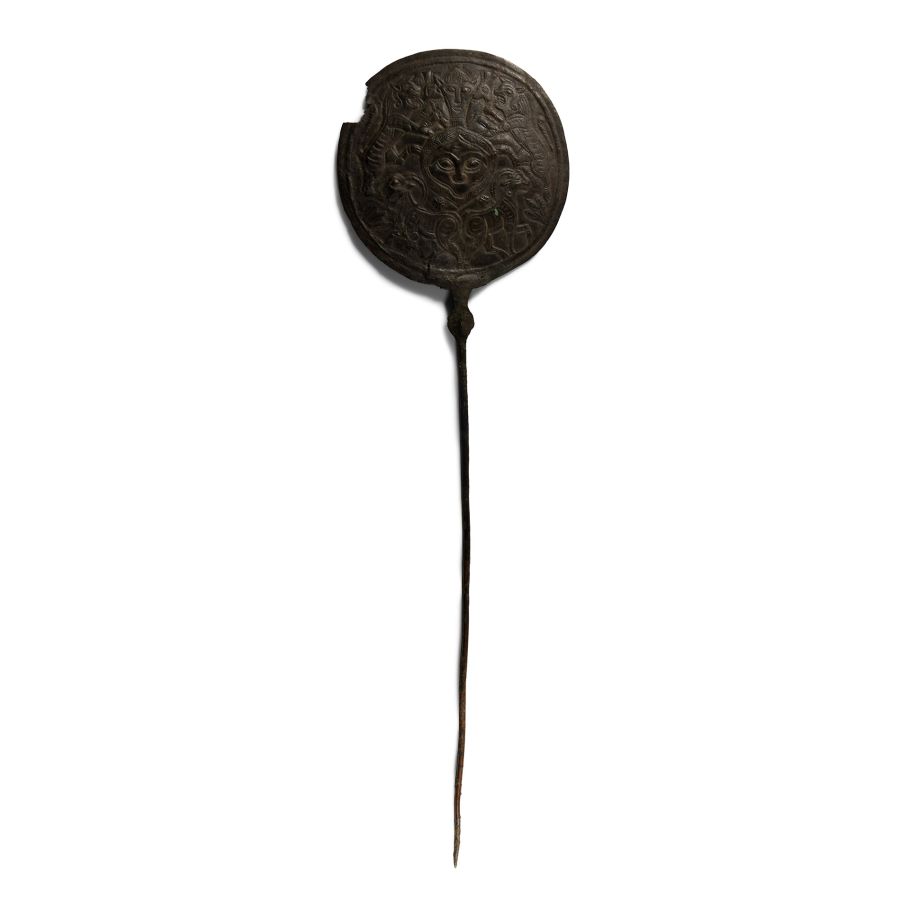
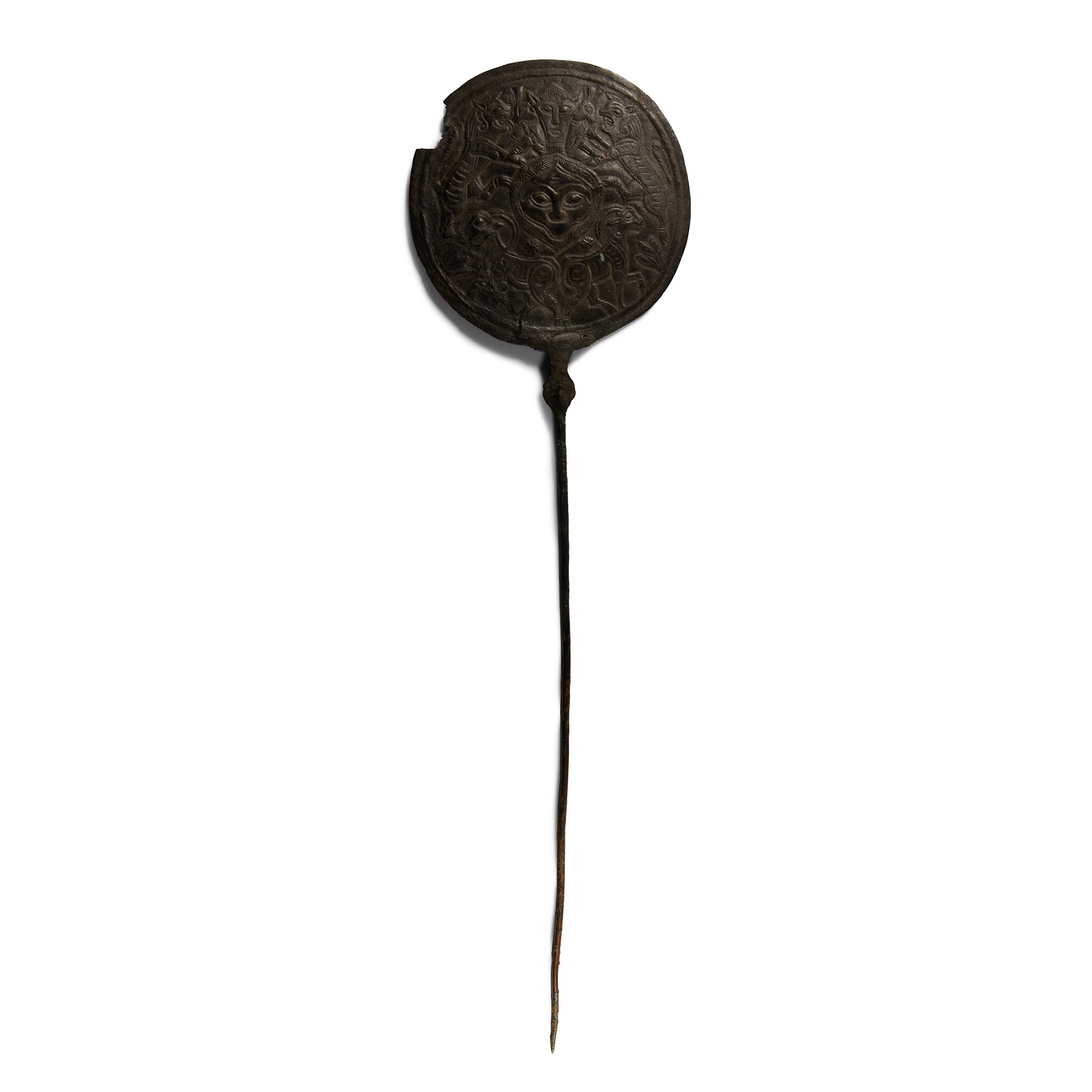
Large Neo-Elamite Decorated Bronze Pin
CIRCA 1200-800 B.C.
16 7/8 in. (228 grams total, 43 cm long).
Comprising a large circular finial with symmetrical repoussé design and a long tapering shank; the finial with a large central head with hatched hair and beard, possibly representing a mask of a deity; two addorsed ibexes below, each with a rosette above and foliage in front; at the top, two rampant lions flanking the 'Master of Animals' motif; the motif with pricked ears and wearing a two-tiered headpiece, a pair of zoomorphic figure emerging from his cheeks and grasp onto the flanking lions; mounted on a custom-made fabric-covered backing.
ProvenanceEx Rabi Gallery 1980-1990.
From an important London, UK, collection.
TimeLine Auctions follows a vetting process to ensure the authenticity and legality of all items, reinforcing our commitment to integrity and responsible trading. Each antiquity, antique, and coin lot undergoes thorough examination by a vetting committee of at least ten external specialists, professional trade association members, scientists, and archaeologists: Our Vetting Process
AUCTIONS:
TimeLine is a leading auction house specialising in antiquities, ancient art, collectables, natural history, coins, medals, and books. Our auctions offer museums, collectors, historians, and enthusiasts the opportunity to acquire unique and historically significant pieces.
LOT 0281
Large Neo-Elamite Decorated Bronze Pin
Estimate £800 - 1,000€930 - 1,160 (for guidance only)$1,080 - 1,350 (for guidance only)
-
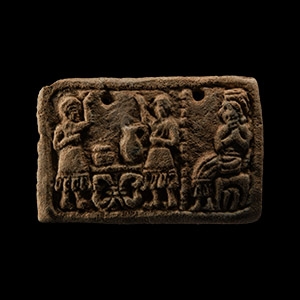
Sumerian Faience Plaque
3rd millennium B.C.Sold for (Inc. bp): £624
A composition rectangular plaque bearing figural scene modelled in the half-round of two figures beside a table, a seated figure behind them; pierced twice along one edge. 45 grams, 82 mm
Acquired 1970-1999. London collection of the late Mr S.M., thence by descent. -

Old Babylonian Haematite Cylinder Seal with Presentation Scene
Circa 1925-1595 B.C.Sold for (Inc. bp): £1,040
With a central male deity (Marduk) in a Hittite gown facing right, holding a mace, facing a supplicant goddess in formal kaunakes, her right hand extended with the waters of Ea flowing from it; crescent moon above, between the figures a pillar and a flower, before na'ga, two supplicants attend with formal dress, possibly some ancient re-cutting; accompanied by a custom-made display stand and a museum-quality impression. 6.00 grams, 20.85 mm (50 grams total, 84 mm high including stand)
Ex Bedfordshire estate collection assembled during the early to mid 20th century. Ex RH collection, Leighton Buzzard, Bedfordshire, UK. Ex Helios Gallery antiquities, Wiltshire, UK. Accompanied by an original Helios Gallery certificate of authenticity with stock reference no.H2934d. Accompanied by a copy of a letter of attribution from antiquarian Phil Jones. -
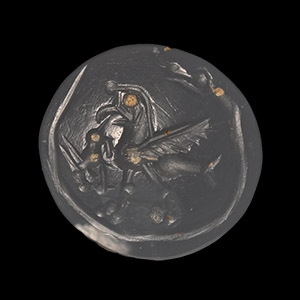
Chalcedony Pendant Stamp Seal with Mythical Creature
Circa 8th-7th century B.C.Sold for (Inc. bp): £1,690
An Assyrian or Urartian bell-shaped seal featuring a ribbed suspension loop attached to a stepped base; on the convex underside of the seal, there is an intricate engraving depicting a mythical creature that combines the body of an eagle with a fish tail; this hybrid creature is depicted facing to the left and holding a hare in its beak, with a snake coiled around the seal's perimeter; accompanied by a museum-quality impression and a typed and signed scholarly note issued by W.G. Lambert, late Professor of Assyriology at the University of Birmingham, 1970-1993, which states: 'Stamp Seal of Chalcedony / 23 x 14.5 mm. / This has a round, convex face, and above it is a cylinder with sharply concave sides, on top of which is (of one piece with the rest) a pierced lug with grooves over its top. The design on the base shows a standing composite creature: legs, wings and head of a bird, but body of a fish. In its beak it is holding a dead hare or other such creature. Around the design is a snake, whose body does not quite complete the circle. / This is an Urartian seal, from the ancient Kingdom of Urartu, c. 800-650 B.C. It comes from the area around Lake Van. The composite creature is a typical feature of the art of this kingdom. The snake is interesting, since it is the forerunner of the famous Ourobouros on magic gems of the period c. 100 B.C. to 200 A.D. It often appears surrounding a design, but it has its tail in its mouth. This seal has very slight chipping of the edges, but generally is in very good condition.' 4.71 grams, 23 mm
Private collection, England, 1990. European art market. Anonymous sale; Christie's, New York, 6 December 2007, no.374. From the 'Empire' collection, an important UK private collection of seals. with Bonhams, London, 7 December 2021, no.64 (£3,000 - £4,000). Accompanied by a copy of a typed and signed scholarly note by the late W.G. Lambert, Professor of Assyriology at the University of Birmingham, 1970-1993.
