Loading, please wait...
LOT 2070
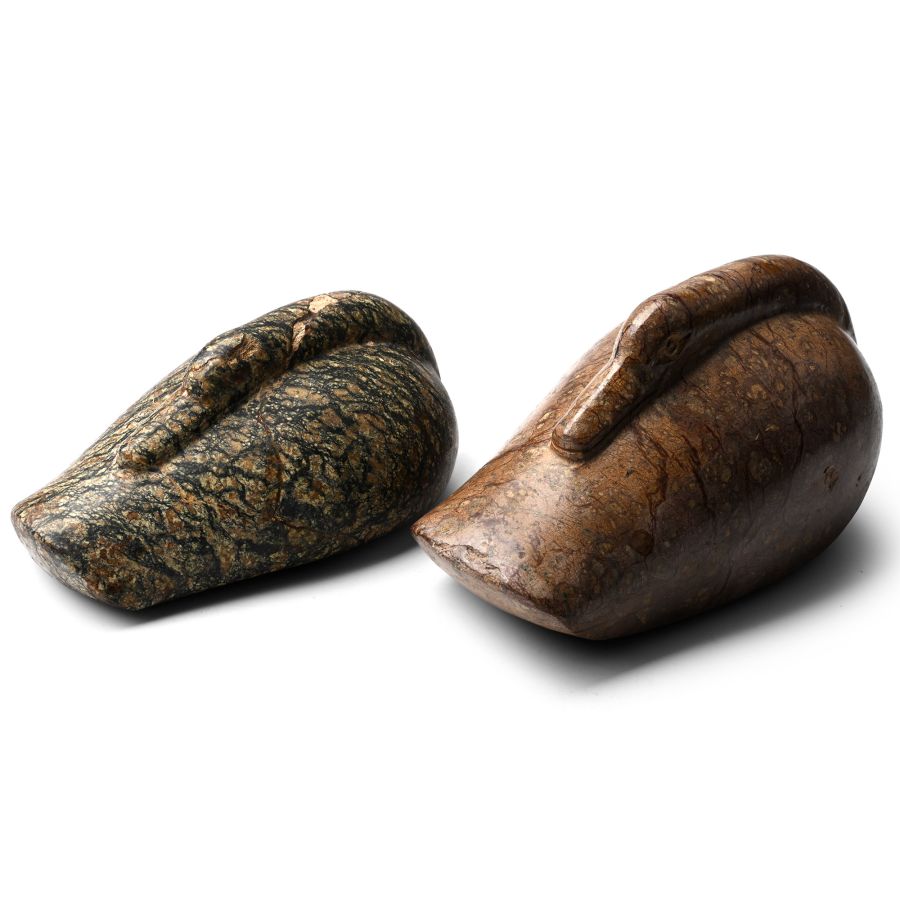
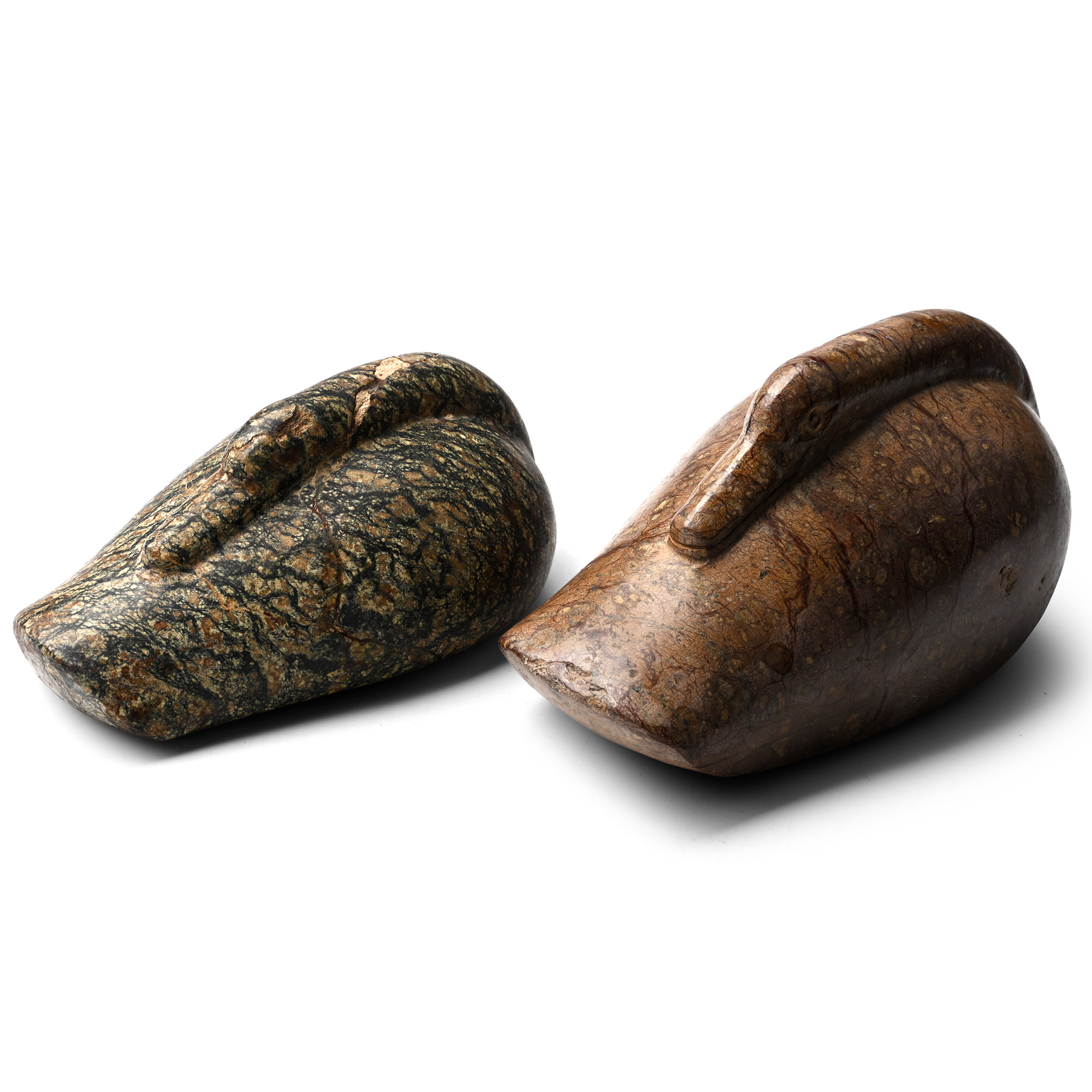
Large Mesopotamian Style Stone Duck Weight Group
20TH CENTURY A.D.
5 3/8 - 5 3/4 in. (2 kg total, 13.5-14.5 cm).
Each carved in the round with the head and neck resting along the spine. [2, No Reserve]
ProvenanceAcquired on the UK art market.
Private collection, London, UK.
TimeLine Auctions follows a vetting process to ensure the authenticity and legality of all items, reinforcing our commitment to integrity and responsible trading. Each antiquity, antique, and coin lot undergoes thorough examination by a vetting committee of at least ten external specialists, professional trade association members, scientists, and archaeologists: Our Vetting Process
AUCTIONS:
TimeLine is a leading auction house specialising in antiquities, ancient art, collectables, natural history, coins, medals, and books. Our auctions offer museums, collectors, historians, and enthusiasts the opportunity to acquire unique and historically significant pieces.
-
Marble Statue of Psyche and Cupid after Antonio Canova on a Marble Pedestal
Late 19th-early 20th century A.D.Sold for (Inc. bp): £286
Depicting Cupid tenderly holding Psyche in his arms after a kiss, Psyche's arms reaching towards his head; Cupid in a dynamic pose with separately made wings, depicted nude except for a vine-leaf; Psyche resting on a rock with her lower body loosely wrapped in a folded garment; inscription on the lower edge 'P. Bazzanti Florence'; mounted on a marble pedestal. It is regarded as a masterpiece of Neoclassical sculpture, but shows the mythological lovers at a moment of great emotion, characteristic of the emerging movement of Romanticism. Or alabaster 122 kg total, 166 cm
Private collection, London. This lot has been checked against the Interpol Database of stolen works of art and is accompanied by search certificate number no.13005-246436.
Psyche Revived by Cupid's Kiss is a sculpture by Italian artist Antonio Canova first commissioned in 1787 by Colonel John Campbell (later Lord Cawdor). It is one of Canova's most popular marbles which represents a well known passage from Apuleius' The Golden Ass, in which Psyche faints after having opened Proserpine's vase and is revived by Cupid's kiss. The original sculpture is today in the Musée du Louvre (M.R. 1777). In 1796 the Russian nobleman Prince Yusupov acquired a second version from Canova in Rome, and that example is today preserved in the Hermitage Museum, Saint Petersburg. -
Russian Travelling Triptych Icon with Silver Mounts
Circa 1800 A.D.Estimate: £600 - 800 (+bp*)
Opening Bid: £320
Comprising: wooden triptych with gilt field and painted figures of St Nikolas and St Charalambos in the lateral panels and SS Konstantine, Helen and Barbara in the central panel, each with red lettering above; house in a purpose-made silver case with engraved scene to the central panel of Maria Theotokos flanked by celestial figures holding a crown above her head; front panels with facing figures of SS Nikolas, Barbara, Konstantine, Helena and Charalambos; in a custom-made wooden travelling case with hooked fastener. 331 grams total, 11.8 x 9.4 cm including case
Ex Iconastas, London SW1, UK, in 1997. Property of a London, UK, gentleman collector. Accompanied by a copy of the Iconastas invoice no.7463 dated 7 April 1997. -
Russian Orthodox Enamelled Bronze Travel Icon with Veneration of the Virgin of Vladimir
19th century A.D.Estimate: £120 - 170 (+bp*)
Opening Bid: £60
Representing the Vladimir Mother of God with the Divine Child; the half-length figure Mary with covered head turned right and with her left hand raised; holding the embracing infant Jesus in her right hand; above them inscription in Greek letters 'ΜΡ ΘΥ' (Mother of God); flanking the central icon and beneath it the images of the Saints Peter, Paul, Peter of Moscow and John Chrysostomos, Saint Gregory and Saint Dimitri; in the foreground the city of Vladimir. 96 grams, 60 mm
Acquired from Chris Martin-Zakheim, Iconastas, 5 Piccadilly Arcade, London SW1. From the private collection of a West London, UK, gentleman, formed since the early 2000s.
The original icon prototype of these smaller icons was the icon of the Virgin Mother of Vladimir with the infant Jesus (the original preserved in the Tretyakov Gallery, Moscow), probably the most famous icon of Russia, which was thought to have been created in Constantinople in the early part of 1100s. This image is sometimes referred to as the ‘tenderness icon’, with artists attempting to show the close relationship of mother and son with their cheeks touching as they embrace.