
Loading, please wait...


LOT 1462
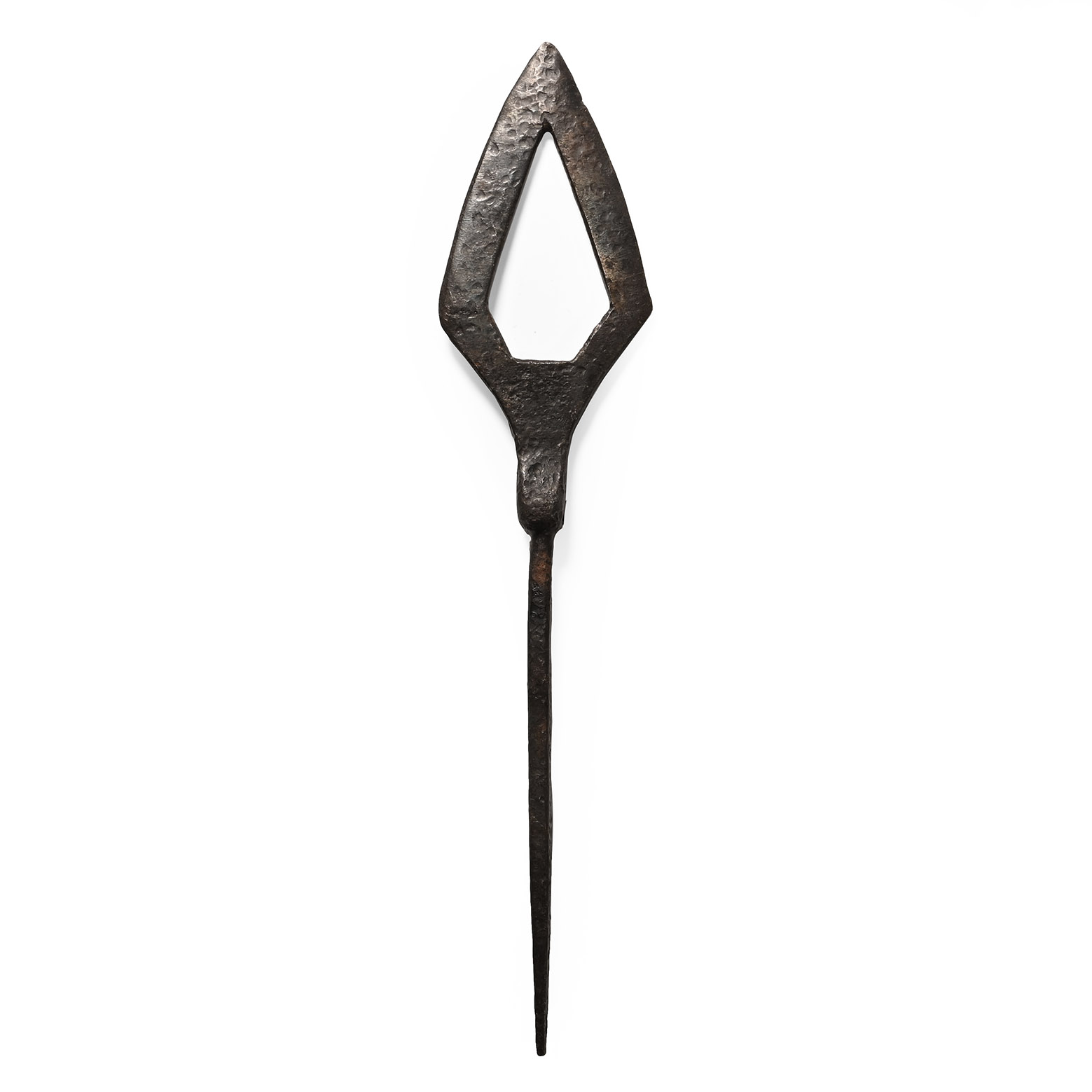
Large Medieval Iron Incendiary Fire Arrowhead
CIRCA 12TH-14TH CENTURY A.D.
8 1/4 in. (52 grams, 21 cm).
A tanged arrowhead with openwork lozengiform blade, the centre with a truncated vesica-shaped void.
ProvenanceAcquired on the French art market.
From the private collection of a Buckinghamshire, UK, gentleman.
The central void was included to allow cloth soaked in tallow to be bound around the arrowhead; this was ignited before shooting.
CONDITIONTimeLine Auctions follows a vetting process to ensure the authenticity and legality of all items, reinforcing our commitment to integrity and responsible trading. Each antiquity, antique, and coin lot undergoes thorough examination by a vetting committee of at least ten external specialists, professional trade association members, scientists, and archaeologists: Our Vetting Process
AUCTIONS:
TimeLine is a leading auction house specialising in antiquities, ancient art, collectables, natural history, coins, medals, and books. Our auctions offer museums, collectors, historians, and enthusiasts the opportunity to acquire unique and historically significant pieces.
-
Elamite Copper Axehead with 'Human' Face
2nd millennium B.C.Sold for (Inc. bp): £1,170
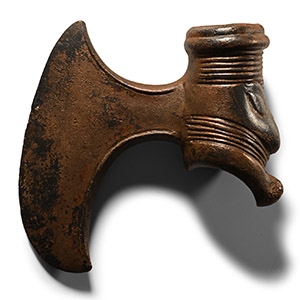
With crescentic blade and rounded knot at the butt, ornamental curved edging to the upper shaft hole, a cord edge on the upper and lower shaft hole, incised band around the edge of the blade; the butt inversed, forming a bearded human face. 246 grams, 94 mm
with a London, UK gallery, 1971-early 2000s.
The type corresponds to Gernez type H.2.H.a, axes with collar and short sleeve lined with mouldings, fan-shaped blade and rear knot. It was a variant only known in Elam and Luristan. In Luristan one identical specimen was found at Chigha Sabz (grave M7). In Elam, the majority of these axes were found in the Middle-Bronze Age (Age of Isin-Larsa or Early Babylonian Age) tombs of Sarcophagi, at Susa. -
Scythian Bronze Arrowhead Collection
Circa 7th-3rd century B.C.Sold for (Inc. bp): £182
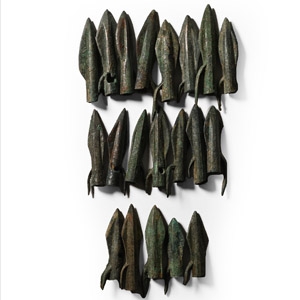
Each with a slender, lozenge-shaped blade and a socket extending near the tip, base of the socket with a side lug. 130 grams total, 37-57 mm
UK private collection before 2000. Acquired on the UK art market. Property of a London gentleman.
In Greek warfare archery was mainly employed by Scythians and Cretans for the longer-ranks. Both used composite bows made of wood, horn, bone and sinew. This explains the great range of Scythian arrowheads found on the Greek sites. -
Cased Medieval to Tudor 'Published' Iron Crossbow Bolt Collection
12th-16h century A.D.Sold for (Inc. bp): £195
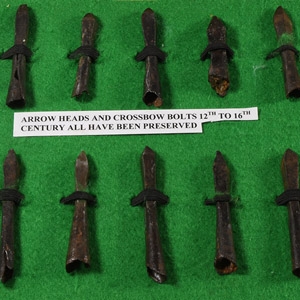
Comprising: 14 crossbow bolts with pyramidal point, square-section shaft, and a tubular socket. 1.24 kg total, 32.5 x 22.5 x 5 cm
From the collection of the famous author, writer and speaker, Gordon Bailey, Essex, UK; formed since 1968.
The crossbow, a bow fixed at its centre to a wooden stock, was a formidable weapon reintroduced in Western Europe in 11th century A.D.; it was used by the Genoese crossbowmen, mainly in French service, during the 100 Years War; its heavy bolt could easily penetrate a shield or armour breast plate at close range.
