
Loading, please wait...
_900x900.jpg "Large Luristan Bronze Ring with Animals")
_200x200.jpg "Large Luristan Bronze Ring with Animals")
.jpg "Large Luristan Bronze Ring with Animals")
LOT 0249
Large Luristan Bronze Ring with Animals
1ST MILLENNIUM B.C.
1 1/8 in. (34 grams, 30.15 mm overall, 22 x 20.4 mm internal diameter (approximate size British T 1/2, USA 9 3/4, Europe 21.89, Japan 21)).
With thick hoop and opposed animal-heads to the reverse, large ellipsoid bezel with incuse winged bull motif.
Provenancewith Pierre Bergé & Associés, Paris, 23 April 2001, no.297 (part).
Acquired by an important European family collection.
Accompanied by copies of the relevant Pierre Bergé & Associés catalogue pages.
This lot has been checked against the Interpol Database of stolen works of art and is accompanied by search certificate no.12055-213660.
Cf. Muscarella, Oscar White, Bronze and Iron Ancient Near Eastern Artifacts in the Metropolitan Museum of Art, New York, item no.292.
CONDITIONTimeLine Auctions follows a vetting process to ensure the authenticity and legality of all items, reinforcing our commitment to integrity and responsible trading. Each antiquity, antique, and coin lot undergoes thorough examination by a vetting committee of at least ten external specialists, professional trade association members, scientists, and archaeologists: Our Vetting Process
AUCTIONS:
TimeLine is a leading auction house specialising in antiquities, ancient art, collectables, natural history, coins, medals, and books. Our auctions offer museums, collectors, historians, and enthusiasts the opportunity to acquire unique and historically significant pieces.
LOT 0249
Large Luristan Bronze Ring with Animals
Estimate £3,000 - 4,000€3,480 - 4,640 (for guidance only)$4,050 - 5,400 (for guidance only)
-
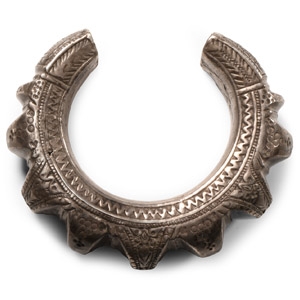
Silver Decorated Bracelet
19th-20th century A.D.Sold for (Inc. bp): £72
Hollow-formed with rattle inside, D-shaped in section with running zigzag to each lateral face, raised transverse crests with punched annulet, rosette and other ornament. 61 grams, 91 mm
UK private collection before 2000. Acquired on the UK art market. Property of a London gentleman. -
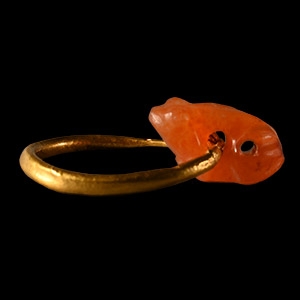
Old Babylonian Carnelian Frog Amulet on Gold Earring
20th-16th century B.C.Estimate: £1,200 - 1,700 (‡+bp*)
Opening Bid: £667
The frog modelled in the round, pierced at the middle and mounted on an asymmetrical gold hoop, possibly a marriage. 2.45 grams, 29.30 mm
Ex K.J. collection. Acquired on the North American art market, 1999. European private collection. -
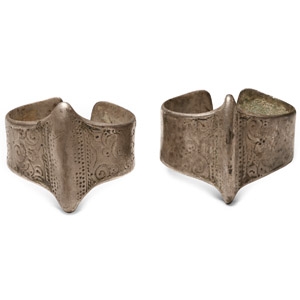
Ghaznavid Silver Decorated Bracelet Pair
10th-11th century A.D.Sold for (Inc. bp): £910
Matched pair, each a penannular band with vertical keel and incised tendril ornament, flared finials. 177 grams total, 54-57 mm
UK private collection before 2000. Acquired on the UK art market. Property of a London gentleman.
