
Loading, please wait...

LOT 1481
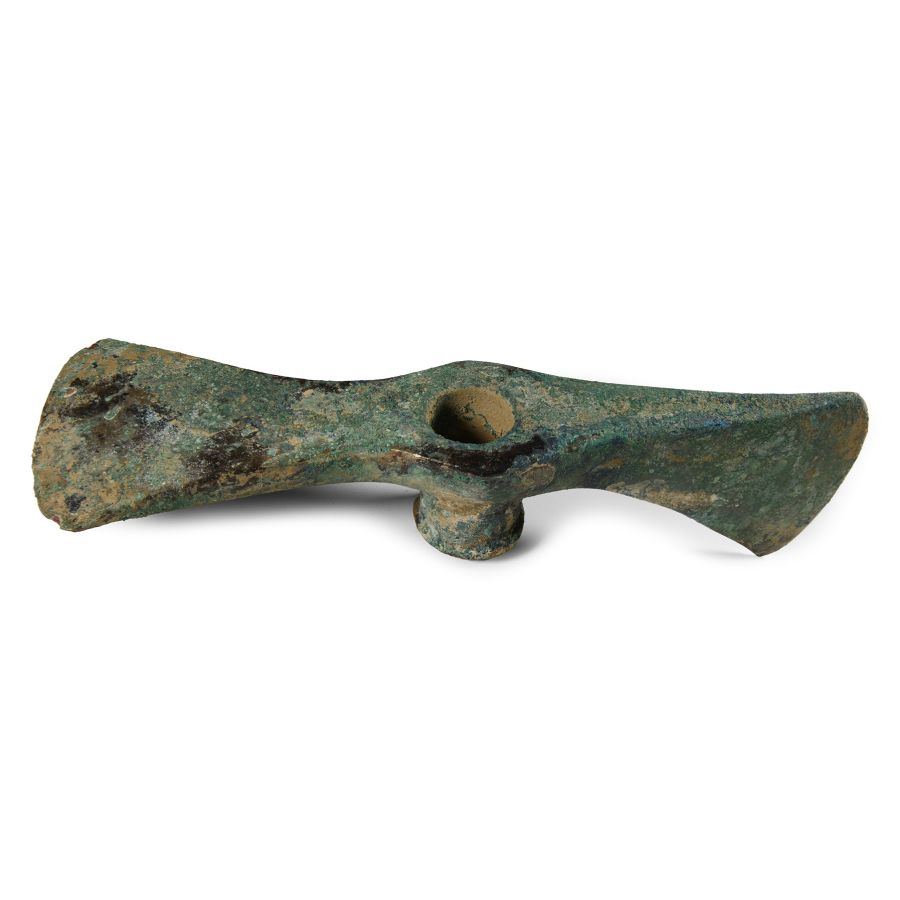
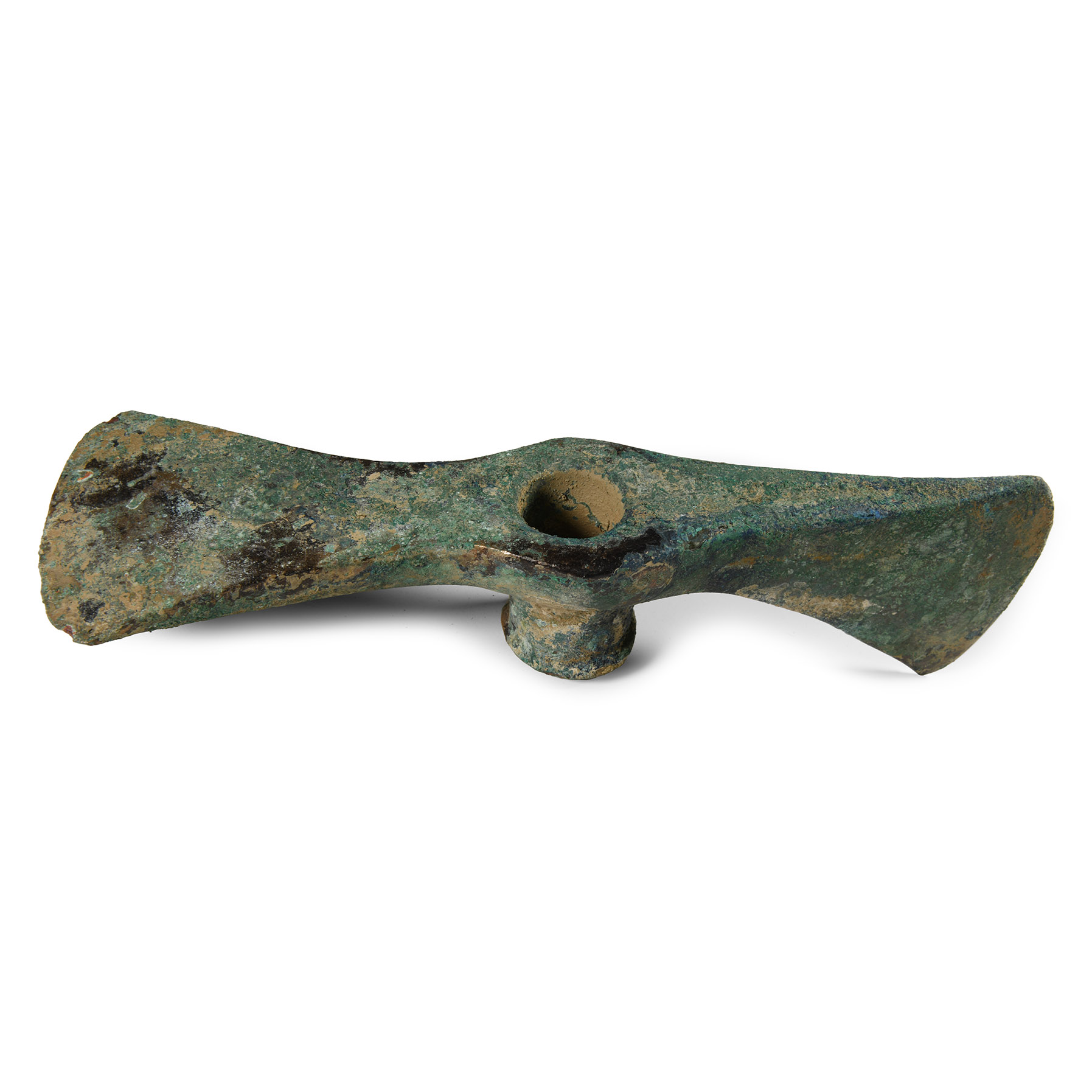
Large Luristan Bronze Adze-Axehead
2ND-1ST MILLENNIUM B.C.
9 5/8 in. (1.22 kg, 24.5 cm).
With central shaft hole and blade set at right angle.
ProvenanceFrom a 1990s German collection.
Ex London, UK, gallery.
Cf. Christie's, The Axel Guttmann Collection of Ancient Arms and Armour, part 2, London, 2004, item 34, p.32.
FootnotesThe adze-axe was a fundamental axe of many Bronze Age cultures of the world. Its form was one that lends itself to dual purposes - for war and peace. As a tool, it was used to shape wood in fabricating a variety of objects or even wooden beams for construction. As a weapon, its heavy mass and compact form make it a very deadly striking and chopping weapon, even able to defeat light armour.
CONDITIONTimeLine Auctions follows a vetting process to ensure the authenticity and legality of all items, reinforcing our commitment to integrity and responsible trading. Each antiquity, antique, and coin lot undergoes thorough examination by a vetting committee of at least ten external specialists, professional trade association members, scientists, and archaeologists: Our Vetting Process
AUCTIONS:
TimeLine is a leading auction house specialising in antiquities, ancient art, collectables, natural history, coins, medals, and books. Our auctions offer museums, collectors, historians, and enthusiasts the opportunity to acquire unique and historically significant pieces.
-
Byzantine 'Greek Fire' Ceramic Fire Bomb or Hand Grenade
9th-11th century A.D.Sold for (Inc. bp): £195
Piriform body with domed filler-hole, the upper body with impressed ring-and-dot motifs; intended to be filled with explosive liquid and wick, used as a hand grenade. 415 grams, 10.6 cm
From a specialist collection of militaria, London, UK, collected 1990s onwards. Accompanied by an academic paper by military specialist Dr Raffaele D'Amato, dated 15 July 2019 and titled 'Eastern Roman Empire - Greek Fire Bomb or Hand Grenade (μεσαίον kακάβιον) 9th-11th century AD'.
Apart from the use of siphons or manual flame-throwers called cheirosiphona, special corps of Roman soldiers employed terracotta grenades, in the form of small jars, abundantly evidenced in archaeological excavations. They were called μεσαία kακαβιά or κυτροκακάβια where the former had a bulbous shape and the latter a more cylindrical form. -
Cased Roman to Medieval Arrow Teaching Aid Collection
1st century A.D.-15th century A.D.Sold for (Inc. bp): £260
Comprising: a Roman ballista bolt with a pyramidal head; a 15th century iron swallowtail arrowhead; three iron medieval crossbow bolts, with pyramidal point, square-section shaft, tubular socket; two medieval ballista bolts with pyramidal point, square-section shaft, tubular socket; two triangular-shaped arrowheads, with pyramidal head; a triangular Eastern Roman bladed arrowhead with a slightly raised mid-rib; a small Anglo-Saxon arrowhead with lozenge form blade and round socket; all mounted on reconstructed modern shafts with their feathered directional lugs, and presented in a wooden display box. 3.83 kg total, 104 x 22 x 9.5 cm including case
From the collection of the famous author, writer and speaker, Gordon Bailey, Essex, UK; formed since 1968.
Crossbow and bows were the protagonist of the 100 Years War between France and England. The crossbow, a bow fixed at its centre to a wooden stock, was a formidable weapon used by the Genoese crossbowmen, mainly in French service; its heavy bolt could easily penetrate a shield or armour breast plate at close range. The longbow, mainly used by the Welsh archers, was able to pierce armours at greater distance. During the reign of Edward III, the long bow distance was estimated to be 400 yards. The capability of the English and Welsh archers enabled the English to secure a victory over the powerful French Cavalry at the battles of Crecy, Poitiers and Agincourt. -
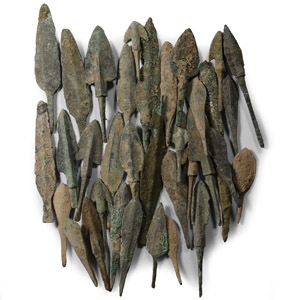
Mesopotamian Bronze Arrowhead Collection
Circa 1800-900 B.C.Sold for (Inc. bp): £247
Including leaf-shaped, barbed, and other small types. 330 grams total, 44-90 mm
Ex London, UK, collection, 1990s.
Paddle-shaped arrowheads with a flat, comparatively wide mid-rib and the blade shaped to a point were typical of Old Babylonian Empire. The shoulders were pronounced and the arrowhead had a rectangular section tapering tang.
