
Loading, please wait...
_900x900.jpg "Large Levantine Crescentic 'Anchor' Axehead")
_200x200.jpg "Large Levantine Crescentic 'Anchor' Axehead")
.jpg "Large Levantine Crescentic 'Anchor' Axehead")
LOT 0328
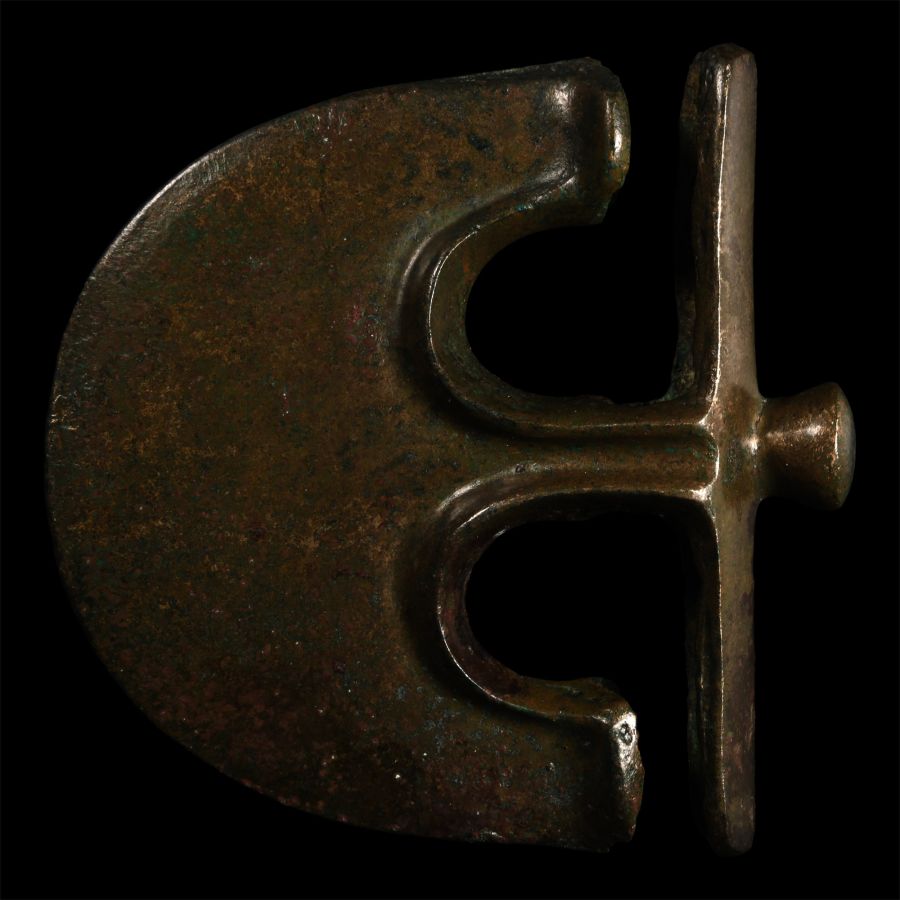
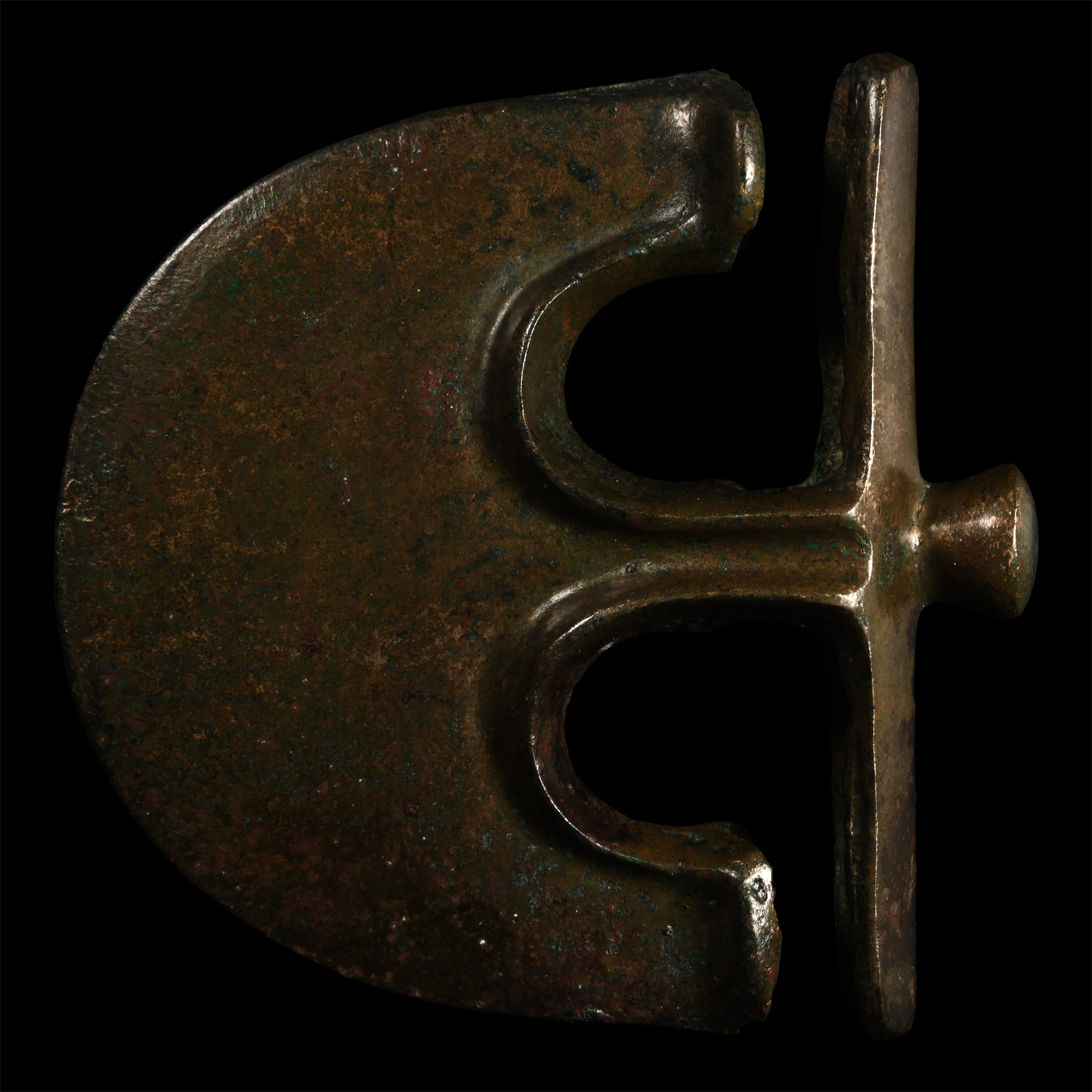
Large Levantine Crescentic 'Anchor' Axehead
MIDDLE BRONZE AGE, LATE 3RD-EARLY 2ND MILLENNIUM B.C.
4 3/8 in. (557 grams, 11.1 cm).
An anchor-shaped semi-circular blade, semi-elliptical in section, narrow socket with a long extension to the rear.
ProvenancePreviously in a London, UK, collection, 1970s.
Ex Rabi Gallery 1991.
This lot is accompanied by an illustrated lot declaration signed by the Head of the Antiquities Department, Dr Raffaele D'Amato.
For a similar example see no.509, p.385, in Muscarell, Bronze and Iron: Ancient Near Eastern Artefacts in the Metropolitan Museum of Art; also cf. Gernez, G., L’armament en métal au Proche et Moyen-Orient: des origines a 1750 av. J.C., Paris, 2007, fig.2.47, type H5, for the type; and an almost example in Christie's New York, 5 December 2012, no.174 ($8,000-$12,000).
FootnotesThe ‘anchor’ axes belonged to a homogeneous type of axe, similar to the fenestrated axes, but displaying a different hafting method. The handle was inserted into a short cylindrical collar except at the back, where it extended to a width roughly equivalent to that of the blade. The two ends of the blade widened to form a concave face resting against the handle, thus ensuring a firm support. The edges of the fenestrelles were prominent and sometimes have decoration. At the back of the collar, there was always a spherical or flattened knob. The function of this knob can only be conjectured: it seems too small to serve as a counterweight, hence it was probably an element used to wind the handle's attachment cord.
CONDITIONTimeLine Auctions follows a vetting process to ensure the authenticity and legality of all items, reinforcing our commitment to integrity and responsible trading. Each antiquity, antique, and coin lot undergoes thorough examination by a vetting committee of at least ten external specialists, professional trade association members, scientists, and archaeologists: Our Vetting Process
AUCTIONS:
TimeLine is a leading auction house specialising in antiquities, ancient art, collectables, natural history, coins, medals, and books. Our auctions offer museums, collectors, historians, and enthusiasts the opportunity to acquire unique and historically significant pieces.
-
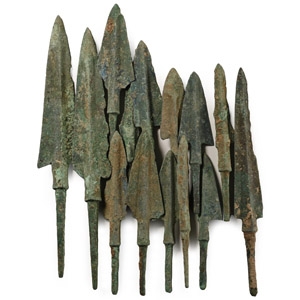
Luristan Bronze Arrowhead Collection
13th-6th century B.C.Sold for (Inc. bp): £169
A group of large tanged arrowheads mainly of triangular type. 319 grams total, 8.7-16.8 cm
Ex London art market, 1980-1990s. This lot is accompanied by an illustrated lot declaration signed by the Head of the Antiquities Department, Dr Raffaele D'Amato.
One category of the represented arrowheads has a sharp, flat blade, the ends of which extend to form wings or barbs, and a prominent midrib extending into a long tang with a stop; the blade shape varies from deltoid to more triangular. Another form has no barbs, but it has a prominent midrib extending to the tang, and a narrow leaf-shaped blade. -
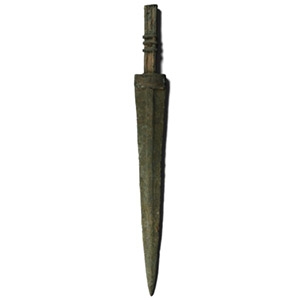
Amarlu Type Bronze Sword with Integral Hilt
10th-9th century B.C.Sold for (Inc. bp): £247
With a tapering two-edged blade with raised midrib and scaphoid lower-guard, rectangular tang with three raised collars and raised edges. 461 grams, 50 cm
Missing ear-shaped pommel
Ex London art market, 1980-1990s. This lot is accompanied by an illustrated lot declaration signed by the Head of the Antiquities Department, Dr Raffaele D'Amato.
The sword belongs to type VII of the Medvedskaya classification, characterised by ear-pommels, unfortunately here lost. These swords, usually found in the Amarlu area, had the handle cast with the blade, and the grip was solid and square, often decorated with horizontal collars. -
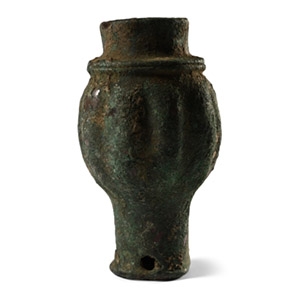
Luristan Bronze Macehead
13th-7th century B.C.Estimate: £100 - 140 (+bp*)
Opening Bid: £55
Comprising a cylindrical shaft with flared mouth, rounded flanges around the swollen head, horizontal stepped bands; Sara Gorz type. 416 grams, 98 mm
Acquired 1980-2015. Ex Abelita family collection. This lot is accompanied by an illustrated lot declaration signed by the Head of the Antiquities Department, Dr Raffaele D’Amato. This lot is accompanied by an illustrated lot declaration signed by the Head of the Antiquities Department, Dr Raffaele D'Amato.
