
Loading, please wait...
LOT 0149
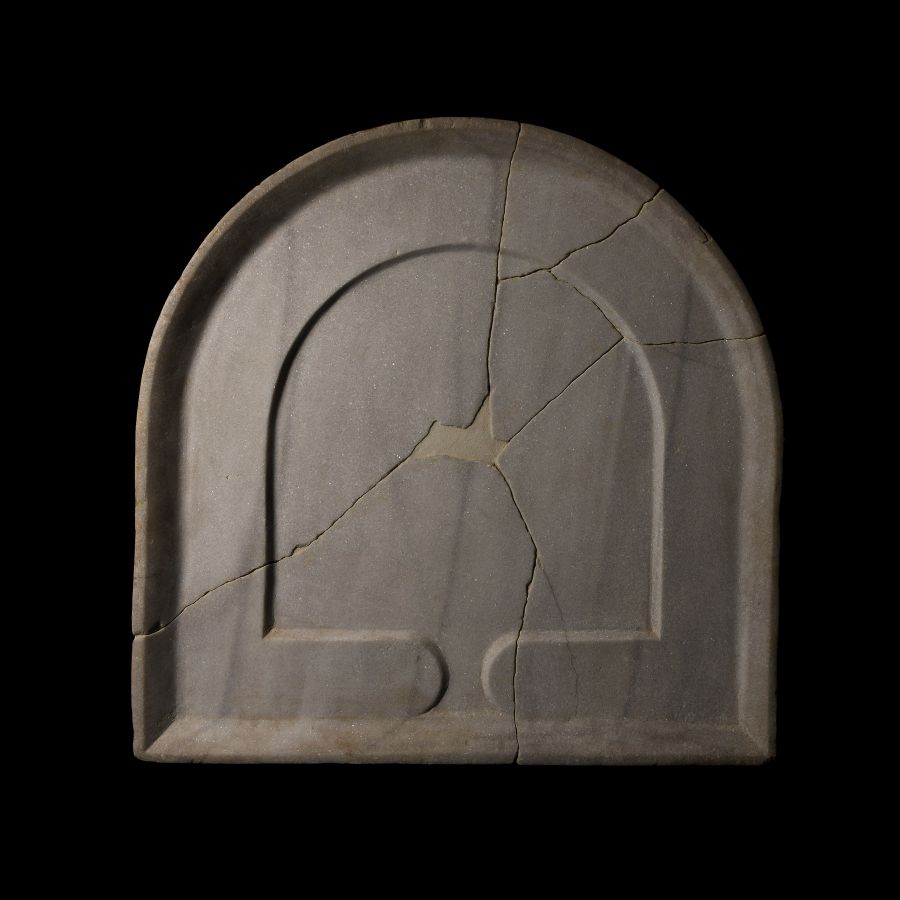
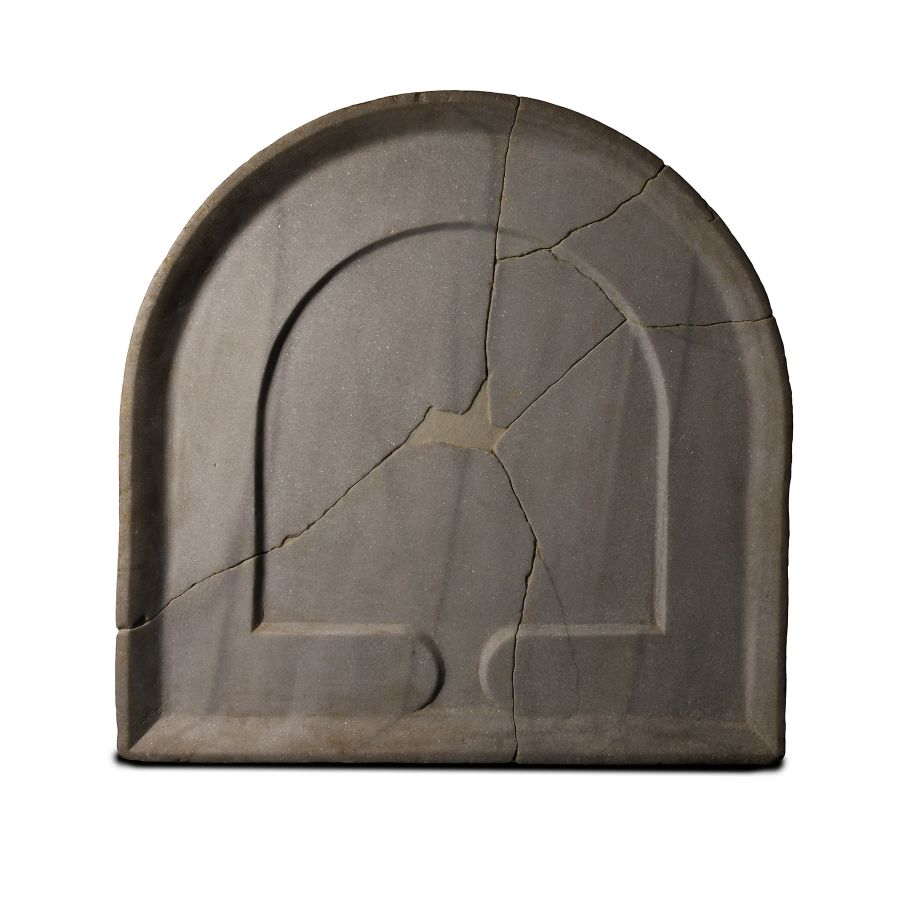
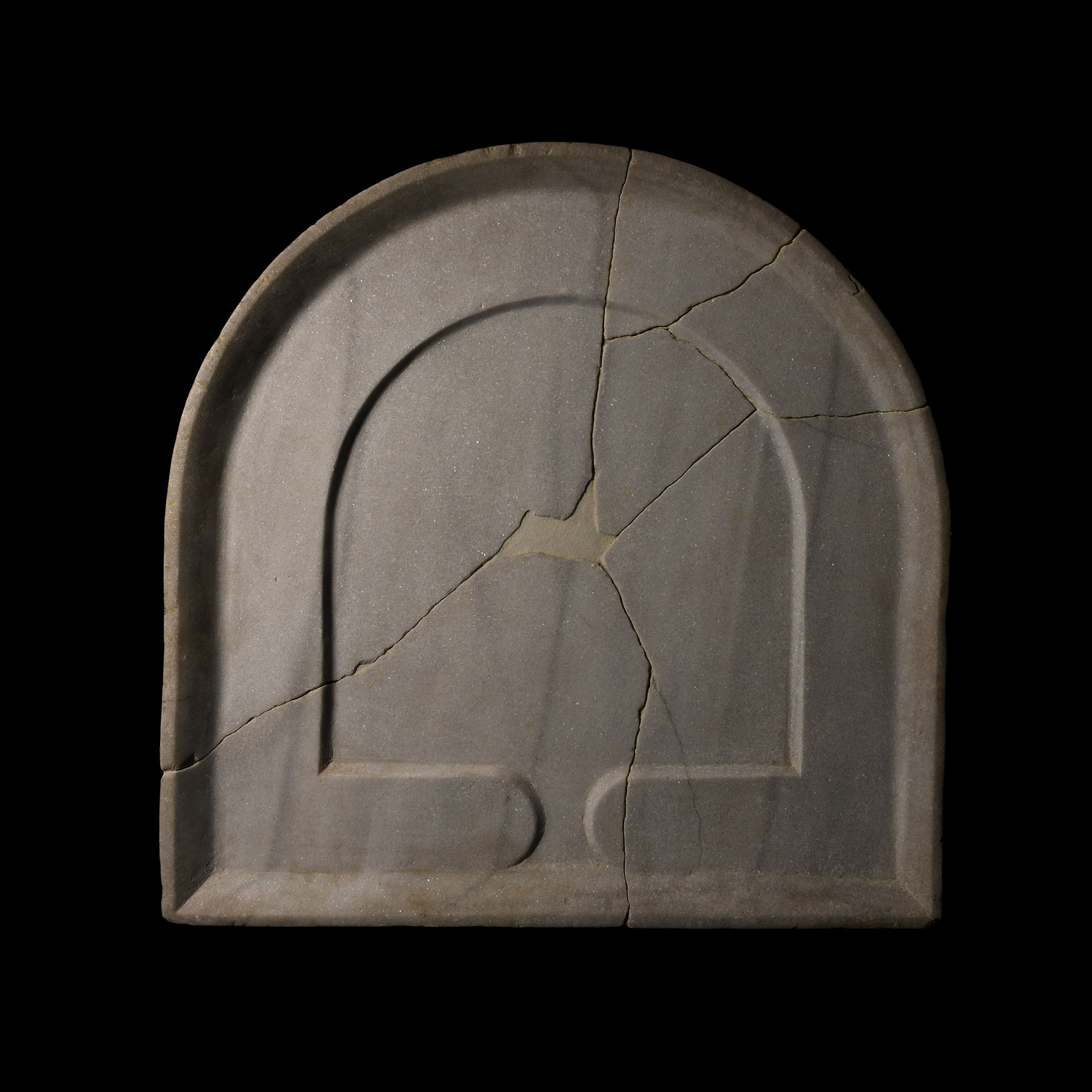
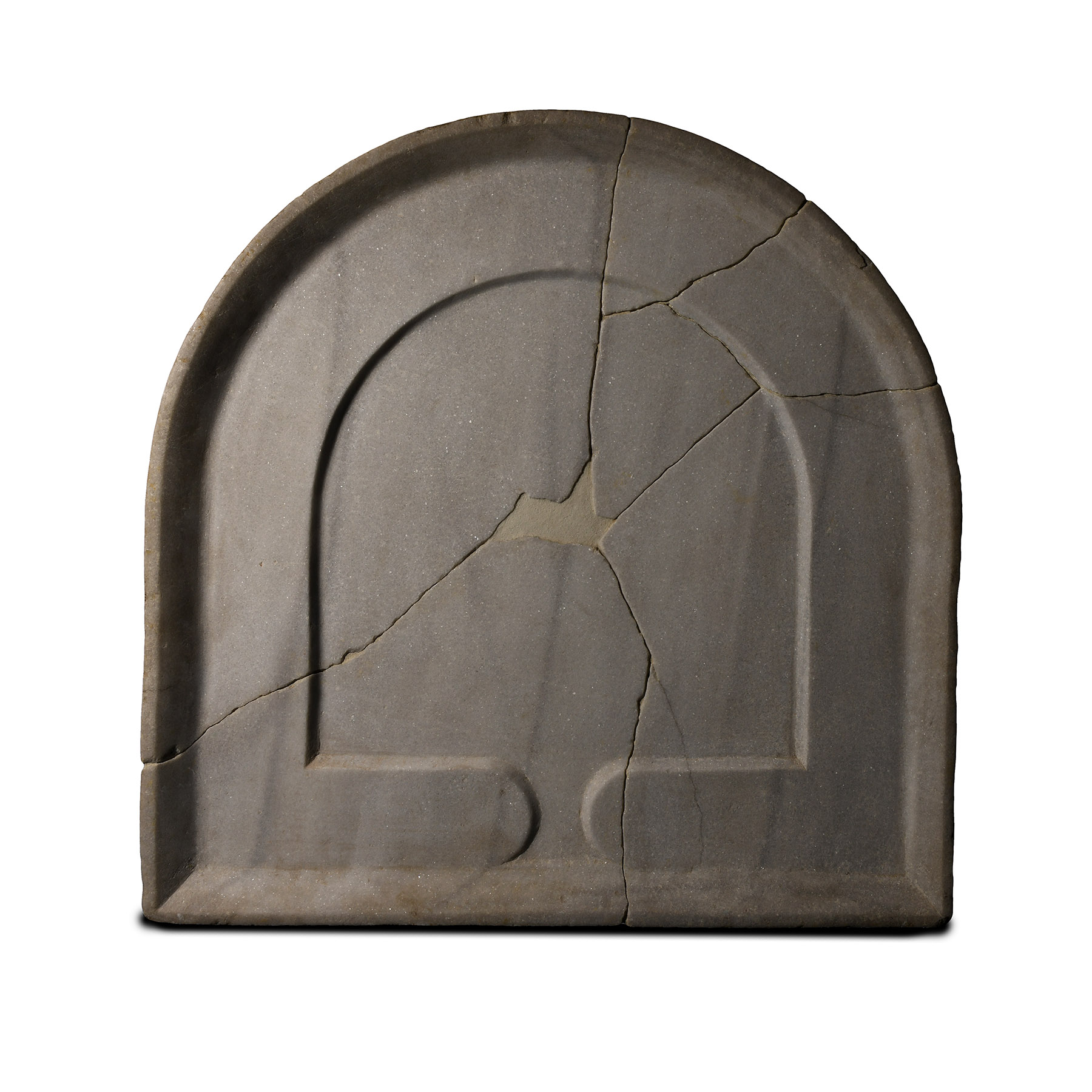
Large Late Roman Sigma-Shaped Marble Offering Table Top
EASTERN MEDITERRANEAN, 4TH-6TH CENTURY A.D.
35 3/4 in. (84.5 kg including backplate, 91 cm wide).
Semi-circular with raised and slightly everted edge, the top with a recessed area with a funnel-shaped outlet; for votive offerings within a church; restored.
ProvenanceAcquired in the late 1960s or early 1970s.
Ex David Read collection.
Accompanied by an academic report by Dr Raffaele D’Amato.
This lot has been checked against the Interpol Database of stolen works of art and is accompanied by search certificate number no.12080-214035.
See Peirano, D., ‘Iasos and Iasian Marble between the Late Antiques and Early Byzantine eras’ in Matetić Poljak, D. and Marasović, K., Asmosia XI, Interdisciplinary Studies on Ancient Stone, Proceedings of the XI Asmosia Conference, Split, 2015, Split, 2018, pp. 123-130, figs. 1-4, for related examples; Rautman, M., Last Suppers at Sardis, Journal of Roman Archaeology, vol.34/2, 2021, pp.667-694, for examples related to domestic dining contexts; a decorated example with elaborated decoration along the edge, is in the Metropolitan Museum (sigma-shaped table with relief border depicting the Birth of Aphrodite and a Marine Thiasos, accession no. L.2020.6a–ii), but this latter was probably for domestic use; another similar specimen for liturgical use can be seen in the same museum under accession number 47.100.50.
FootnotesMarble tables such as the present example are called in archaeological terms sigma tables, in consideration of their resemblance to the Greek letter sigma. Sigma-shaped tables appeared in the banquet halls at the end of the 4th century and within Christian buildings from the following century. Most of the undecorated slabs were used as liturgical table tops for feasts to honour the deceased. This commemorative practice was known throughout the late Roman world in west and east, where it continued in the daily life of the citizens of the Eastern Roman Empire. In ecclesiastical settings, circular and sigma-shaped tables were used to collect offerings or for celebrating the agape, more generally as secondary furniture, while the rectangular form was preferred for use as an altar.
CONDITIONTimeLine Auctions follows a vetting process to ensure the authenticity and legality of all items, reinforcing our commitment to integrity and responsible trading. Each antiquity, antique, and coin lot undergoes thorough examination by a vetting committee of at least ten external specialists, professional trade association members, scientists, and archaeologists: Our Vetting Process
AUCTIONS:
TimeLine is a leading auction house specialising in antiquities, ancient art, collectables, natural history, coins, medals, and books. Our auctions offer museums, collectors, historians, and enthusiasts the opportunity to acquire unique and historically significant pieces.
LOT 0149
Large Late Roman Sigma-Shaped Marble Offering Table Top
Estimate £10,000 - 14,000€11,600 - 16,240 (for guidance only)$13,500 - 18,900 (for guidance only)
-
Roman Silver Key Ring with Dolphins
3rd-4th century A.D.Estimate: £600 - 800 (+bp*)
Opening Bid: £300
The hoop formed with dolphin-head shoulders supporting an openwork tiered bezel with four outward-facing dolphins on a disc, their tails joining to form a tube with inset garnet cloison; possibly originally a key-ring with the tune forming a mandrel. 7.13 grams, 31.06 mm overall, 19.89 mm internal diameter (approximate size British N, USA 6 1/2, Europe 13.72, Japan 13)
Ex Cotswold collection, UK, 1990s. Accompanied by a copy of a statement of opinion from Striptwist Ltd, a London-based company run by precious metal specialist Dr Jack Ogden, reference number 221202. -
Roman Terracotta Oil Lamp with Cybele Riding a Lion
2nd-3rd century A.D.Sold for (Inc. bp): £312
Lug handle to the rear, shallow discus with filling holes and a low-relief image of goddess Cybele riding on her frequent companion, a lion. 172 grams, 12 cm
Acquired on the European art market, 1980s. English private collection.
This lamp belongs to the group of Provincial African lamps with a plain shoulder and a heart-shaped nozzle. The shoulder form of the lamps (irrespective of African, Italic, or eastern place of manufacture or origin) varies widely. Some of them had undecorated shoulders, like our example. Discus decors include mythology, amphitheatre, daily life, animals (our example), geometric patterns and plain discus. -
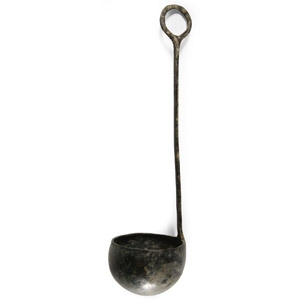
Roman Bronze Ladle with Loop Handle
2nd-3rd century A.D.Sold for (Inc. bp): £338
With deep bowl, integral square-section handle and loop finial. 66 grams, 23 cm
UK private collection before 2000. UK art market. Property of a London gentleman.
This type of ladle was used for libations of wine to the gods during sacrifices. The shape of the simpulum was that of a small cup, with a single elongated handle. The material of which it was made varied according to the wealth of the altar; there were specimens in silver; some were of brass and others made of wood or terracotta. This simpulum or simpuvium is often found depicted on Roman medals or coins, like a denarius of Augustus (2 B.C.-2 A.D.).
