
Loading, please wait...
_900x900.jpg "Large Late Medieval Wooden Spread Eagle Lectern Figure")
_200x200.jpg "Large Late Medieval Wooden Spread Eagle Lectern Figure")
_900x900.jpg "Large Late Medieval Wooden Spread Eagle Lectern Figure")
_200x200.jpg "Large Late Medieval Wooden Spread Eagle Lectern Figure")
_900x900.jpg "Large Late Medieval Wooden Spread Eagle Lectern Figure")
_200x200.jpg "Large Late Medieval Wooden Spread Eagle Lectern Figure")
.jpg "Large Late Medieval Wooden Spread Eagle Lectern Figure")
.jpg "Large Late Medieval Wooden Spread Eagle Lectern Figure")
.jpg "Large Late Medieval Wooden Spread Eagle Lectern Figure")
LOT 0362
Large Late Medieval Wooden Spread Eagle Lectern Figure
FLANDERS, 16TH CENTURY A.D.
68 7/8 in. (15.3 kg total, 1.75 m high including stand).
Painted and carved in the round as an imposing eagle standing atop a globe, wings half-spread, semi-naturalistic detailing and remains of gilding; accompanied by its (likely) original wrought iron tripod stand with facetted and collared shaft; also accompanied by a modern custom-made display stand. [No Reserve]
ProvenanceEx Mayer collection.
Private collection, South West France.
with SVV Prunier, 11 October 2020, lot 79.
Ex central London gallery.
This lot has been checked against the Interpol Database of stolen works of art and is accompanied by search certificate number no.202075.
Cf. similar eagle figurine in the collection of the Metropolitan Museum of Art, New York, forming part of a larger display lectern, under accession no. 68.8.
FootnotesPossibly used as a lectern at some point and modified for this purpose with a transverse ledge cut into the rear of the tail.
CONDITIONTimeLine Auctions follows a vetting process to ensure the authenticity and legality of all items, reinforcing our commitment to integrity and responsible trading. Each antiquity, antique, and coin lot undergoes thorough examination by a vetting committee of at least ten external specialists, professional trade association members, scientists, and archaeologists: Our Vetting Process
AUCTIONS:
TimeLine is a leading auction house specialising in antiquities, ancient art, collectables, natural history, coins, medals, and books. Our auctions offer museums, collectors, historians, and enthusiasts the opportunity to acquire unique and historically significant pieces.
LOT 0362
Large Late Medieval Wooden Spread Eagle Lectern Figure
Sold for (Inc. bp): £3,900
-
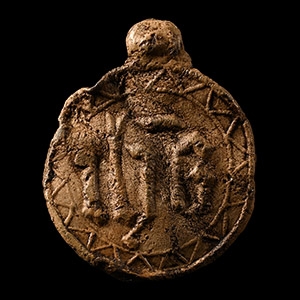
Medieval Lead Saint Margaret of Antioch Pilgrim's Badge
14th-15th century A.D.Sold for (Inc. bp): £33
Discoid plaque with image of crowned St Margaret to obverse, 'ihs' monogram to reverse in a segmented ring border. 8.02 grams, 33 mm
Found near Ketsby, Lincolnshire, UK.
Attributed to the shrine at Ketsby, Lincolnshire, England and found nearby. -
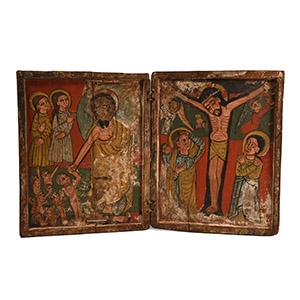
Late Medieval Ethiopian Wooden Diptych Depicting the Crucifixion and Resurrection
Circa 1550 A.D.Sold for (Inc. bp): £286
Composed of a pair of recessed panels forming folding doors; the right panel with painted crucifixion scene depicting robed Mary, John the Evangelist and another apostle, angels collecting the blood in cups; the left panel with nude Adam and Eve with deceased reaching up towards resurrected Christ holding the standard of Victory in his left hand, two holy women, the myrrh bearers (Mary Magdalen and Mary, mother of Jesus) to the left. 499 grams, 24 cm high each
Ex French private collection, 2000. Ex central London gallery.
The icon shows the Western influence on Ethiopian art. The Crucifixion image contains many elements of this iconography which are found in many Oriental and Western Art of Middle Ages, but with significant changes from the previous representations: Jesus is nailed with three nails and not four, the head leaning towards his right shoulder and the hair falling on his shoulders. Following the Western influence, Christ is represented in a spasm of physical pain, and consequently a more detailed anatomy of his chest and abdomen is depicted. This concept of the Crucifixion, common in the Italian Late Middle Age and Renaissance art, found its way to Ethiopia at some time towards the end of the 15th century, or at the beginning of the 16th century. As in the majority of the Resurrection icons of this period, Christ is dressed in a long robe with a cloak or toga draped over one shoulder. -
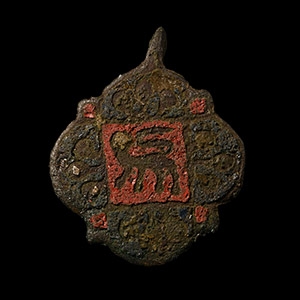
Medieval Bronze Knight's Heraldic Horse Harness Pendant with Royal Lion
14th-15th century A.D.Sold for (Inc. bp): £260
Quatrefoil-type with low-relief leaf detailing, pellets between the leaves with red enamel fill, central rectangular panel with red enamel fill and reserved lion passant; integral suspension lug. 12.4 grams, 38 mm
Found Farnborough, Kent, UK, circa 1987.
