
Loading, please wait...
LOT 0654
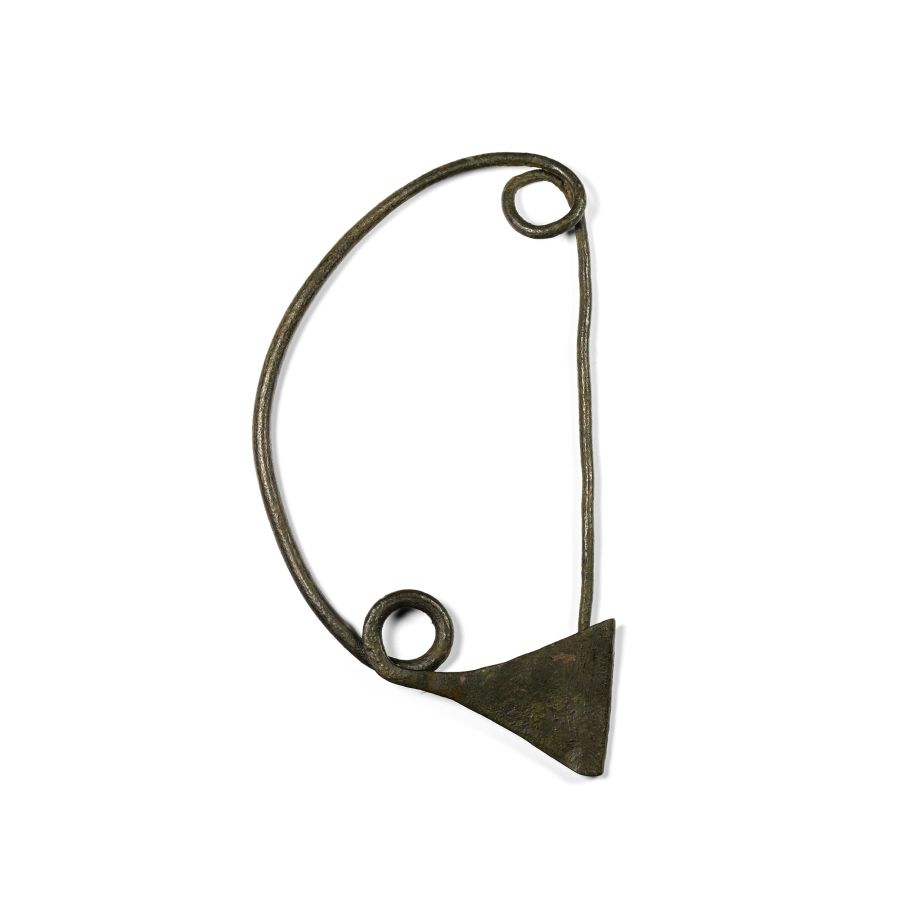
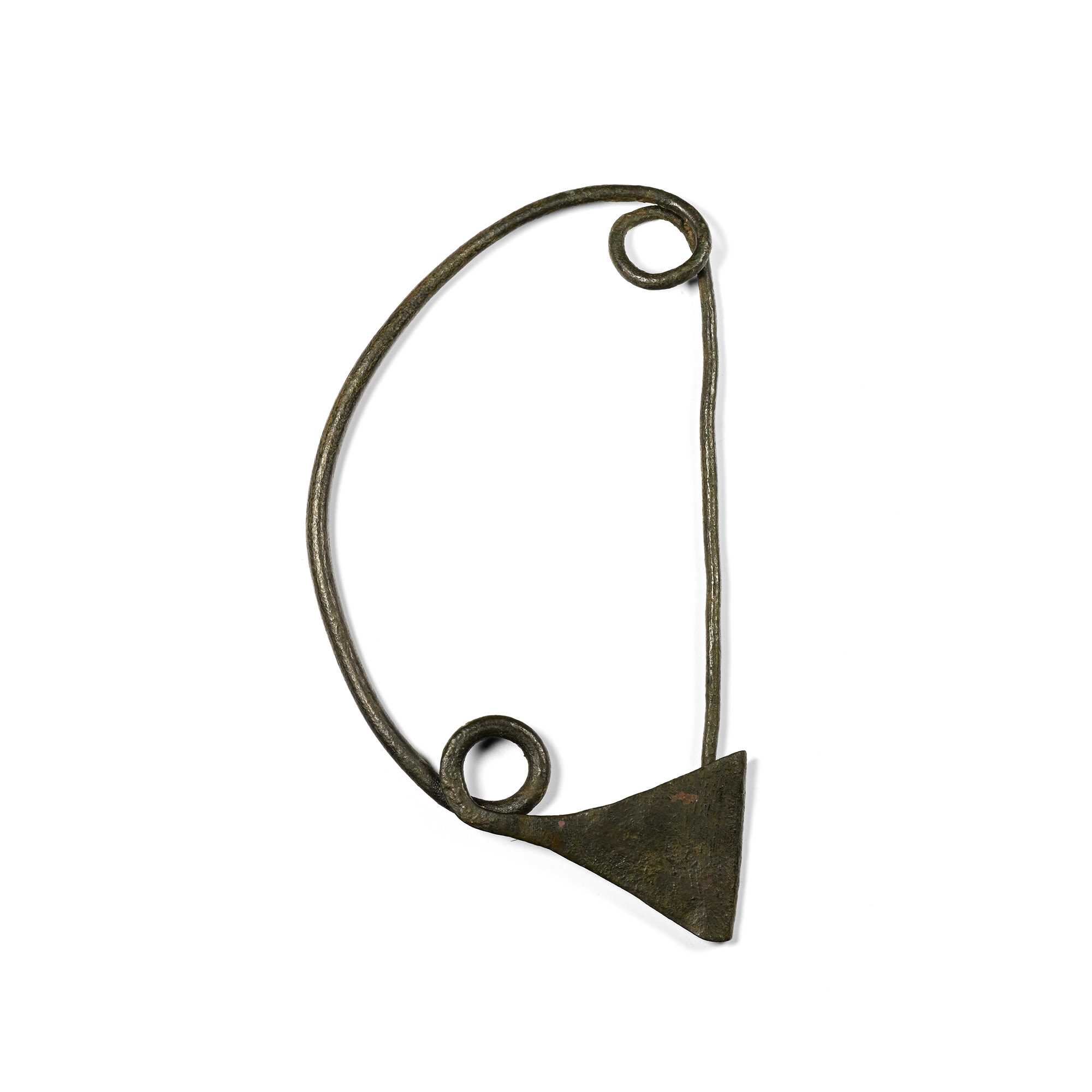
Large Greek Bronze Fibula
IRON AGE, 8TH-4TH CENTURY B.C.
4 in. (15.7 grams, 10 cm).
Single-piece fibula comprising a curved bow with integral coiled spring to one end developing to a sturdy pin; to the other end, a flared catchplate on a single-coil spring.
ProvenanceEx important German collection of brooches, 1980s.
This lot is accompanied by an illustrated lot declaration signed by the Head of the Antiquities Department, Dr Raffaele D'Amato.
Cf. Beck, H. et al., Fibel und Fibeltracht, Berlin, 2000, abb.86, for type.
CONDITIONTimeLine Auctions follows a vetting process to ensure the authenticity and legality of all items, reinforcing our commitment to integrity and responsible trading. Each antiquity, antique, and coin lot undergoes thorough examination by a vetting committee of at least ten external specialists, professional trade association members, scientists, and archaeologists: Our Vetting Process
AUCTIONS:
TimeLine is a leading auction house specialising in antiquities, ancient art, collectables, natural history, coins, medals, and books. Our auctions offer museums, collectors, historians, and enthusiasts the opportunity to acquire unique and historically significant pieces.
-
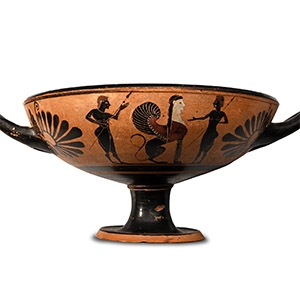
Greek Black-Figure Kylix with Warriors and Sphinxes
Attic, circa 530 B.C.Estimate: £9,000 - 12,000 (+bp*)
Opening Bid: £4,500
Comprising: a broad shallow bowl with two loop handles curving up towards the rim, short stem and broad foot with chamfered outer edge; the bowl with reserved central disc to inner face, palmette motifs at the junctions of the handles, frieze depicting two standing nude males flanking a crouching sphinx in profile; restored and with old dealer's labels beneath base. 414 grams, 27.3 cm wide
Ex Prof. F.S., Villingen-Schwenningen, Germany, 1991. with Gallery Drees Archeo S.P.R.L., Brussels. Acquired from the above, 16 December 2017. Accompanied by a copy of an Art Loss Register certificate, no.S00041086. Accompanied by a Gallery Drees Archeo certificate of authenticity. Accompanied by a thermoluminescence report no.0102 0910 from Laboratory Ralf Kotalla, 6 September 2010. This lot has been checked against the Interpol Database of stolen works of art and is accompanied by search certificate number no.12945-246388. -
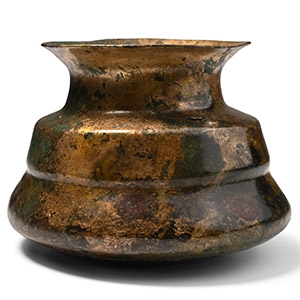
Greek Bronze Jar
Late 1st millennium B.C.Sold for (Inc. bp): £468
Bell-shaped in profile with stepped sidewall, carinated shoulder and flared rim; domed and tiered underside with basal disc. 263 grams, 11.6 cm wide
Ex property of a London, UK, gentleman, Mayfair gallery, 1990s. -
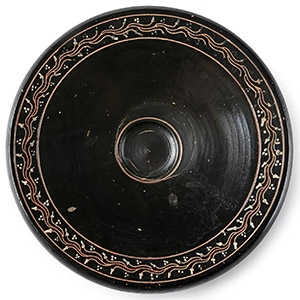
Large Hellenistic Teano-Ware Fish Plate
Early 3rd century B.C.Estimate: £1,500 - 2,000 (+bp*)
Opening Bid: £750
Broad face with incised rings outlining the painted border of running vinescroll in red and white; with a shallow central socket outlined in red, broad carinated rim and low foot. 834 grams, 26.5 cm
Acquired at Auction, London, UK, 1990s, no.233. Private collection, Suffolk, UK. Accompanied by a copy of the relevant catalogue page.
'Teano ware' is a type of ceramic produced in the late 4th century to the early 3rd century BC. Its modern name derives from Teanum Sidicinum, in northern Campania, the main centre of production. White and red pigment was used for the painted decoration on the black surface. It was probably used for votive or funerary purposes.
